1. Ifihan
This manual provides comprehensive instructions for the safe and effective operation of the KORAD KA3005P Programmable DC Power Supply. The KA3005P is a high-precision, variable, and adjustable linear power supply designed for laboratory, educational, and industrial applications. It offers stable and reliable DC power output with advanced features such as programmable control, memory storage, and multiple safety protections.

Nọmba 1.1: KORAD KA3005P Programmable DC Power Supply. This image shows the front and side view of the power supply unit, highlighting its compact design and the clear digital display.
2. Awọn ilana aabo
To ensure safe operation and prolong the life of your KORAD KA3005P power supply, please observe the following safety precautions:
- Always connect the power supply to a properly grounded AC outlet.
- Do not operate the unit in a wet or damp ayika.
- Rí i dájú pé afẹ́fẹ́ tó péye wà ní àyíká ẹ̀rọ náà kí ó má baà gbóná jù. Má ṣe dí àwọn ihò afẹ́fẹ́.
- Maṣe ṣii casing ti ipese agbara. Ko si awọn ẹya ti o le lo ninu. Da gbogbo iṣẹ itọju naa si awọn oṣiṣẹ ti o peye.
- Daju igbewọle voltage selector switch (110V/220V) on the rear panel is set correctly for your local power supply before connecting to AC mains.
- Disconnect the power cord before performing any maintenance or when the unit is not in use for extended periods.
- Avoid short-circuiting the output terminals. Although the unit has short-circuit protection, prolonged short circuits can cause damage.
- Use appropriate test leads and ensure they are rated for the voltage and current levels you intend to use.
3. Ohun ti o wa ninu Apoti
Upon unpacking your KORAD KA3005P, please verify that all the following items are included:
- 1 x KORAD KA3005P Power Supply Unit
- 1 x AC Power Okun
- 1 x Okun USB
- 1 x Set of 5 Amp Test Leads (Banana plug to Crocodile clip)
- 1 x Itọsọna olumulo
- 1 x CD containing Remote Control Software
4. Awọn ẹya Ọja
The KORAD KA3005P is equipped with a range of features designed for precision and ease of use:
- Abajade Itọkasi giga: Provides stable and accurate 0-30V and 0-5A DC output.
- Ifihan LED oni-nọmba marun-un: Bright and clear display for precise voltage (0.001V resolution) and current (0.001A resolution) readings.
- Iṣakoso ti a le ṣeto: USB and RS232 ports for remote control via PC software.
- Ibi ipamọ Iranti: Four dedicated memory locations (M1-M4) to save and recall frequently used voltage ati lọwọlọwọ eto.
- Ibakan Voltage (CV) & Constant Current (CC) Modes: Automatically switches between modes to maintain stable output.
- Awọn Idaabobo Aabo Okeerẹ: Includes Over-Current Protection (OCP), Over-Voltage Protection (OVP), and Short-Circuit Protection.
- Bọ́tìnì TÍTÁN/PÁ ÌṢẸ̀DÁ: Allows safe connection and disconnection of loads without powering down the unit.
- Iṣẹ titiipa: Ṣe idilọwọ awọn ayipada lairotẹlẹ si awọn eto lakoko iṣẹ.
- Switchable Input Voltage: Supports 110V/220V AC input, making it suitable for international use.
- Quiet Cooling Fan: Built-in variable speed fan for efficient heat dissipation and reduced operational noise.

Nọmba 4.1: Key features of the KORAD KA3005P. This image illustrates the power and protection mechanisms, memory settings, the bright 4-digit LED display, and the switchable power input on the rear panel.
5. Panel Loriview
5.1 Igbimọ iwaju

Nọmba 5.1: Front Panel Layout of the KORAD KA3005P. This image provides a detailed view of the front panel with numbered labels indicating the function of each control and indicator.
- Voltage Readout (V): Han awọn wu voltage ni Volts.
- Current Readout (A or mA): Displays the output current in Ampere tabi milliamperes.
- Power Readout (Watts): Displays the calculated output power in Watts.
- Ibakan Voltage Mode Indicator (CV): Illuminates when the unit is operating in Constant Voltage mode.
- Constant Current Mode Indicator (CC): Illuminates when the unit is operating in Constant Current mode.
- Memory Setting Indicator (M1-M4): Indicates which memory preset is currently active.
- Over-Current Protection Indicator (OCP): Illuminates when Over-Current Protection is active.
- Lori-Voltage Protection Indicator (OVP): Illuminates when Over-Voltage Protection is active.
- Front Panel Lock Indicator (LOCK): Illuminates when the front panel controls are locked.
- Output On/Off Indicator (ON): Illuminates when the output is active.
- A/mA Button: Yipada laarin Amperage and milliAmperage display, and also serves as the Panel Lock button when held.
- Bọ́tìnì OCP: Activates/deactivates Over-Current Protection.
- OCP SET Button: Used to set the Over-Current Protection limit.
- OVP Button: Activates/deactivates Over-Voltage Idaabobo.
- OVP SET Button: Used to set the Over-Voltage Protection limit.
- Bọtini TAN/PA: Toggles the output power ON or OFF.
- Memory Save/Recall Buttons (M1-M4): Used to save and recall voltage ati lọwọlọwọ eto.
- BEEP Button: Toggles the audible feedback (beeper) ON or OFF.
- SENSE Button: (Functionality may vary, typically for remote sensing).
- Setting Adjustment Dial: Rotary encoder for adjusting voltage ati awọn iye lọwọlọwọ.
- Digit Selection Buttons (Left/Right Arrows): Used to select the digit to be adjusted by the Setting Adjustment Dial.
- Voltage/Current Adjustment Selector: Toggles between adjusting voltage ati lọwọlọwọ.
- Awọn ebute Ipajade: Red (+) and Black (-) terminals for connecting the load.
- Ibùdó Ilẹ̀ (GND): Green terminal for chassis ground connection.
- Bọtini agbara: Yipada agbara akọkọ fun ẹyọkan.
5.2 ru Panel
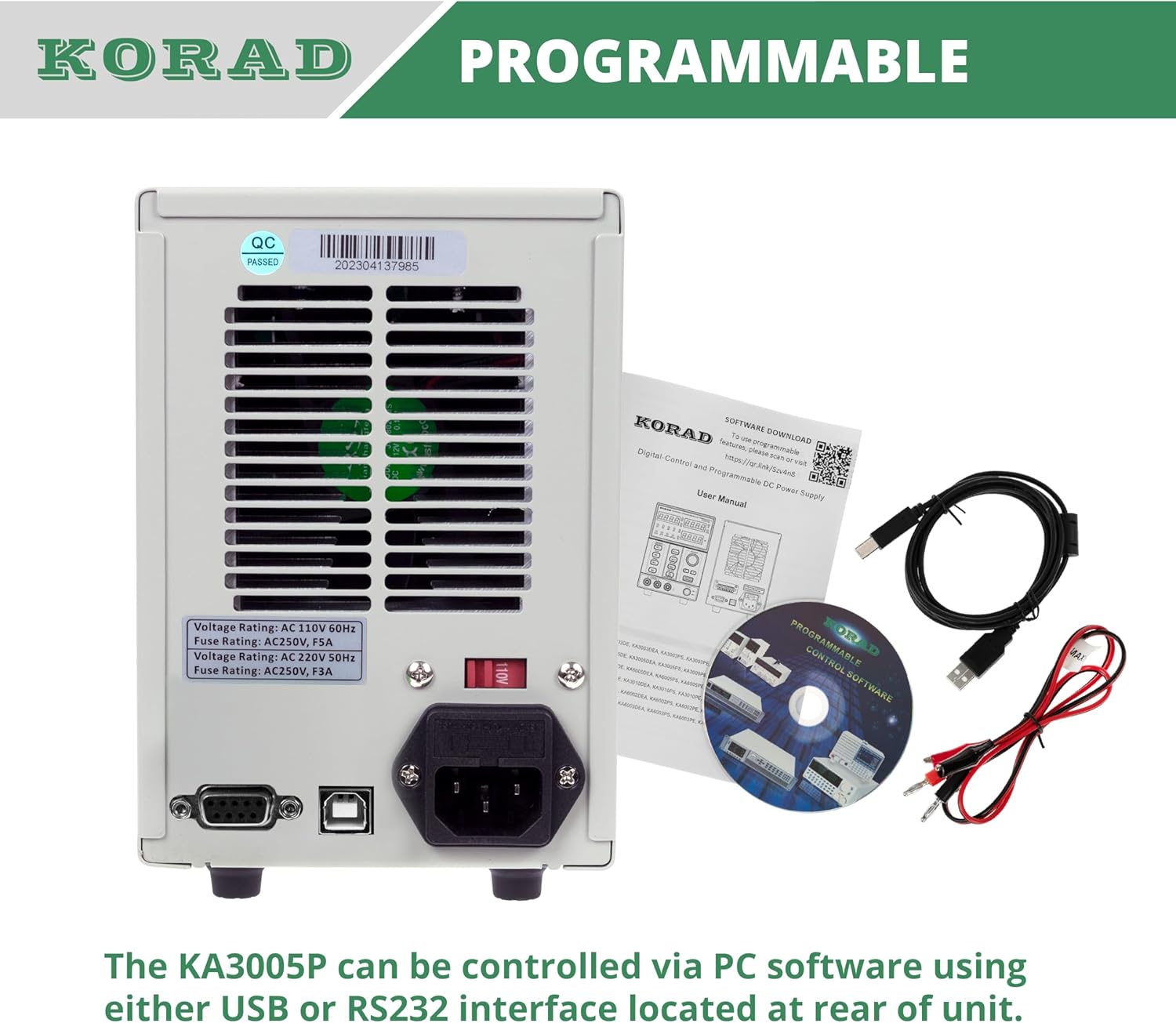
Nọmba 5.2: Rear Panel Layout of the KORAD KA3005P. This image displays the rear panel, showing the AC input, voltage selector, cooling fan, and communication ports.
- AC Input Socket: For connecting the supplied AC power cord.
- Voltage Selector Switch (110V/220V): Allows selection of the appropriate input voltage fun agbegbe rẹ. Ensure this is set correctly before connecting to power.
- Olufẹ itutu: Automatically adjusts speed based on internal temperature to maintain optimal operating conditions.
- Ibudo USB: For connecting to a computer for programmable control.
- Ibudo RS232: For connecting to a computer or other devices for programmable control.
- Dimu Fuse: Contains the main AC input fuse.
6. Eto
6.1 Ibẹrẹ Ayẹwo
Before connecting the power supply, inspect the unit for any signs of physical damage that may have occurred during shipping. If any damage is found, contact your supplier immediately.
6.2 Setting Input Voltage
Wa voltage selector switch on the rear panel of the unit. Ensure it is set to match your local AC mains voltage (110V or 220V). Incorrect setting can damage the unit.

Nọmba 6.1: Rear panel showing the 110V/220V voltage selector switch. This switch must be correctly set to match the local AC power supply before operation.
6.3 Asopọ agbara
Connect the supplied AC power cord to the AC input socket on the rear panel and then plug it into a grounded wall outlet.
6.4 o wu Awọn isopọ
Connect your load to the output terminals on the front panel using the provided test leads or other suitable leads. Ensure correct polarity: Red for positive (+), Black for negative (-). The green terminal is for chassis ground.
7. Awọn ilana Iṣiṣẹ
7.1 Titan / Pa a
- Tẹ awọn AGBARA button on the front panel to turn the unit ON. The display will illuminate.
- Tẹ awọn AGBARA button again to turn the unit OFF.
7.2 Eto Voltage ati Lọwọlọwọ
- Tẹ awọn VOLTAGE/O lọwọlọwọ button to select whether you are adjusting voltage or current. The corresponding display will flash.
- Lo awọn Osi/Ọfà ọtun buttons to select the digit you wish to adjust. The selected digit will flash.
- Yiyi awọn Setting Adjustment Dial to change the value of the selected digit.
- Lọgan ti o fẹ voltage and current limit are set, press the TAN/PA button to enable the output. The ON atọka yoo tan ina.

Nọmba 7.1: Close-up of the bright 4-digit LED display. This display provides precise and clear readouts of voltage and current, essential for accurate power delivery.
7.3 Memory Functions (M1-M4)
The unit allows you to save and recall up to four sets of voltage ati lọwọlọwọ eto.
- Lati Fipamọ: Ṣeto awọn ti o fẹ voltage and current. Press and hold the desired memory button (M1, M2, M3, tàbí M4) until you hear a beep or the display indicates saving.
- Lati Ranti: Briefly press the desired memory button (M1, M2, M3, tàbí M4). The saved settings will be loaded.

Nọmba 7.2: Close-up of the memory save/recall buttons (M1-M4). These buttons allow users to quickly store and retrieve frequently used voltage ati lọwọlọwọ eto.
7.4 Output ON/OFF Control
Awọn TAN/PA button controls the output power to the terminals independently of the main power switch.
- Tẹ TAN/PA to enable output. The ON atọka yoo tan.
- Tẹ TAN/PA again to disable output. The ON Atọka yoo wa ni pipa.
- It is recommended to disable the output before connecting or disconnecting loads.
7.5 Titiipa Išė
To prevent accidental changes to settings during operation, you can lock the front panel controls.
- Tẹ mọlẹ A/mA bọtini fun kan diẹ aaya titi ti Titiipa indicator illuminates. All front panel controls will be disabled.
- Lati ṣii, tẹ mọlẹ A/mA bọtini lẹẹkansi titi ti Titiipa Atọka wa ni pipa.
7.6 Over-Current Protection (OCP) and Over-Voltage Idaabobo (OVP)
These features protect your connected load and the power supply from damage due to excessive current or voltage.
- Setting OCP/OVP: Tẹ awọn OCP SET or OVP SET bọtini. Lo awọn Setting Adjustment Dial ati Osi/Ọfà ọtun buttons to set the desired protection limit.
- Activating OCP/OVP: Tẹ awọn OCP or OVP button to enable the protection. The corresponding indicator will light up.
- When an OCP or OVP event occurs, the output will automatically shut off, and the respective indicator will flash. To reset, disable the protection or resolve the fault, then press the TAN/PA button to re-enable output.

Nọmba 7.3: Close-up of the protection and control buttons. This image highlights the OCP, OVP, and Lock buttons, which are crucial for safe operation and preventing accidental changes.
8. Programmable Control
The KORAD KA3005P can be controlled remotely via a computer using the USB or RS232 ports located on the rear panel.
- Fifi sori ẹrọ software: Insert the provided CD into your computer and follow the on-screen instructions to install the remote control software. Drivers for the USB/RS232 interface may also be included.
- Asopọmọra: Connect the power supply to your computer using the supplied USB cable or an RS232 cable (not included for RS232).
- Isẹ sọfitiwia: Launch the installed software. Select the correct COM port corresponding to your connected power supply. The software allows you to set voltage, current, enable/disable output, and configure protection limits from your computer. Some software versions may support programmable sequences or data logging.
- Ilana Serial: For advanced users, the user manual and CD typically contain documentation on the serial communication protocol, allowing for custom software development or integration with other programming environments (e.g., LabVIEW, Python).
Nọmba 8.1: Rear panel showing USB and RS232 ports for programmable control. The image also displays the included user manual, USB cable, test leads, and software CD, which facilitate remote operation.
For software downloads or updates, please refer to the official KORAD website or the link provided in the manual (e.g., www.koradtechnology.com).
9. Itọju
The KORAD KA3005P is designed for reliable operation with minimal maintenance. Follow these guidelines:
- Ninu: Disconnect the power supply from the AC mains before cleaning. Use a soft, dry cloth to wipe the exterior. Do not use abrasive cleaners or solvents.
- Afẹfẹ: Ensure the ventilation openings on the sides and rear of the unit are free from dust and obstructions. Periodically clean the fan vents with compressed air if necessary.
- Rirọpo Fuse: If the unit does not power on, check the fuse located in the fuse holder on the rear panel. Replace only with a fuse of the same type and rating (e.g., 5A/250V for 110V input, 3A/250V for 220V input). Always disconnect the power cord before replacing the fuse.
- Ibi ipamọ: Tí o kò bá lò ó fún ìgbà pípẹ́, tọ́jú ẹ̀rọ náà sí ibi tí ó tutù tí ó sì gbẹ, kúrò níbi tí oòrùn kò ti lè tàn án tàbí ibi tí ó gbóná janjan.
10. Laasigbotitusita
If you encounter issues with your KORAD KA3005P, refer to the following common problems and solutions:
| Isoro | Owun to le Fa | Ojutu |
|---|---|---|
| Ẹka ko ni agbara lori. | No AC power; Blown fuse; Incorrect voltage selector setting. | Check power cord connection and wall outlet. Replace fuse if blown. Verify voltage selector (110V/220V) on rear panel is correct. |
| Ko si voltage/lọwọlọwọ. | Output is OFF; OCP/OVP triggered; Short circuit at output. | Tẹ awọn TAN/PA button to enable output. Check if OCP/OVP indicators are flashing; resolve fault and reset. Check for short circuits in the load or test leads. |
| O wu voltage/current is unstable. | Poor load connection; Overheating; Faulty test leads. | Ensure secure connections to the load. Check ventilation and allow unit to cool. Inspect and replace test leads if damaged. |
| Display shows incorrect readings. | Calibration issue; External interference. | If readings are consistently inaccurate, contact support for calibration. Minimize external electromagnetic interference. |
| Software communication issues. | Incorrect COM port; Driver issues; Software incompatibility. | Verify COM port selection in software. Reinstall USB/RS232 drivers. Ensure software version is compatible with your operating system. Refer to software documentation. |
If the problem persists after attempting these solutions, please contact KORAD customer support.
11. Awọn pato
Technical specifications for the KORAD KA3005P Programmable DC Power Supply:

Nọmba 11.1: KORAD KA3005P Unit Specifications. This image provides a visual summary of the key technical parameters of the power supply.
| Paramita | Iye |
|---|---|
| Voltage Ibiti | 0-30V |
| Ibiti lọwọlọwọ | 0-5A |
| Load Regulation (Voltage) | ≤0.01%+2mV |
| Load Regulation (Current) | ≤0.1%+10mA |
| Line Regulation (Voltage) | ≤0.01%+3mV |
| Line Regulation (Current) | ≤0.1%+3mA |
| Setup Resolution (Voltage) | 10mV |
| Setup Resolution (Current) | 1mA |
| Setup Accuracy (25°C ± 5°C) (Voltage) | ≤0.5%+20mV |
| Setup Accuracy (25°C ± 5°C) (Current) | ≤0.5%+10mA |
| Ripple (20-20M) (Voltage) | ≤2mVrms |
| Ripple (20-20M) (Current) | 2mArms |
| Olùsọdipúpọ̀ ìwọ̀ntúnwọ̀nsì (Voltage) | ≤150ppm |
| Temperature Coefficient (Current) | ≤150ppm |
| Read Back Resolution (Voltage) | 10mV |
| Read Back Resolution (Current) | 1mA |
| Reaction Time (Voltage Rise) | ≤100mS (Voltage silẹ) |
| Ni wiwo | Programmable (USB, RS232) |
| Iwọn | 9.52 lbs / 4.32 Kg |
| Awọn iwọn (W x H x D) | 100mm (W) x 156mm (H) x 260mm (D) |
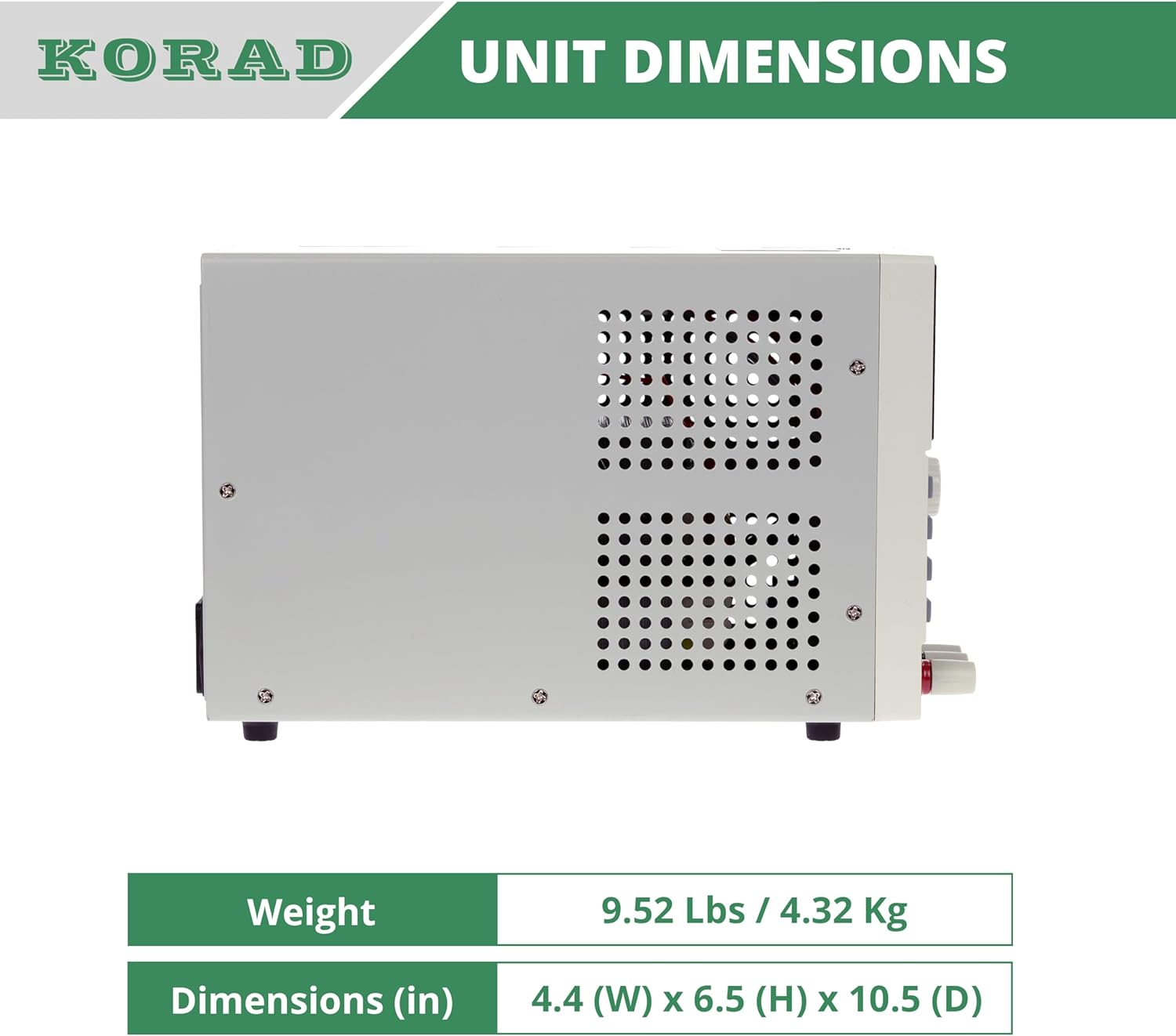
Nọmba 11.2: Apa view of the KORAD KA3005P, illustrating its physical dimensions. The unit measures 4.4 inches (W) x 6.5 inches (H) x 10.5 inches (D).
12. Atilẹyin ọja ati Support
KORAD products are manufactured to high quality standards. For warranty information and technical support, please refer to the documentation included with your purchase or visit the official KORAD webojula.
- Atilẹyin ọja: Please retain your proof of purchase for warranty claims. Warranty terms and conditions may vary by region.
- Oluranlowo lati tun nkan se: For technical assistance, troubleshooting beyond this manual, or service inquiries, please contact KORAD customer support through their official channels.
- Awọn orisun Ayelujara: Check the KORAD website for updated manuals, software, and FAQs.