
Samyang 7616
Samyang 8mm f/3.5 UMC CS II Fisheye Lens for Canon User Manual
Detailed instructions for the setup, operation, and maintenance of your Samyang 8mm f/3.5 UMC CS II Fisheye Lens designed for Canon EF-S mount cameras.
1. Ifihan
The Samyang 8mm f/3.5 Aspherical IF MC Fisheye lens is an ultra-wide angle lens designed for cameras with APS-C or smaller sensors. Its optical construction features 10 elements in 7 groups, including an aspherical hybrid lens. The lens incorporates a multilayer anti-reflection coating (UMC) to enhance optical performance, minimize flare, and reduce ghosting. The aperture consists of six diaphragm blades and can be set to f/22 for extensive depth-of-field. A built-in lens hood helps prevent unwanted light. This lens provides a 180-degree diagonal field of view, offering unique photographic perspectives.
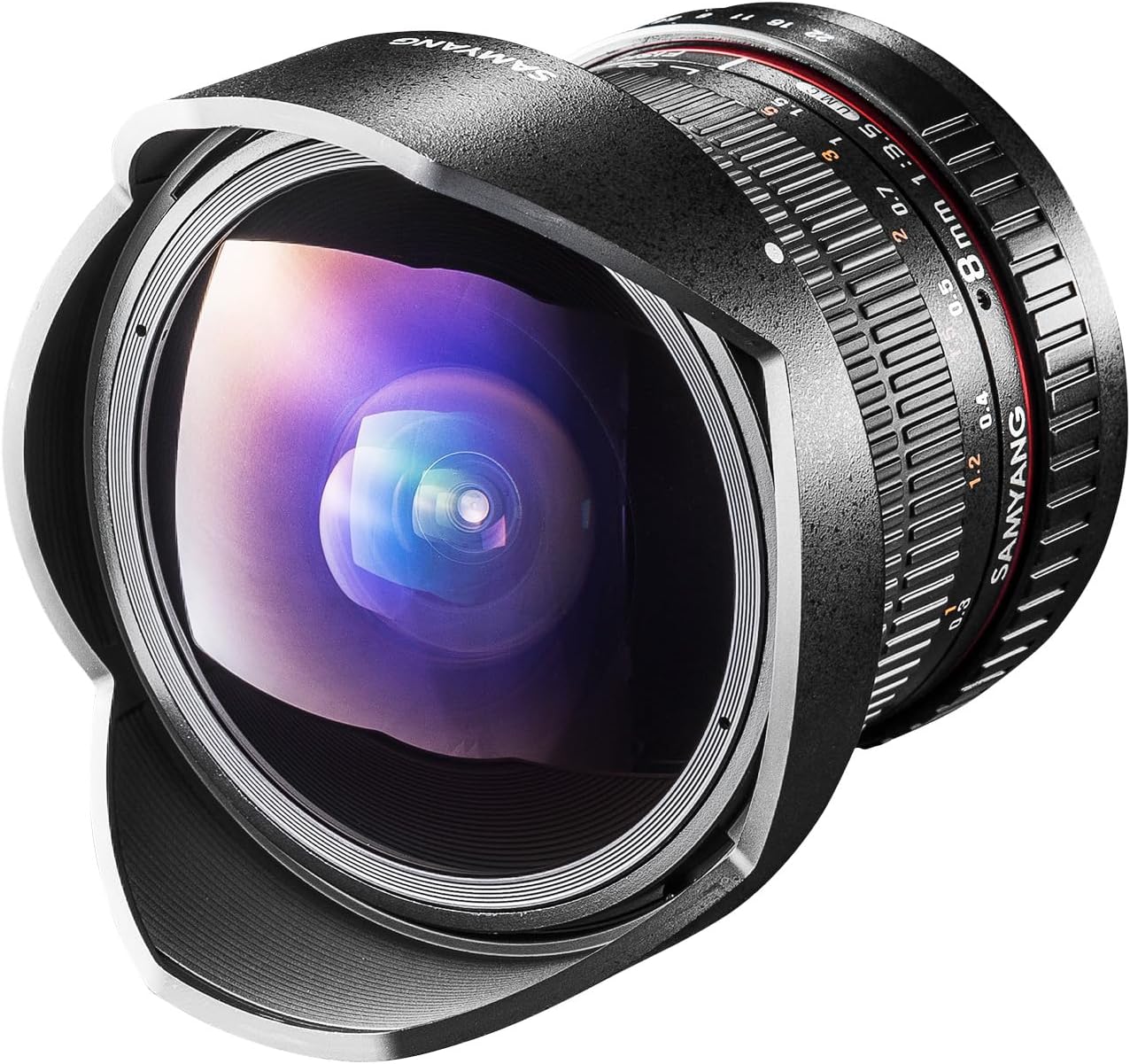
Aworan 1.1: Iwaju view of the Samyang 8mm f/3.5 UMC CS II Fisheye Lens with its integrated lens hood.
2. Package Awọn akoonu
Jọwọ rii daju pe gbogbo awọn ohun ti a ṣe akojọ si isalẹ wa ninu package ọja rẹ:
- 1x Samyang 8mm f/3.5 UMC CS II Fisheye Lens (for Canon EF-S mount)
- 1x Front Lens Cap
- 1x Rear Lens Cap
- 1x Lens Pouch

Image 2.1: Illustration of the items included in the lens package, showing the lens, front and rear caps, and a lens pouch.
3. Key Awọn ẹya ara ẹrọ
- Ultra Wide-Angle Fisheye: 8mm focal length with an exaggerated perspective for dramatic photographic effects.
- Broad Field-of-View: Offers an ultra-wide 180° diagonal field-of-view, optimized for APS-C size image sensors.
- Ilọsiwaju Apẹrẹ Opiti: Constructed with hybrid aspherical lenses to deliver sharp, well-defined images.
- UMC Coating: Features a multi-layer anti-reflection ultra multi-coating (UMC) to effectively minimize lens flare and ghosting.
- Close-Up Capability: Minimum focusing distance of 0.3 meters (12 inches) for enhanced close-up photography.
4. Awọn ohun elo
The Samyang 8mm f/3.5 UMC CS II Fisheye Lens is particularly well-suited for capturing unique perspectives in various photographic genres due to its ultra-wide field of view and distinct fisheye effect. It excels in situations where a broad, immersive view ni o fẹ.
- Iṣẹ ọna: Capture entire buildings or interior spaces with dramatic distortion.
- Artistic Photography: Create surreal and imaginative images with exaggerated perspectives.
- Iseda: Encompass vast landscapes, forests, or celestial scenes.
- Irin-ajo: Document travel experiences with a wide, encompassing view of locations.
- Ala-ilẹ: Ideal for expansive landscape shots, adding a creative twist.

Aworan 4.1: Examples of photographic applications for the Samyang 8mm Fisheye Lens, including architecture, nature, and travel scenes.
5. Eto ati fifi sori
5.1 So awọn lẹnsi
- Rii daju pe kamẹra rẹ ti wa ni pipa.
- Remove the rear lens cap from the Samyang 8mm lens and the body cap from your camera.
- Align the red index mark on the lens barrel with the corresponding red index mark on your camera's lens mount.
- Fi lẹnsi sii sinu oke kamẹra ki o yi lọ si ọna aago titi yoo fi tẹ si aaye. Maṣe fi agbara mu lẹnsi naa.
5.2 Yíyọ Lẹ́ńsì náà kúrò
- Rii daju pe kamẹra rẹ ti wa ni pipa.
- Nígbà tí o bá ń tẹ bọ́tìnì ìtújáde lẹ́ńsì lórí ara kámẹ́rà rẹ, yí lẹ́ńsì náà padà sí ọ̀nà òdìkejì títí tí yóò fi dúró.
- Fi pẹ̀lẹ́pẹ̀lẹ́ yọ lẹ́ńsì náà kúrò lórí ibi tí a gbé kámẹ́rà sí.
- So ideri lẹnsi ẹhin mọ lẹnsi naa ati ideri ara mọ kamẹra rẹ lati daabobo wọn kuro ninu eruku ati ibajẹ.

Aworan 5.1: Ẹyin view of the Samyang 8mm lens, showing the Canon EF-S mount interface.
6. Ṣiṣẹ awọn lẹnsi
6.1 Àfiyèsí Ọwọ́
This is a manual focus lens. To achieve sharp images, rotate the focus ring on the lens barrel until your subject appears clear in the viewfinder or on the camera's LCD screen. For fisheye lenses, a common technique is to set the focus to a specific distance (e.g., 1 meter or 3 feet) and rely on the extensive depth of field to keep most of the scene in focus, especially at smaller apertures.
6.2 Iṣakoso Afara
The lens features an aperture ring on the barrel. To control the aperture directly from your camera body (if supported), set the lens's aperture ring to its smallest aperture value (f/22). This allows the camera to electronically control the aperture setting. If your camera does not support electronic aperture control with this lens, you will need to adjust the aperture manually using the ring on the lens.
6.3 Ifihan Eto
Since this is a manual lens, you may need to set your camera to Manual (M) or Aperture Priority (Av/A) mode. In Manual mode, you control both aperture (via the lens ring or camera, as described above) and shutter speed. In Aperture Priority mode, you set the aperture, and the camera automatically selects the appropriate shutter speed.
7. Itọju ati Itọju
7.1 Ninu awọn lẹnsi
- Use a soft, lint-free cloth or a lens brush to remove dust from the lens surfaces.
- For smudges or fingerprints, apply a small amount of lens cleaning solution to a clean microfiber cloth and gently wipe the lens in a circular motion from the center outwards.
- Never use abrasive materials or harsh chemicals on the lens elements.
7.2 Ibi ipamọ
- Máa so àwọn fìlà lẹ́nsì iwájú àti ẹ̀yìn mọ́ nígbà tí lẹ́nsì náà kò bá sí ní lílò.
- Tọju lẹnsi naa ni itura, aye gbigbẹ, kuro lati orun taara ati awọn iwọn otutu to gaju.
- Ti o ba titoju fun awọn akoko ti o gbooro sii, ronu nipa lilo aṣoju iyọkuro lati ṣe idiwọ idagbasoke m.
8. Laasigbotitusita
8.1 Images are blurry or out of focus
- Idojukọ Afowoyi: Ensure you are manually focusing correctly. Rotate the focus ring until your subject is sharp.
- Eto kamẹra: Verify your camera is set to a manual focus mode.
- Ijinle aaye: At wider apertures (smaller f-numbers), the depth of field is shallower, requiring more precise focus. Try stopping down the aperture (larger f-number) to increase the depth of field.
8.2 Cannot control aperture from camera
- Aperture Ring Setting: For electronic aperture control via the camera, ensure the lens's aperture ring is set to its smallest aperture (f/22).
- Ipo kamẹra: Ensure your camera is in an appropriate mode (e.g., Aperture Priority or Manual) that allows aperture control.
8.3 Dark or underexposed images
- Exposure Settings: As this is a manual lens, the camera may not automatically set the correct exposure. Adjust your camera's ISO, shutter speed, or aperture to achieve proper exposure.
- Ipo Iwọn: Experiment with different metering modes on your camera.
9. Imọ ni pato
| Ẹya ara ẹrọ | Ẹ̀kúnrẹ́rẹ́ |
|---|---|
| Nọmba awoṣe | 7616 |
| Ifojusi Gigun | 8mm |
| O pọju Iho | f/3.5 |
| Iboju Kere | f/22 |
| Ikole lẹnsi | 10 elements in 7 groups (1 Aspherical) |
| Igun ti View | 180 degrees (diagonal for APS-C) |
| Ijinna Idojukọ Kere | 0.3m (12 inches) |
| Idojukọ Iru | Idojukọ Afowoyi |
| Awọn abẹfẹlẹ diaphragm | 6 |
| Filter Dimeter | N/A (Built-in lens hood) |
| Dimensions (Max) | 75 x 74.8 mm (2.95 x 3.07 x 3.07 inches) |
| Iwọn | 14.1 iwon (isunmọ 400g) |
| Awọn iṣagbesori ibaramu | Canon EF-S |

Image 9.1: Technical specifications and dimensions of the Samyang 8mm f/3.5 UMC CS II Fisheye Lens.
10. Ibamu kamẹra
This lens is designed for Canon EF-S mount cameras with APS-C sensors. Compatible models include, but are not limited to:
- Canon EOS 850D
- Canon EOS 90D
- Canon EOS 250D
- Canon EOS 2000D
- Canon EOS 4000D
- Canon EOS 200D
- Canon EOS 77D
- Canon EOS 800D
- Canon EOS 1300D
- Canon EOS 80D
- Canon EOS 750D/EOS 760D

Image 10.1: Visual representation of compatible Canon EF-S mount cameras for the Samyang 8mm Fisheye Lens.
11. Atilẹyin ọja ati Support
For information regarding warranty coverage, technical support, or service, please refer to the official Samyang website or contact your local authorized Samyang dealer. Keep your purchase receipt as proof of purchase for warranty claims.
Ask a question about this manual
Ask about setup, troubleshooting, compatibility, parts, safety, or missing instructions. Manuals+ will review the question and use this page’s manual context to help answer it.