
TTI BS407
Ìwé Ìtọ́sọ́nà Olùlò TTI BS407 Precision Milli/Micro Ohmmeter
Awoṣe: BS407
Ọja Pariview
The TTI BS407 is a high-precision digital microohmmeter designed for accurate resistance measurements from 1 micro-ohm up to 20 kilo-ohms. It features a 4-wire connection method to eliminate lead resistance errors, ensuring high accuracy for critical applications. This instrument is suitable for a wide range of industrial and scientific testing requirements.
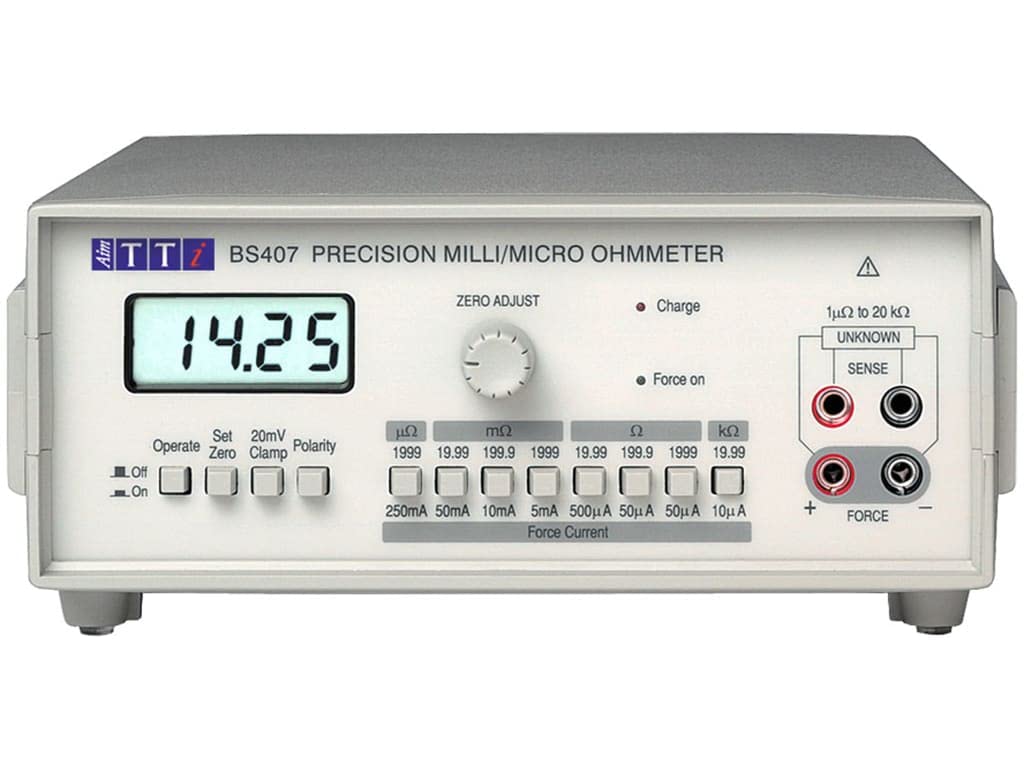
The image displays the front panel of the TTI BS407 Precision Milli/Micro Ohmmeter. Key features visible include the digital display, the 'ZERO ADJUST' knob, buttons for 'Operate', 'Set Zero', '20mV Clamp', and 'Polarity', and the input terminals for 'SENSE' and 'FORCE' connections. Below the display, various resistance ranges (µΩ, mΩ, Ω, kΩ) and corresponding force currents (250mA, 50mA, 10mA, 5mA, 500µA, 50µA, 50µA, 10µA) are indicated.
Eto ati Awọn isopọ
Before operating the BS407, ensure it is placed on a stable, level surface and connected to a suitable power source. The instrument uses a 4-wire connection method for precise resistance measurements.
Asopọ agbara:
- Connect the provided power cord to the instrument's power input at the rear.
- Plug the other end into a standard AC power outlet.
- Ensure the power switch on the front panel is in the 'Off' position before connecting.
4-Wire Measurement Connection:
The 4-wire (Kelvin) connection method eliminates the resistance of the test leads from the measurement, providing higher accuracy, especially for low resistance values.
- Identify the 'SENSE' terminals (red and black) and 'FORCE' terminals (red and black) on the front panel.
- Connect the 'FORCE' leads to the points on the component or circuit where the test current will be injected. The red 'FORCE' terminal is positive (+), and the black 'FORCE' terminal is negative (-).
- Connect the 'SENSE' leads as close as possible to the points where the voltage drop across the component is to be measured. The red 'SENSE' terminal corresponds to the positive voltage sense, and the black 'SENSE' terminal to the negative voltage ori.
- Ensure good contact between the test leads and the component under test to prevent measurement errors.
Awọn ilana Iṣiṣẹ
This section details the steps for performing resistance measurements using the BS407.
Basic Measurement Procedure:
- Agbara Tan: Flip the 'On/Off' switch on the front panel to the 'On' position. The display will illuminate.
- Atunṣe odo: Before connecting the test leads to the component, ensure the leads are open-circuited (not touching anything). Use the 'ZERO ADJUST' knob to fine-tune the display to read zero. For more precise zeroing, press the 'Set Zero' button.
- Select Range and Force Current: The BS407 automatically selects the appropriate range. However, you can observe the selected range (µΩ, mΩ, Ω, kΩ) and the corresponding force current (e.g., 250mA, 50mA, 10mA, 5mA, 500µA, 50µA, 10µA) indicated by the LEDs below the display. The instrument will apply the necessary force current for the selected range.
- So awọn itọsọna idanwo pọ: Connect the 4-wire test leads to the component as described in the "Setup and Connections" section.
- Ka Iwọn: The resistance value will be displayed on the large digital readout.
- Polarity: If measuring components with inherent polarity or when observing voltage drop, the 'Polarity' button can be used to reverse the current direction if needed, or to observe the polarity of the measured voltage.
- 20mV Clamp: The '20mV Clamp' function limits the voltage across the device under test to 20mV, which is useful for testing sensitive components like thermistors or fuses without causing self-heating errors.
- Operate Button: The 'Operate' button initiates or holds a measurement cycle.
Understanding Display Indicators:
- Ifihan Digital: Shows the measured resistance value.
- Range Indicators: LEDs illuminate next to µΩ, mΩ, Ω, or kΩ to indicate the active measurement range.
- Force Current Indicators: LEDs illuminate next to the current values (e.g., 250mA, 50mA) to show the applied test current.
- Atọka idiyele: Indicates the internal battery charging status (if applicable, or internal capacitor charge for measurement).
- Force On Indicator: Confirms that the force current is being applied to the test leads.
Itoju
Proper maintenance ensures the longevity and accuracy of your TTI BS407.
- Ninu: Use a soft, dry cloth to clean the exterior of the instrument. Do not use abrasive cleaners or solvents.
- Ibi ipamọ: Store the instrument in a clean, dry environment away from direct sunlight and extreme temperatures.
- Iṣatunṣe: For continued accuracy, periodic calibration by a qualified service center is recommended. Refer to the manufacturer's guidelines for calibration intervals.
- Àyẹ̀wò Olórí: Regularly inspect test leads for any signs of wear, damage, or corrosion. Replace damaged leads immediately to ensure safe and accurate operation.
Laasigbotitusita
Abala yii n pese awọn ojutu si awọn ọran ti o wọpọ ti o le ba pade.
| Isoro | Owun to le Fa | Ojutu |
|---|---|---|
| Ohun elo ko ni agbara lori. | No power supply; faulty power cord; internal fuse blown. | Check power cord connection and wall outlet. Try a different power cord. If issue persists, contact service. |
| Inaccurate readings or fluctuating display. | Poor lead connection; incorrect zero adjustment; external interference; damaged test leads. | Ensure leads are securely connected. Perform zero adjustment. Move instrument away from strong electromagnetic fields. Inspect and replace damaged leads. |
| "OVERLOAD" or "OL" displayed. | Resistance value exceeds selected range; open circuit. | Ensure the component is connected. The instrument should auto-range, but if not, check the component's expected resistance. |
Awọn pato
| Paramita | Iye |
|---|---|
| Resistance Wiwọn Ibiti | 1µohm to 20kohm |
| Ipinnu | 1µohm |
| Yiye | ± 0.1% |
| Idanwo Lọwọlọwọ | Up to 250mA (range dependent) |
| Waya Asopọ | 4-Wire (Kelvin) |
| External Height | 88mm |
| Ibú Ita | 220mm |
| External Depth | 230mm |
| Iwọn | 1.3kg (Instrument only), 6.02 Pounds (Shipping weight) |
| Orisun agbara | Okun Itanna |
| Nọmba awoṣe | BS407 |
| Olupese | AIM-TTI Instruments |
| RoHS ni ibamu | Bẹẹni |
Atilẹyin ọja ati Support
For information regarding product warranty, technical support, or service, please contact AIM-TTI Instruments directly or refer to their official webojula. Tọju iwe-ẹri rira rẹ bi ẹri rira fun awọn iṣeduro atilẹyin ọja.
Olupese: AIM-TTI Instruments
Webojula: www.aimtti.com (Note: This is a general manufacturer website, specific support details may vary.)
Ask a question about this manual
Ask about setup, troubleshooting, compatibility, parts, safety, or missing instructions. Manuals+ will review the question and use this page’s manual context to help answer it.