
1. Ifihan ati Loriview
The Casio Privia PX-870 is an 88-key weighted console digital piano designed to deliver an authentic piano experience. It features the Tri-Sensor II Scaled Hammer Action keyboard with simulated ebony and ivory textures, providing a realistic touch and dynamic control. The AiR Sound Source offers rich detail with advanced damper and string resonance, key-off simulation, and mechanical sounds, recreating the depth of a concert grand piano.
Equipped with a powerful 40W 4-speaker Sound Projection system, the PX-870 fills any room with immersive sound. It also includes features built for learning and practice, such as Duet Mode, dual headphone jacks, 60 built-in songs, a 2-track MIDI recorder, and Concert Play with orchestral backing tracks. Its sleek console design with a sliding key cover and class-compliant USB-MIDI connectivity make it a versatile instrument for any setting.
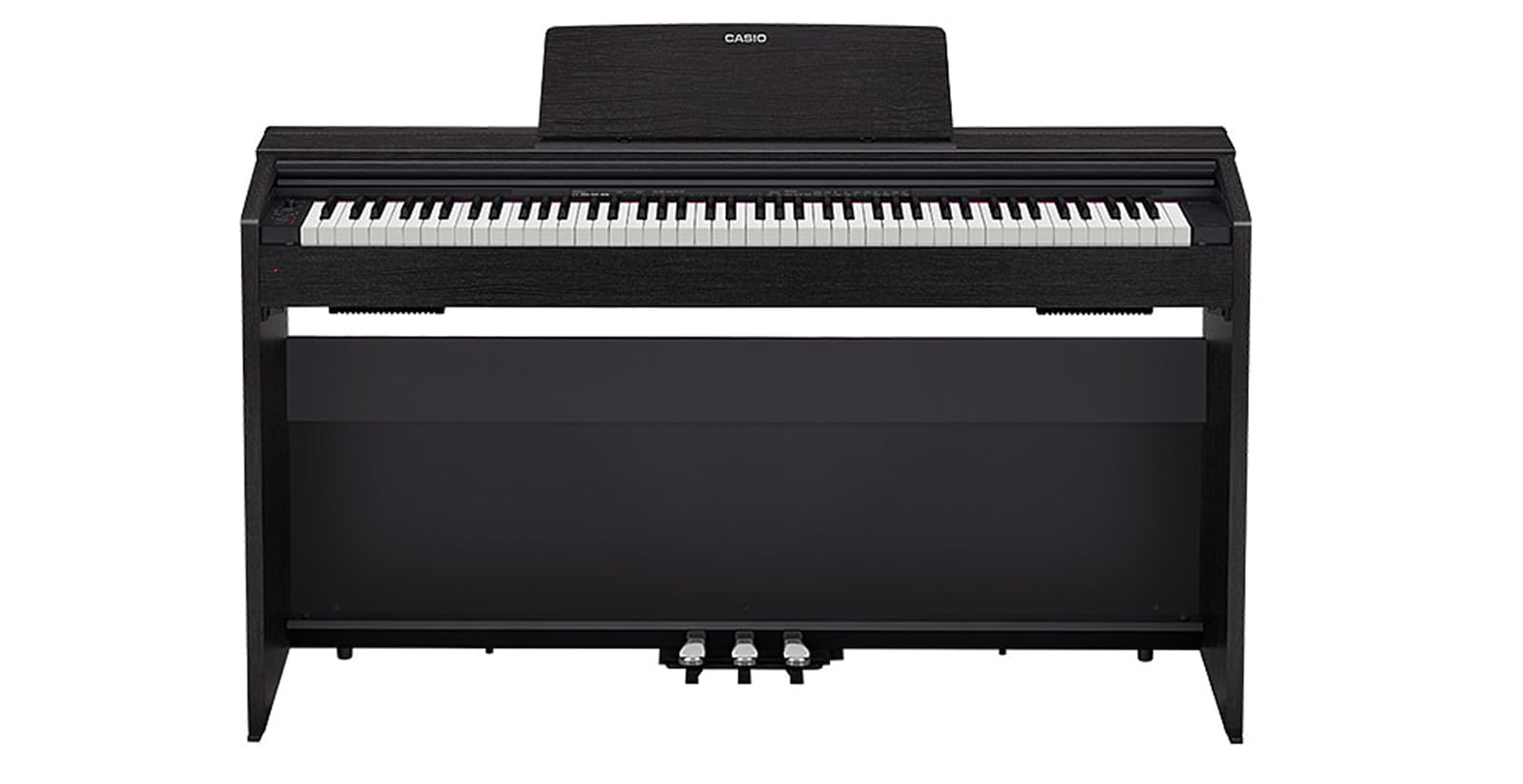
olusin 1: Iwaju view of the Casio Privia PX-870 Digital Piano.
2. Eto
Unpacking and assembly of the Casio Privia PX-870 should be performed carefully, ideally with two people due to the instrument's weight. Ensure all components are present before beginning assembly.
- Yọ awọn ohun elo kuro: Carefully remove all parts from the packaging. Verify that the main piano unit, stand components, pedals, power adapter, music stand, and any included accessories (like the sliding key cover and USB-MIDI cable) are present.
- Ṣe apejọ Iduro naa: Follow the detailed instructions provided in the separate assembly guide for connecting the side panels, crossbars, and pedal unit. Ensure all screws are securely tightened.
- Attach the Piano Unit: With assistance, carefully lift the main piano unit and place it onto the assembled stand, aligning the mounting holes. Secure the piano unit to the stand using the provided screws.
- So awọn Pedals: Connect the pedal unit cable to the corresponding port on the underside of the piano unit.
- Install Music Stand and Key Cover: Insert the music stand into its slot on the piano. Slide the key cover into its designated tracks.
- Asopọ agbara: Connect the supplied AC adapter to the DC 24V input jack on the rear of the piano, then plug the adapter into a standard wall outlet.

olusin 2: Apa view of the Casio Privia PX-870 Digital Piano, showing its console design.
3. Awọn ilana Iṣiṣẹ
The Casio Privia PX-870 offers a range of functions for playing, practicing, and connecting to other devices.
3.1 Ipilẹ idari
- Bọtini agbara: Located on the left side of the control panel. Press to turn the piano ON/OFF.
- Bọtini Iwọn didun: Adjusts the overall output volume of the piano.
- Grand Piano Button: Selects the primary grand piano tone.
- E. Piano 1 Button: Selects the electric piano tone.
- Bọtini Iṣẹ: Used in combination with keyboard keys to access various settings and tones.

Figure 3: Close-up of the control panel and keyboard keys, showing various functions and tone selections.
3.2 Ohun Awọn ẹya ara ẹrọ
The PX-870 provides 19 instrument tones, including multiple variations of grand pianos, electric pianos, organs, and strings. Use the Išẹ button in conjunction with specific keys (as indicated on the piano's surface or in the full user manual) to select different tones and adjust their characteristics (e.g., Concert, Mellow, Bright for Grand Piano).
- Tri-Sensor II Scaled Hammer Action: Provides an authentic piano touch with varying key weights across the keyboard, mimicking an acoustic grand piano.
- AiR Sound Source: Delivers highly realistic piano sounds with advanced resonance modeling.
- Sound Projection System: The 4-speaker system is designed to produce a rich, immersive sound experience.
3.3 Practice and Learning Tools
- Metronome: Activate the metronome to practice with precise timing. Adjust tempo and beat using the Išẹ button and corresponding keys.
- Concert Play: Play along with 10 classical live orchestra recordings. You can choose to listen to the full performance, practice the piano part with orchestral accompaniment, or practice the orchestral part with the piano melody.
- Ipo Duet: Splits the keyboard into two equal pitch ranges, allowing two players to play simultaneously in the same octave range. Ideal for student-teacher lessons.
- Agbohunsile MIDI: Record your performances (up to 2 tracks) directly onto the piano's internal memory.
- USB Audio Recording: Record your performances as audio files directly to a connected USB flash drive.
3.4 Asopọmọra
- Agbekọri Jacks: Two 3.5mm headphone jacks are provided for silent practice or duet sessions.
- USB-MIDI: Connect the piano to a computer (Mac, PC, iOS, or Android) via USB for MIDI data transfer, allowing use with music software.
- Port USB Flash Drive: For USB audio recording and playback.

olusin 4: Pada view of the Casio Privia PX-870 Digital Piano, highlighting connectivity ports.
3.5 Osise Video ọja
Fidio 1: Ọja osise ti pariview of the Casio PX-870 Privia Digital Home Piano, showcasing awọn ẹya ara ẹrọ ati awọn agbara ohun rẹ.
4. Itọju
Itọju to dara ṣe idaniloju igbesi aye gigun ati iṣẹ aipe ti duru oni nọmba rẹ.
- Ninu: Use a soft, dry cloth to wipe the surface of the piano. For stubborn dirt, lightly dampen the cloth with water and a mild, non-abrasive cleaner, then wipe dry immediately. Avoid harsh chemicals.
- Abojuto bọtini: Wipe the keys regularly with a soft cloth. Do not use alcohol or strong cleaning agents, as these can damage the key surfaces.
- Ideri Ekuru: Always use the sliding key cover when the piano is not in use to protect the keys and internal components from dust.
- Awọn ipo Ayika: Avoid exposing the piano to direct sunlight, extreme temperatures, or high humidity, which can cause damage.
5. Laasigbotitusita
If you encounter issues with your Casio Privia PX-870, try the following basic troubleshooting steps:
- Ko si Ohun: Check if the power is on and the volume is turned up. Ensure headphones are not plugged in if you expect sound from the speakers. Verify all cables are securely connected.
- Awọn bọtini Ko Dahun: Ensure the piano is powered on. If only some keys are affected, contact customer support.
- Metronome Not Working: Check if the metronome function is activated and its volume is audible.
- Ohun Yiyi: Lower the volume. Check for any external interference or loose connections.
- Awọn oran agbara: Ensure the AC adapter is correctly connected and the power outlet is functional.
For more complex issues, refer to the full user manual or contact Casio customer support.
6. Awọn pato
| Ẹya ara ẹrọ | Sipesifikesonu |
|---|---|
| Orukọ awoṣe | Casio PX-870 Privia Digital Home Piano |
| Nọmba ti Awọn bọtini | 88 |
| Iṣe bọtini | Tri-Sensor II Scaled Hammer Action Keyboard |
| Key Surface | Simulated Ebony and Ivory Textures |
| Orisun Ohun | AiR Sound Source |
| Polyphony | 256-akọsilẹ |
| Awọn ohun orin | 19 Built-in Tones |
| Awọn agbọrọsọ | 40W (20W + 20W) 4-Speaker Sound Projection System |
| Asopọmọra | USB-MIDI, 2x Headphone Jacks (3.5mm), USB Flash Drive Port |
| Ọja Mefa | 59.5"D x 16"W x 15"H |
| Iwọn Nkan | 75.6 iwon |
| Àwọ̀ | Dudu |
7. Atilẹyin ọja ati Support
Fun alaye atilẹyin ọja, jọwọ tọkasi kaadi atilẹyin ọja ti o wa pẹlu ọja rẹ tabi ṣabẹwo si Casio osise website. For technical support, product registration, or service inquiries, please contact Casio customer service through their official channels.