
1. Ifihan
The HQST 20A PWM Flush Mount Solar Charge Controller is designed to efficiently manage power flow from your solar panels to your battery bank, ensuring optimal charging and protection. It is compatible with both 12V and 24V battery systems, supporting various battery types including Lithium, Sealed (AGM), Gel, and Flooded batteries. This manual provides essential information for proper installation, operation, and maintenance of your solar charge controller.
2. Ọja Ipariview
Familiarize yourself with the components of your HQST solar charge controller:
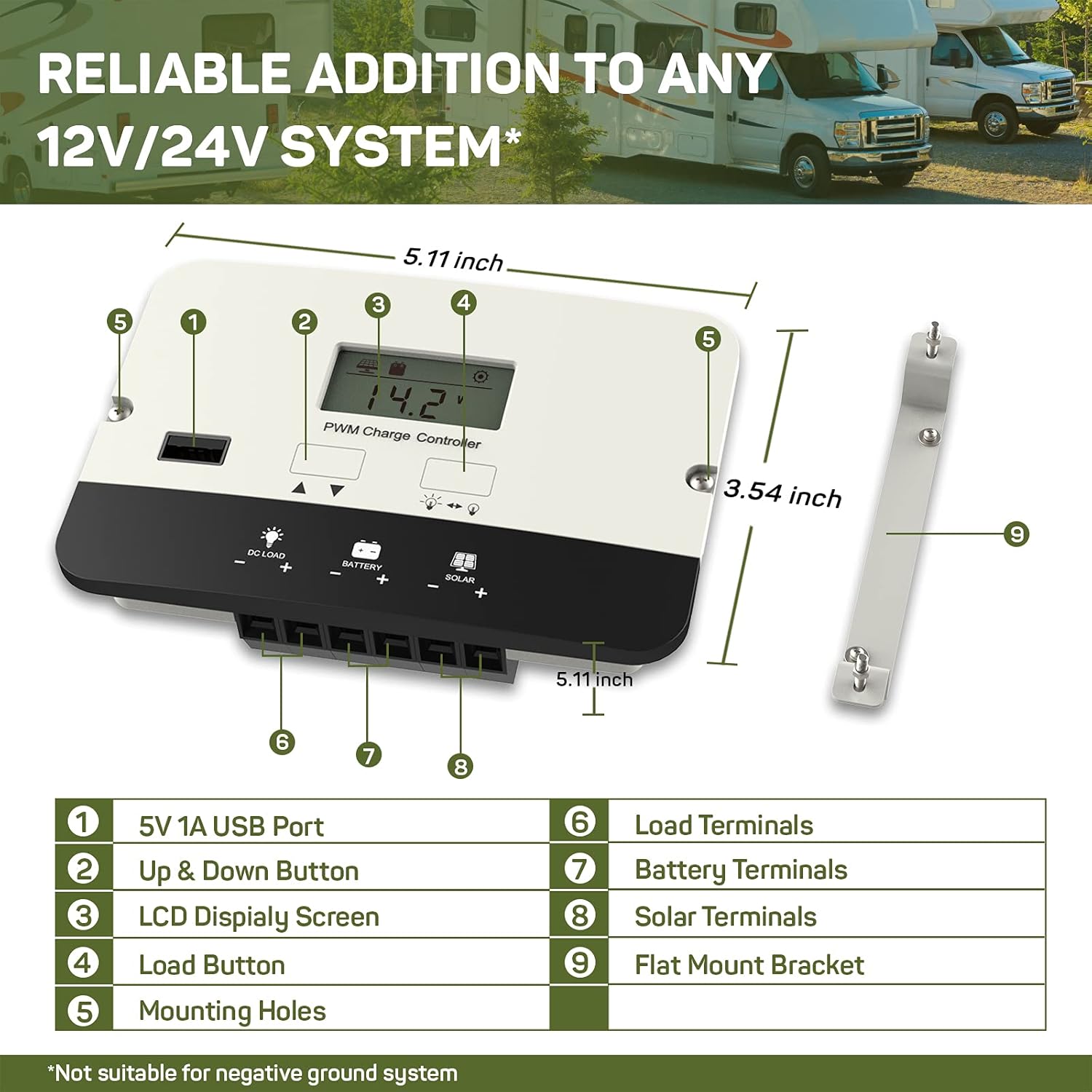
This diagram illustrates the key components and dimensions of the HQST 20A PWM Flush Mount Solar Charge Controller. It measures approximately 5.11 inches in length and 3.54 inches in width.
- 5V 1A USB Port: Fun gbigba agbara awọn ẹrọ ti o ni ibamu pẹlu USB.
- Bọtini Soke & Isalẹ: Used for navigating display screens and adjusting settings.
- Iboju Ifihan LCD: Shows real-time system data and settings.
- Bọtini fifuye: Controls the DC load output.
- Awọn ihò iṣagbesori: For securing the controller during installation.
- Load Terminals: Connect to your DC loads.
- Awọn ibudo batiri: Connect to your battery bank.
- Solar Terminals: Connect to your solar panel array.
- Flat Mount Bracket: Optional bracket for surface mounting.
3. Eto
3.1 Iṣagbesori Adarí
The controller offers flexible mounting options:

The controller can be installed using either a flush mount for a seamless look or a flat mount with the provided bracket. Choose a location that is dry, well-ventilated, and away from direct sunlight or heat sources.
- Òkè Ńlá: Integrate the controller directly into a panel or wall for a clean finish.
- Òkè pẹlẹbẹ Use the included bracket to mount the controller on a surface.
Ensure adequate space around the controller for air circulation to prevent overheating.
3.2 Awọn isopọ onirin
Follow the correct wiring sequence to prevent damage to the controller or battery:
- So batiri pọ: First, connect the battery to the controller's battery terminals (7). Ensure correct polarity (positive to positive, negative to negative). The LCD will power on.
- Solar Panel: Next, connect the solar panel to the controller's solar terminals (8). Ensure correct polarity.
- So DC Load pọ: Finally, connect your DC loads to the controller's load terminals (6). Ensure correct polarity.
Ìtẹ̀lé Ìjápọ̀: To disconnect the system, reverse the order: disconnect the load, then the solar panel, and finally the battery.

This wiring diagram illustrates the proper connection order for the solar panel, battery, and DC load to the HQST solar charge controller.

When connecting wires, ensure they are inserted into the correct square socket for the cable, not the screw hole. Fully unscrew the terminal screws, insert the wire ends, then tighten the screws securely.
3.3 Batiri Iru Eto
The controller automatically recognizes 12V/24V Sealed (AGM), Gel, and Flooded batteries. For Lithium batteries, manual parameter setting is required:

The LCD display allows for manual adjustment of battery parameters, especially crucial for Lithium-ion batteries.
- Press and hold the 'Up & Down' button to enter the setting mode.
- Use the 'Up & Down' buttons to navigate to the battery type setting (e.g., "b01" for Gel, "b02" for Sealed, "b03" for Flooded, "b04" for Lithium).
- For Lithium batteries, further adjust charging voltage, over-discharge voltage, and other parameters as per your battery manufacturer's specifications.
- Press and hold the 'Load' button to save the settings and exit.
4. Awọn ilana Iṣiṣẹ
4.1 LCD Ifihan Lilọ kiri
The LCD screen provides real-time monitoring of your solar system:

The intuitive LCD screen cycles through various operational data, including battery voltage, PV voltage, charge current, load current, controller temperature, and battery state of charge (SOC).
- Press the 'Up & Down' button (2) to manually cycle through the displayed parameters.
- The display will automatically cycle through parameters if no button is pressed for a few seconds.
4.2 fifuye Iṣakoso
The controller features a DC load output with multiple control modes:
- Press the 'Load' button (4) to manually turn the DC load output on or off.
- The controller supports 17 different load control modes, allowing for customized operation (e.g., dusk-to-dawn, timed operation). Refer to the full manual for detailed instructions on setting load modes.
4.3 Okun gbigba agbara USB
The integrated 5V 1A USB port (1) can charge small electronic devices. This port is active when the DC load output is enabled.
4.4 4-Stage Smart Ngba agbara
The controller employs an advanced 4-stage charging algorithm to optimize battery health and lifespan:

This graph illustrates the voltage ati lọwọlọwọ profiles during the 4-stage charging process, including Bulk, Boost/Absorption, Float, and Equalization stages.
- Idiyele pupọ: Delivers maximum current to rapidly charge the battery.
- Boost/Absorption Charge: N ṣetọju vol ti o duro nigbagbogbotage to ensure the battery is fully charged without overcharging.
- Gbigba agbara leefofo: Reduces voltage to a lower level to maintain the battery at full charge, compensating for self-discharge.
- Owo Idogba: (For lead-acid batteries only) Periodically overcharges the battery to balance cell voltagati idilọwọ sulfation.
5. Itọju
To ensure the longevity and optimal performance of your HQST solar charge controller, perform the following maintenance checks:
- Ayẹwo igbagbogbo: Periodically check all wiring connections for tightness and signs of corrosion. Loose connections can cause voltage silė ati overheating.
- Mimọ: Keep the controller's exterior clean and free from dust, dirt, and debris. Use a dry cloth for cleaning. Do not use harsh chemicals or abrasive materials.
- Afẹfẹ: Ensure that the installation area remains well-ventilated to allow for proper heat dissipation. Blocked vents can lead to overheating and reduced efficiency.
- Ilera Batiri: Monitor your battery's health and performance regularly. Follow the battery manufacturer's maintenance guidelines.
6. Laasigbotitusita
If you encounter issues with your solar charge controller, refer to the following common problems and solutions:
| Isoro | Owun to le Fa | Ojutu |
|---|---|---|
| Controller Display is Off | Ko si agbara lati batiri tabi asopọ batiri ti ko tọ. | Check battery connections and ensure correct polarity. Verify battery voltage jẹ loke awọn kere ṣiṣẹ voltage. |
| Batiri Ko Ngba agbara | No solar input, incorrect solar panel connection, or faulty solar panel. | Ensure solar panels are receiving adequate sunlight. Check solar panel wiring for correct polarity and secure connections. Test solar panel voltage. |
| DC Load Not Working | Load output disabled, incorrect load connection, or over-discharge protection active. | Press the Load button to enable output. Check load wiring for correct polarity and secure connections. Verify battery voltage is above the over-discharge protection threshold. |
| Error Code Displayed (e.g., E02) | Specific system fault (e.g., E02 typically indicates over-discharge). | Consult the full product manual for a complete list of error codes and their corresponding solutions. Address the underlying issue (e.g., charge battery for E02). |
If the problem persists after attempting these solutions, please contact HQST customer support.
7. Awọn pato
| Ẹya ara ẹrọ | Sipesifikesonu |
|---|---|
| Awoṣe | 20A PWM Flush Mount |
| Eto Voltage | 12V / 24V Auto-recognition (Lithium batteries require manual setting) |
| Gbigba agbara ti o pọju lọwọlọwọ | 20A |
| Ibamu batiri | Lithium, Sealed (AGM), Gel, Flooded |
| Gbigba agbara Stages | 4-Stage (Bulk, Boost/Absorption, Float, Equalization) |
| Ijade USB | 5V1A |
| Ifihan Iru | LCD |
| Awọn iwọn Ọja (L x W x H) | 5.11 x 3.54 x 1.36 inches |
| Iwọn Nkan | 9.1 iwon |
| Iwọn Iṣiṣẹ ti o pọju | 45°C (113°F) |
| Idaabobo Awọn ẹya ara ẹrọ | Reverse polarity, over-voltage, over-current, over-discharge, short-circuit, reverse current. |
8. Atilẹyin ọja ati Support
This HQST product is backed by a 10-odun atilẹyin ọja, reflecting our commitment to quality and durability. For any technical assistance, troubleshooting, or warranty claims, please contact HQST customer support.
You can find contact information and additional resources on the official HQST webojula: www.hqst.com
Please have your product model number (20A PWM Flush Mount) and purchase details ready when contacting support.