
Ansmann 1260-0006
ANSMANN AES4 Timer Switch User Manual
Awoṣe: 1260-0006
Brand: Ansmann
Ọja Pariview
The ANSMANN AES4 Timer Switch is a digital weekly timer designed to automate the switching of electrical devices. It features a clear LCD display, 10 programmable switching times, a random function for simulating presence, and a summer time adjustment feature. This device helps in managing energy consumption and enhancing home security.

Nọmba 1: Iwaju view of the ANSMANN AES4 Timer Switch, showing the LCD display and control buttons.
Eto ati Iṣeto Ibẹrẹ
Before first use, ensure the timer switch is fully charged by plugging it into a live socket for at least 30 minutes. This will activate the internal battery for memory retention.
1. Ntun awọn Device
To clear all previous settings and ensure a fresh start, locate the small Tunto button (usually recessed) and press it with a pointed object (e.g., a pen tip). The display will show all segments, then reset to 00:00.
2. Ṣiṣeto Akoko ati Ọjọ lọwọlọwọ
- Tẹ awọn Aago button once. The display will show the current time.
- Tẹ awọn OSE button repeatedly to set the current day (MO, TU, WE, TH, FR, SA, SU).
- Tẹ awọn WAKATI button repeatedly to set the current hour (0-23).
- Tẹ awọn ISEJU button repeatedly to set the current minute (0-59).
- To exit time setting mode, press any other button or wait approximately 30 seconds for the device to return to normal display.

Nọmba 2: Close-up of the LCD display, illustrating the day and time setting interface. Note the "SUMMER" indicator for summer time function.
3. 12/24 Hour Display Selection
While in normal clock mode, press the Aago bọtini ati ki o si awọn Aago button simultaneously to toggle between 12-hour (with AM/PM indicator) and 24-hour display formats.
4. Summer Time Function
To activate or deactivate the summer time (Daylight Saving Time) function, press the Aago bọtini ati ki o si awọn TAN/Afọwọṣe/PA button simultaneously. The display will show "SUMMER" when activated, and the time will advance by one hour.
Awọn ilana Iṣiṣẹ
The AES4 Timer Switch allows for up to 10 ON/OFF programs per day or week, along with manual control and a random function.
1. Siseto ON / PA Times
- Tẹ awọn Aago button. The display will show "1 ON". This is the first ON program.
- Lo OSE, WAKATI, ati ISEJU buttons to set the desired ON time and day(s) for this program. You can select specific days, weekdays, weekends, or all days.
- Tẹ awọn Aago button again. The display will show "1 OFF". This is the first OFF program.
- Lo OSE, WAKATI, ati ISEJU buttons to set the desired OFF time and day(s) for this program.
- Repeat steps 1-4 for up to 10 ON/OFF programs. Pressing Aago will cycle through P1 ON, P1 OFF, P2 ON, P2 OFF, ..., P10 ON, P10 OFF.
- Lati jade kuro ni ipo siseto, tẹ bọtini naa Aago bọtini tabi duro fun 30 aaya.

Nọmba 3: Example of the timer switch being used to automate Christmas lighting, turning lights on from 17:00 to 08:00.
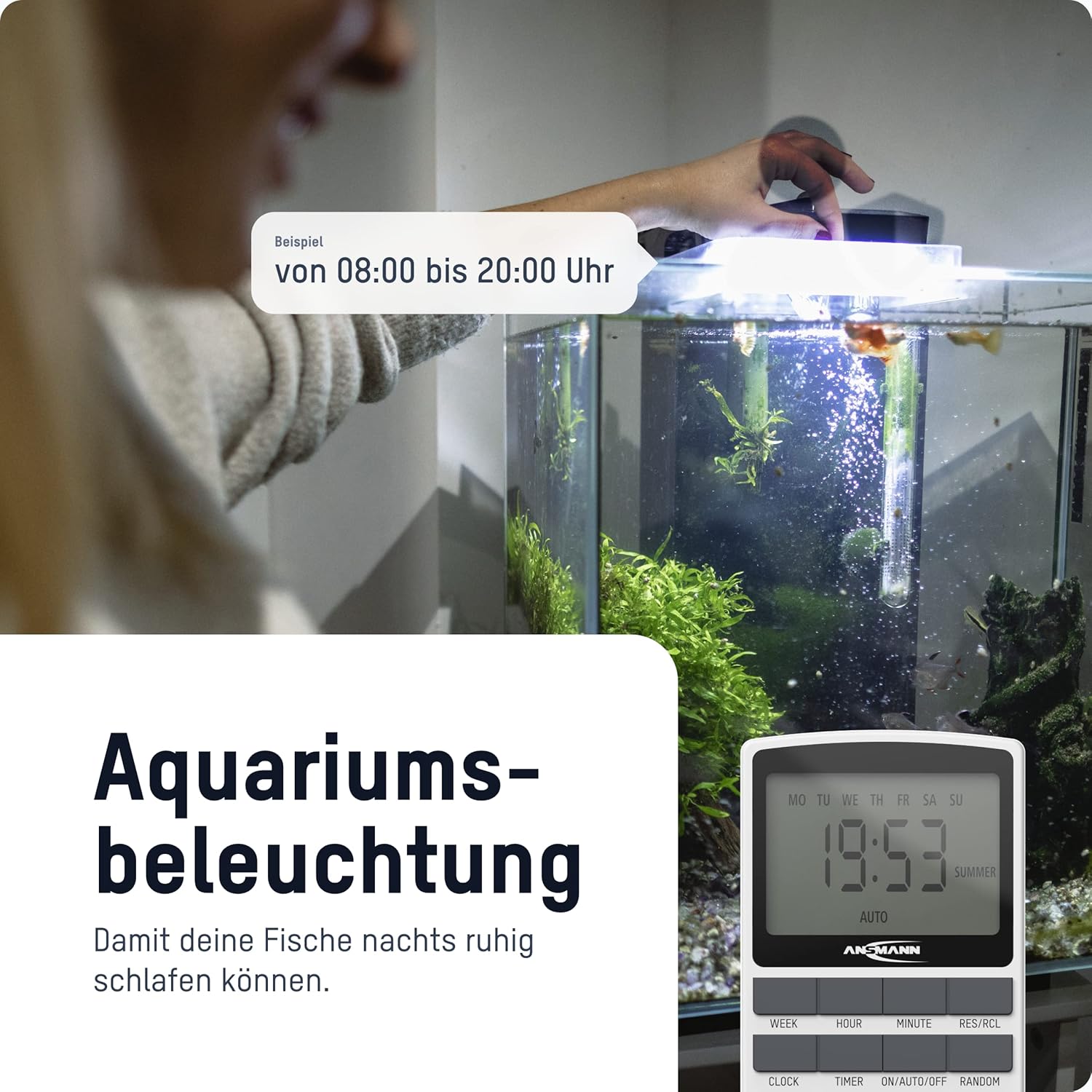
Nọmba 4: The timer switch automating aquarium lighting, ensuring fish have a regular light cycle, for example, lati 08:00 to 20:00.
2. Manual ON/AUTO/OFF Mode
Tẹ awọn TAN/Afọwọṣe/PA bọtini lati yipo nipasẹ awọn ipo iṣiṣẹ:
- LATI: The connected device is continuously ON, overriding all programs.
- LATIO: The connected device operates according to the programmed ON/OFF times. This is the standard operating mode for automated control.
- PA: The connected device is continuously OFF, overriding all programs.
3. ID Išė
The random function is designed to simulate presence in your home by randomly switching the connected device ON and OFF within a specific time window (e.g., 18:00 to 06:00). This can deter potential intruders.
To activate the random function, press the ID button. "RANDOM" will appear on the display. Press it again to deactivate.
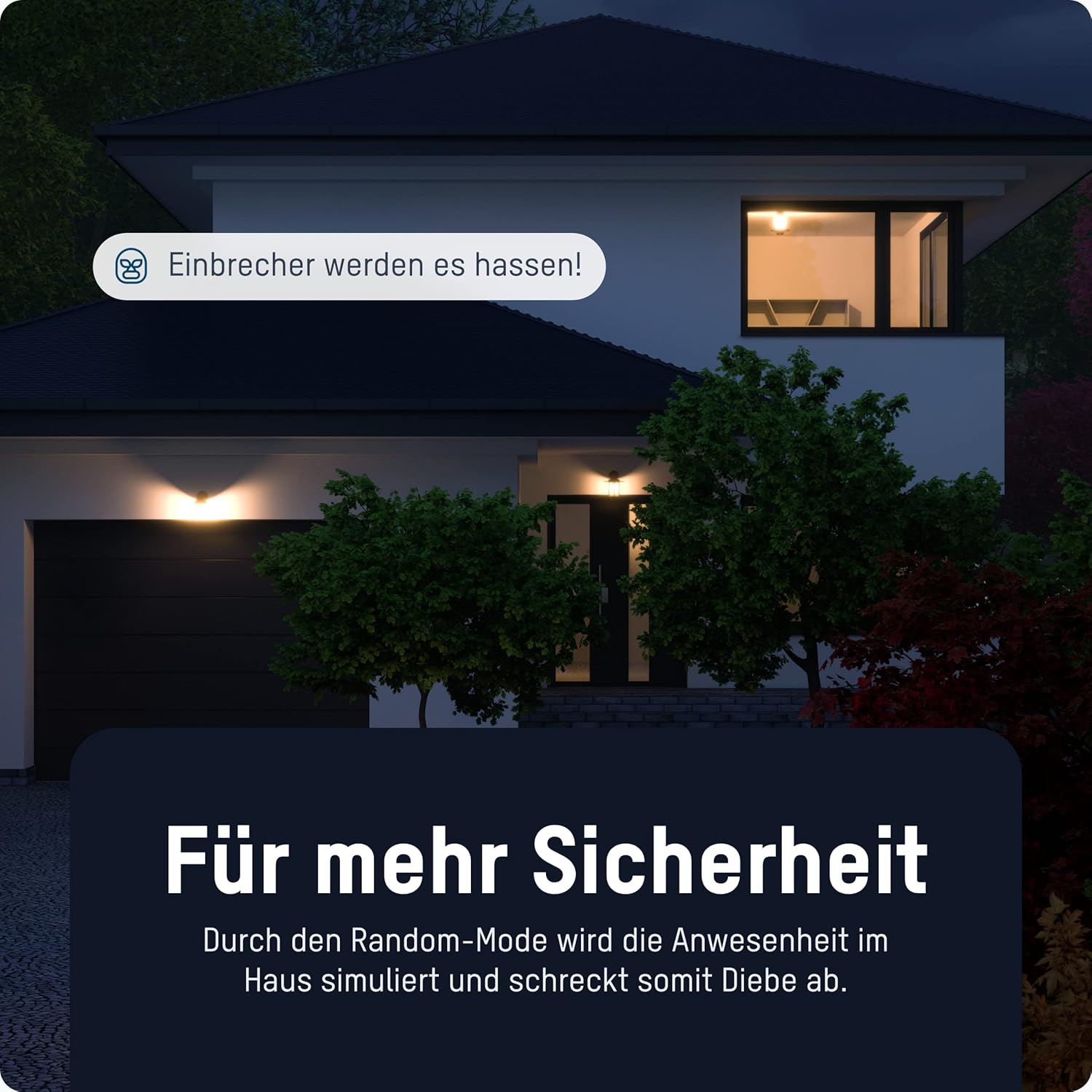
Nọmba 5: The timer switch utilizing its random mode to simulate occupancy, enhancing home security by randomly turning lights on and off.
Itoju
The ANSMANN AES4 Timer Switch requires minimal maintenance.
- Ninu: Fi aṣọ gbígbẹ tó rọ, tó sì gbẹ nu ẹ̀rọ náà. Má ṣe lo àwọn ohun ìfọṣọ tàbí àwọn ohun èlò ìfọṣọ. Rí i dájú pé o ti yọ ẹ̀rọ náà kúrò kí o tó sọ ọ́ di mímọ́.
- Ibi ipamọ: If storing the device for an extended period, ensure it is unplugged and kept in a dry, cool place.
- Batiri: The internal battery is designed for memory retention during power outages. It is not user-replaceable.
Laasigbotitusita
If you encounter issues with your ANSMANN AES4 Timer Switch, try the following steps:
- Ifihan naa ṣofo tabi ko dahun: Ensure the timer is plugged into a live power outlet. If it has been unplugged for a long time, the internal battery might be depleted. Plug it in for at least 30 minutes to charge.
- Àwọn ètò kò ṣiṣẹ́:
- Check if the timer is in "AUTO" mode. If it's in "ON" or "OFF" mode, programs will be overridden.
- Rí i dájú pé a ṣètò àkókò àti ọjọ́ lọ́wọ́lọ́wọ́ dáadáa.
- Review your programmed ON/OFF times to ensure they are set as intended and do not conflict.
- Device connected to timer is not turning ON/OFF:
- Ensure the connected device is properly plugged into the timer switch.
- Check if the connected device itself is working by plugging it directly into a wall socket.
- Ensure the timer switch is receiving power.
- Random function not working: Ensure the "RANDOM" indicator is visible on the display.
- Aṣiṣe gbogbogbo: Perform a full reset of the device by pressing the recessed Tunto button. Note that this will erase all programmed settings.
Awọn pato
| Ẹya ara ẹrọ | Ẹ̀kúnrẹ́rẹ́ |
|---|---|
| Nọmba awoṣe | 1260-0006 |
| Ọja Mefa | 2.36 x 2.35 x 5.31 inches |
| Iwọn Nkan | 5.4 iwon (153 Giramu) |
| Iwon iboju | 2.1 inches |
| O pọju. Agbara Rating | 3680 W (as per product title/description) |
| Yipada Times | Up to 10 ON/OFF programs per day/week |
| Awọn iṣẹ | Digital Timer, Random Function, Summer Time, 12/24-hour display |
Atilẹyin ọja ati Support
For detailed warranty information and technical support, please refer to the official Ansmann webojula tabi kan si wọn onibara iṣẹ taara. Tọju iwe-ẹri rira rẹ bi ẹri rira.
Official Ansmann Webojula: www.ansmann.de
Ask a question about this manual
Ask about setup, troubleshooting, compatibility, parts, safety, or missing instructions. Manuals+ will review the question and use this page’s manual context to help answer it.