
1. Ọja Ipariview
The NC GBS-8100 is a versatile video converter board designed for arcade game systems. It facilitates the conversion of VGA/SVGA/XGA/SXGA signals to CGA, RGBS, CVBS, or S-Video outputs, making it compatible with a wide range of display devices, including older arcade monitors and standard definition televisions. This board features true digital 24-bit A/D conversion for accurate color reproduction and offers user controls for image adjustment.
Awọn ẹya pataki:
- Iṣagbewọle agbara: DC 5V/2A via 6.3mm connector.
- Input Signal Support: VGA/SVGA/XGA/SXGA resolutions (640x480, 800x600, 1024x768, 1280x1024).
- Awọn aṣayan Ijade: CGA (15K), VGA bypass, Video (CVBS), S-Video.
- Iṣakoso aworan: Supports position and zoom adjustments.
- Ijinle Awọ: True digital 24-bit A/D converter for 16.7-million color conversion.
- Akojọ OSD: English On-Screen Display for adjustments.
- Awọn iṣakoso olumulo: Dedicated keys for Output Switch, Image Zoom, Image Position, and Output Adjust.
- Ibamu: Supports NTSC and PAL video standards.
Awọn akoonu idii:
- 1x Video Output Converter Board (GBS-8100)
- 1x Power supply wire

Figure 1: The GBS-8100 converter board along with the included power supply wire and a multi-color signal cable.
2. Eto ati fifi sori
This section provides instructions for connecting and setting up your GBS-8100 converter board.
2.1. Idanimọ paati
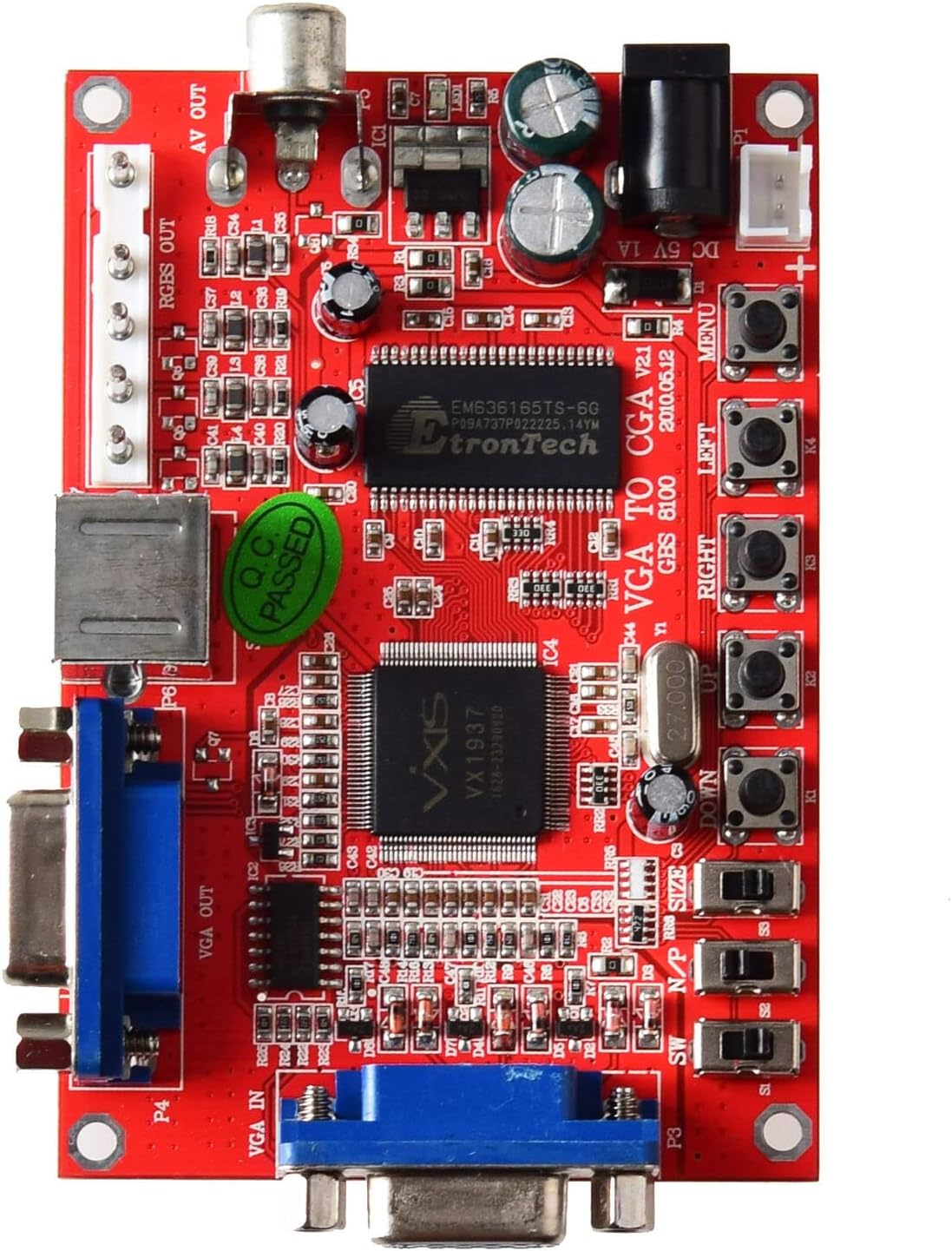
olusin 2: Top view of the GBS-8100 board, highlighting VGA IN, VGA OUT, AV OUT, RGBS OUT, S-Video port, DC 5V input, and control buttons.
- VGA IN (P3): Connect your source device (e.g., PC, game console) with a VGA output here.
- VGA OUT (P4): For VGA bypass, connect a VGA monitor here.
- RGBS/CGA OUT (P7): Connect to an arcade monitor or display that accepts RGBS or CGA signals.
- AV OUT (P5): Connect to a standard definition TV using a composite video cable.
- S-Video OUT (P6): Connect to a TV or display using an S-Video cable.
- DC 5V/2A Input: Connect the included power supply wire here. Ensure the power supply provides 5V DC at 2A.
- Awọn bọtini Iṣakoso: Buttons for MENU, UP, DOWN, LEFT, RIGHT, Output Switch, Image Zoom, Image Position, Output Adjust.
2.2. Asopọ Igbesẹ
- Asopọ agbara: Connect the provided power supply wire to the DC 5V/2A input on the GBS-8100 board. Connect the other end to a suitable 5V DC power source (not included, typically a power adapter).
- Orisun igbewọle: Connect your VGA source (e.g., PC, arcade JAMMA board with VGA output) to the VGA IN (P3) port on the converter board.
- Ifihan Ijade:
- Fun CGA/RGBS output: Connect your arcade monitor or display to the RGBS/CGA OUT (P7) ibudo.
- Fun Composite Video (AV) output: Connect your TV to the AV OUT (P5) ibudo.
- Fun S-Fidio output: Connect your TV to the S-Video OUT (P6) ibudo.
- Fun VGA Bypass: Connect a VGA monitor to the VGA OUT (P4) ibudo.
- Olohun (Aṣayan): If your source provides audio via VGA, ensure your display setup can handle it, or use a separate audio solution as this board primarily handles video.

olusin 3: Isunmọ view of the VGA IN, VGA OUT, and S-Video ports on the GBS-8100 board.
3. Awọn ilana Iṣiṣẹ
Once connected, power on the GBS-8100 board and your display. The board will automatically detect the input signal. Use the onboard buttons to navigate the OSD menu and adjust settings.
3.1. On-iboju Ifihan (OSD) Akojọ aṣyn
Tẹ awọn Akojọ button to access the OSD. Use the UP ati SILE buttons to navigate through menu options, and OSI ati OTO buttons to change values or select sub-menus.
3.2. Awọn iṣakoso olumulo
- Yipada Abajade: Cycles through available output modes (CGA, Video, S-Video, VGA Bypass).
- Sún Aworan: Adjusts the zoom level of the displayed image.
- Ipo Aworan: Adjusts the horizontal and vertical position of the image on the screen.
- Ṣatunṣe Abajade: Fine-tunes specific output parameters.
3.3. Supported Input/Output Resolutions
| Ẹka | Awọn alaye |
|---|---|
| Input Signal (Auto Scan) |
|
| Ifihan agbara jade |
|
4. Itọju
The GBS-8100 converter board is designed for durability and requires minimal maintenance.
- Ninu: Use a soft, dry cloth to gently wipe the surface of the board. Avoid using liquid cleaners or solvents, as they may damage the electronic components.
- Ayika: Operate the board in a clean, dry environment, away from excessive dust, moisture, and extreme temperatures.
- Mimu: Mu pákó náà ní ẹ̀gbẹ́ rẹ̀ kí ó má baà fọwọ́ kan àwọn ohun èlò, pàápàá jùlọ nígbà tí a bá ń ṣiṣẹ́.
- Agbara Pa: Always disconnect power before making or changing any connections.
5. Laasigbotitusita
If you encounter issues with your GBS-8100 converter board, refer to the following common problems and solutions:
| Isoro | Owun to le Fa / Solusan |
|---|---|
| Ko si aworan lori ifihan. |
|
| Àwòrán náà ti yípadà tàbí ó ń tàn yòò. |
|
| OSD menu not appearing or unresponsive. |
|
| Awọn awọ jẹ ti ko tọ. |
|
6. Awọn pato
Detailed technical specifications for the GBS-8100 converter board.
| Paramita | Iye |
|---|---|
| Nọmba awoṣe | GBS-8100 |
| Input Ipese agbara | DC 5V/2A (6.3mm connector) |
| Input Signal Support | VGA/SVGA/XGA/SXGA (640x480, 800x600, 1024x768, 1280x1024) |
| Input Signal Frequencies |
|
| Orisi ifihan agbara | CGA (15K), VGA (Bypass), Video (CVBS), S-Video |
| Output Signal Resolutions |
|
| Iyipada Awọ | True digital 24-bit A/D converter (16.7 million colors) |
| OSD Èdè | English |
| Awọn iwọn (Itosi.) | 3.94 x 3.15 x 1.18 inches (Awọn iwọn idii) |
| Iwọn Nkan | 3.52 iwon (0.1 kilo) |
7. Atilẹyin ọja ati Support
This section provides information regarding product warranty and customer support.
7.1. atilẹyin ọja Information
Specific warranty details for the NC GBS-8100 converter board are typically provided at the point of purchase or within the product packaging. Please refer to your purchase receipt or contact the seller for precise warranty terms and conditions. Generally, electronic components may come with a limited manufacturer's warranty covering defects in materials and workmanship.
7.2. Onibara Support
For technical assistance, troubleshooting beyond this manual, or inquiries regarding your product, please contact the seller or manufacturer directly. Contact information can often be found on the product packaging, the seller's webaaye, tabi iwe rira rẹ.
Fun awọn ibeere gbogbogbo, o le ṣabẹwo si NC Store on Amazon.