
Ọrọ Iṣaaju
The LFF Atomic Wall Clock with Jumbo Display (Model LWC215) is designed for clear visibility and precise timekeeping. It automatically adjusts time and date via atomic signal and provides both indoor and outdoor temperature readings. This manual provides detailed instructions for setup, operation, and maintenance to ensure optimal performance of your device.

Image: LFF Atomic Clock with its accompanying outdoor sensor.
Kini To wa
- 1 x LFF Atomic Wall Clock (Model LWC215)
- 1 x Sensọ Ita gbangba Alailowaya
- 1 x Itọsọna olumulo
Ṣeto
1. Fifi sori batiri
The atomic clock requires 4 AA batteries (not included), and the wireless outdoor sensor requires 2 AAA batteries (not included). Ensure batteries are inserted with correct polarity.

Aworan: Ẹyin view of the clock showing battery compartments for 4 AA batteries.
2. Initial Pairing and Time Setting
After inserting batteries into both the clock and the outdoor sensor, place them together for approximately 15 minutes to establish a strong connection. The clock will automatically begin searching for the WWVB atomic signal to set the time and date. This process typically occurs overnight (1:00 AM, 2:00 AM, 3:00 AM, 4:00 AM, 5:00 AM) and the signal icon will become solid upon successful connection.
You can manually set the time zone (EST, CST, MST, PST, AKT, HST), language, date, time, RCC reception, alarm clock, and reception channel (Default channel 1) using the buttons on the back of the unit if automatic synchronization is not immediately successful or preferred.
Video: This video demonstrates the initial setup and pairing process for the LFF Atomic Clock and its outdoor sensor.
3. Ifiweranṣẹ
The clock offers dual installation methods: a table stand for desk placement or hang holes for wall mounting. For the outdoor sensor, place it in an area protected from direct rain and sunlight to ensure accurate temperature readings. The transmission range is up to 328ft (100M) in an open area.
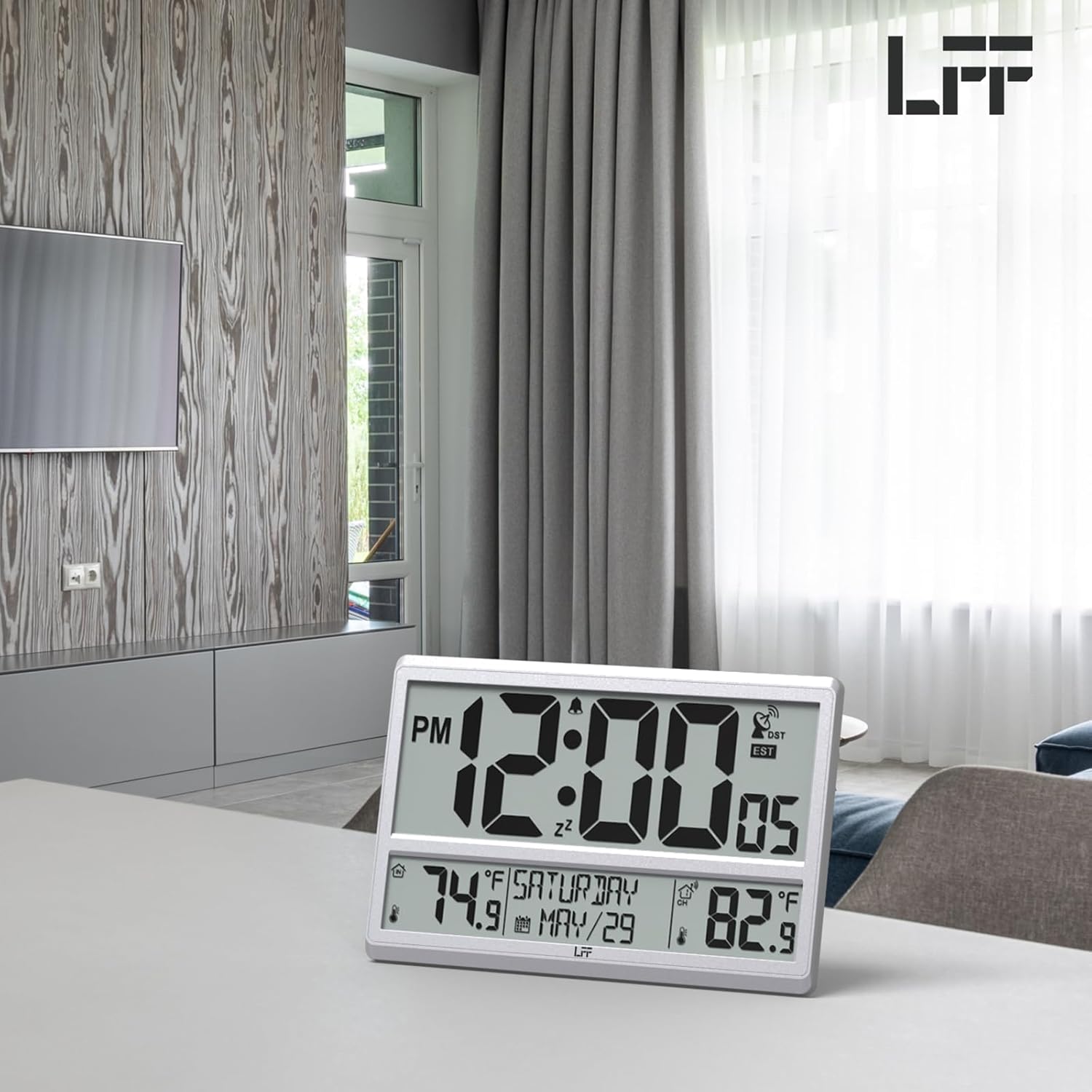
Image: Illustration of the wireless transmission range between the clock and the outdoor sensor.
Awọn ilana Iṣiṣẹ
Ifihan Awọn ẹya ara ẹrọ
The large LCD screen displays the following information:
- Àkókò: Ọna kika 12/24.
- Ọjọ: Month and day.
- Ọjọ Ọsẹ: Full day name.
- Awọn iwọn otutu inu ile: Displayed in °F / °C.
- Iwọn otutu ita gbangba: Received from the wireless sensor, displayed in °F / °C.
- Itaniji: Alarm icon indicates active alarm.
- DST: Ifojumọ Time Atọka.
- RCC Reception Icon: Indicates atomic signal reception status.

Image: Close-up of the clock display highlighting various functions like time, temperature, and date.
Ṣiṣeto Itaniji naa
To set the alarm, press and hold the 'ALARM' button on the back of the clock. Use the UP/DOWN buttons to adjust the alarm time, then press 'SET' to confirm. Press 'ALARM' again to turn the alarm ON/OFF.
Adjusting Time Zone and DST
To adjust the time zone or turn Daylight Saving Time (DST) on/off, press and hold the 'SET' button for 2 seconds to enter setting mode. Follow the prompts to select your desired time zone and DST setting. Press 'SET' to confirm each selection.
Itoju
- Rirọpo Batiri: Replace batteries in both the main clock unit and the outdoor sensor when the display dims or becomes erratic. For temperatures below -4°F, lithium batteries are recommended for the outdoor sensor.
- Ninu: Wipe the clock and sensor with a soft, dry cloth. Avoid using abrasive cleaners or solvents.
- Itọju Sensọ Ita gbangba: While the outdoor sensor has an IPX4 splash-proof rating, it is best to place it in a sheltered location to protect it from direct heavy rain and prolonged exposure to sunlight.
Laasigbotitusita
- No Atomic Signal (RCC) Reception:
- Ensure the clock is placed near a window or an outside wall, away from electronic devices that may cause interference.
- Manually initiate RCC reception by pressing and holding the 'RCC' button on the back of the clock.
- Jẹrisi agbegbe aago to pe ti yan.
- Outdoor Temperature Not Displaying or Incorrect:
- Ensure both the clock and sensor have fresh batteries.
- Verify the outdoor sensor is set to Channel 1 (default) and the clock is also receiving on Channel 1. You can cycle through channels on the clock using the 'CHANNEL' button.
- Press and hold the 'RCC' button on the back of the clock for a few seconds to force a re-scan for the sensor signal.
- Ensure the sensor is within the 328ft (100M) transmission range and free from major obstructions.
- Ifihan jẹ Dim tabi Ofo:
- Replace all batteries in both units.
- Note that the clock does not have a backlight display.
Awọn pato
| Ẹya ara ẹrọ | Ẹ̀kúnrẹ́rẹ́ |
|---|---|
| Brand | LFF |
| Nọmba awoṣe | LWC215 |
| Àwọ̀ | Fadaka |
| Ifihan Iru | Oni-nọmba |
| Ọja Mefa | 14.2"W x 9.4"H |
| Orisun agbara | Battery Powered (4 AA for clock, 2 AAA for sensor) |
| Pataki Awọn ẹya ara ẹrọ | Large Display, Multiple Time Zone, Temperature Display, Atomic, Calendar Display |
| inu ile / ita gbangba Lilo | Nínú ilé (Aago), Ìta gbangba (Sẹ́nsọ̀) |
| Ohun elo | Ṣiṣu |
| Iṣagbesori Iru | Odi Oke, Table Iduro |
| Iwọn Nkan | 1 iwon |
| Outdoor Sensor Waterproof Rating | IPX4 (Imudaniloju Asesejade) |
Atilẹyin ọja ati Support
For any quality problems or technical assistance, please contact LFF support directly. We are committed to ensuring your satisfaction with our products.
Imeeli atilẹyin: support@lfftech.com