
1. Ifihan
The BARSKA Escape Porro 10-30x60 Zoom Binoculars (Model AB11050) are designed for versatile long-distance viewing. These binoculars feature a powerful variable magnification range, allowing users to observe a wide field of view and then zoom in for detailed examination of distant objects. The large objective lenses and multi-coated optics enhance light gathering, providing clear images even in low-light conditions. Ergonomic design elements, such as a zoom lever and fold-down eyecups, ensure comfortable and efficient use.
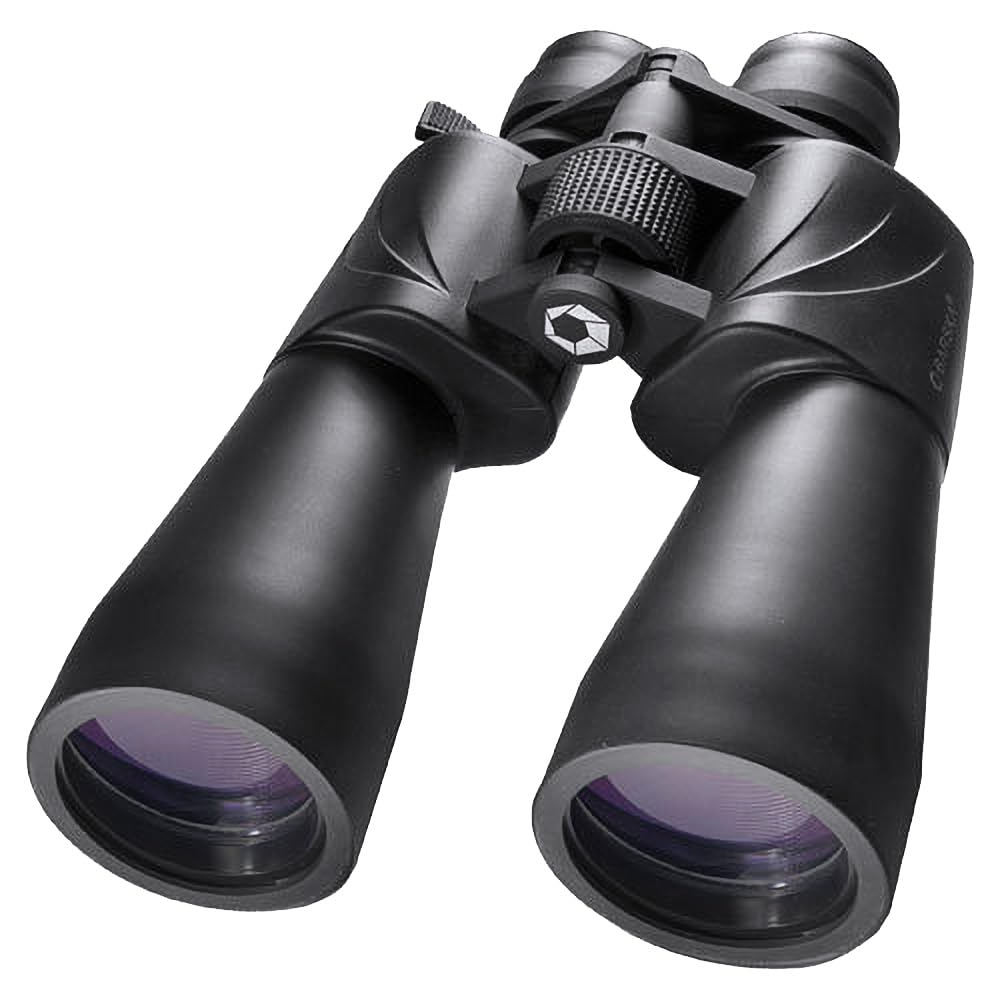
Aworan 1.1: Iwaju view of the BARSKA Escape Porro 10-30x60 Zoom Binoculars.
2. Ọja Ipariview
2.1 irinše
The BARSKA Escape Porro 10-30x60 Zoom Binoculars include the following main components:
- Awọn lẹnsi Idi: The large front lenses that gather light.
- Awọn oju oju: Ibi ti o wo nipasẹ si view aworan.
- Central Focus Wheel: Used to adjust focus for both barrels simultaneously.
- Oruka Atunse Diopter: Located on the right eyepiece, used for fine-tuning focus to compensate for differences between your eyes.
- Lever Sisun: Adjusts the magnification level.
- Àtúnṣe Ìjìnnà Àárín-ẹ̀kọ́: The hinge mechanism that allows you to adjust the distance between the two barrels to match your eye spacing.
- Neck Strap Lugs: Attachment points for the included neck strap.
- Tripod Adapter Socket: A threaded socket for mounting the binoculars on a tripod (adapter sold separately).

Aworan 2.1: Oke view highlighting the central focus wheel and zoom lever.

Image 2.2: Close-up of the eyepiece and focus wheel.
2.2 Key Awọn ẹya ara ẹrọ
- Ìfikún: 10-30x variable zoom.
- Opin Lẹnsi Idi: 60mm for enhanced light gathering.
- Iru Prism: Porro Prism for bright, clear images.
- Iru gilasi: BK-7 glass.
- Optics Coating: Multi-Coated for improved light transmission and image clarity.
- Armor: Durable rubber armor for protection and a secure grip.
- Eyecups: Fold-down eyecups for comfortable viewing with or without eyewear.
- Omi Resistance: Omi-sooro ikole.
- Tripod Adaptable: Can be mounted on a tripod for extended viewing igba.

Image 2.3: Key features of the binoculars.
3. Eto
3.1 Ṣíṣí àpò àti àwọn ohun èlò míìrán
Carefully remove the binoculars and all accessories from the packaging. Ensure the following items are present:
- BARSKA Escape Porro 10-30x60 Zoom Binoculars
- Okun Ọrun
- Ọran gbigbe
- Lens Caps (Objective and Eyepiece)
- Aṣọ Ninu Aṣọ

Image 3.1: Binoculars with included neck strap and carrying case.
3.2 Attaching the Neck Strap
- Thread the ends of the neck strap through the strap lugs on each side of the binocular body.
- Secure the strap by threading it back through the buckle, ensuring it is tight and will not slip.
- Adjust the strap length for comfortable carrying around your neck.
3.3 Adjusting Interpupillary Distance (IPD)
The interpupillary distance is the distance between the centers of your pupils. To adjust:
- Hold the binoculars with both hands and look through the eyepieces.
- Bend the binocular body at the hinge until you see a single, clear circular field of view.
- Note this setting for future use.
3.4 Diopter Atunse
This adjustment compensates for differences in vision between your left and right eyes.
- Close your right eye or cover the right objective lens.
- Look through the left eyepiece at a distant object. Rotate the central focus wheel until the image is sharp and clear.
- Close your left eye or cover the left objective lens.
- Look through the right eyepiece. Without touching the central focus wheel, rotate the diopter adjustment ring on the right eyepiece until the image is sharp and clear.
- Both eyes should now be in focus. The diopter setting can be left in this position for subsequent use unless another user adjusts it.
4. Awọn ilana Iṣiṣẹ
4.1 Idojukọ
After performing the initial diopter adjustment:
- Look through both eyepieces at your desired object.
- Rotate the central focus wheel until the image is sharp and clear for both eyes.
4.2 Sisun
To change the magnification:
- Locate the zoom lever on the right eyepiece.
- While observing, move the zoom lever to increase or decrease magnification.
- After changing the zoom, you may need to slightly re-adjust the central focus wheel for optimal clarity.
4.3 Eyecup Adjustment
The binoculars feature fold-down eyecups for comfortable viewing.
- For non-eyeglass wearers: Use the eyecups in the fully extended position to block out peripheral light and ensure proper eye relief.
- Fun awọn ti o wọ gilasi oju: Fold down the eyecups to bring your eyes closer to the eyepieces, allowing you to see the full field of view without your eyeglasses interfering.
4.4 Tripod iṣagbesori
Fún ìgbà pípẹ́ viewing or to stabilize the image at higher magnifications, the binoculars can be mounted on a tripod.
- Locate the tripod adapter socket, usually found under a cap at the front of the central hinge.
- Yọ fila naa kuro.
- Screw a compatible tripod adapter (sold separately) into the socket.
- Attach the tripod adapter to your photographic tripod.
5. Itọju
5.1 Cleaning tojú
Proper lens cleaning is crucial to maintain optical performance.
- First, use a soft brush or compressed air to remove any loose dust or debris from the lens surfaces.
- If further cleaning is needed, apply a small amount of lens cleaning fluid to a clean, soft microfiber lens cloth.
- Gently wipe the lens surface in a circular motion. Avoid excessive pressure.
- Do not use abrasive cloths, paper towels, or household cleaners, as these can scratch or damage the lens coatings.
5.2 Gbogbogbo Itọju ati Ibi ipamọ
- Always replace lens caps when the binoculars are not in use to protect the lenses from dust and scratches.
- Store the binoculars in their carrying case in a cool, dry place, away from direct sunlight and extreme temperatures.
- Avoid dropping or subjecting the binoculars to harsh impacts, as this can misalign the optics.
- The rubber armor provides a degree of protection and grip; keep it clean by wiping with a damp asọ ti o ba wulo.
- While water-resistant, avoid submerging the binoculars in water. If they get wet, wipe them dry immediately.
6. Laasigbotitusita
If you encounter issues with your binoculars, refer to the following common problems and solutions:
| Isoro | Owun to le Fa | Ojutu |
|---|---|---|
| Aworan jẹ blurry tabi ko ni idojukọ. | Incorrect focus adjustment; diopter not set correctly; zoom level too high for conditions. | Adjust the central focus wheel. Re-perform diopter adjustment (Section 3.4). Reduce zoom magnification. |
| Two overlapping images or difficulty merging images. | Interpupillary distance (IPD) is incorrect. | Adjust the binocular body at the hinge until a single circular field of view is seen (Section 3.3). |
| Difficulty focusing at higher zoom levels (e.g., 20x or 30x). | Atmospheric conditions (heat haze); natural hand-shake at high magnification; optical limitations. | Use a tripod for stability. Try focusing on a closer object first, then fine-tune for the distant object. High magnification can be more sensitive to environmental factors. |
| Central focus wheel or zoom lever is stiff or stuck. | Internal mechanism issue; dirt or debris. | Do not force the mechanism. Contact customer support for assistance. Avoid attempting to disassemble the binoculars. |
| Reduced image brightness or clarity. | Dirty lenses; low light conditions; damaged lens coatings. | Clean lenses as per Section 5.1. Ensure viewing in adequate light. If coatings are damaged, contact support. |
7. Awọn pato
The following are the technical specifications for the BARSKA Escape Porro 10-30x60 Zoom Binoculars (Model AB11050):
- Brand: Barska
- Orukọ awoṣe: AB11050
- Ìfikún: 10-30x
- Opin Lẹnsi Idi: 60 mm
- Iru Prism: Porro Prism
- Opin-Akẹẹkọ Jade: 2 mm (at 30x)
- Aso: Olona-Ti a bo
- Ipele Resistance Omi: Omi sooro
- Iru Idojukọ: Manual Focus (Fixed Focus, Individual Focus)
- Ibiti Atunse Diopter: +/- 3 diopters
- Aaye ti View: 144 Meters (at 1000m)
- Imọ-ẹrọ Imọlẹ Kekere: Bẹẹni
- Àwọ̀: Dudu
- Ohun elo Apoti: Roba
- Ìwọ̀n Nkan: 40.8 iwon
- Awọn eroja to wa: Unit, Instruction Guide
- UPC: 658240292930
8. Atilẹyin ọja ati Support
8.1 atilẹyin ọja Alaye
For detailed warranty information regarding your BARSKA Escape Porro 10-30x60 Zoom Binoculars (AB11050), please refer to the official Barska manufacturer's website or the warranty card included with your product. Warranty terms and conditions may vary.
8.2 Onibara Support
If you require technical assistance, have questions about product operation, or need to inquire about repairs, please contact Barska customer support directly. Contact information can typically be found on the manufacturer's webaaye tabi ni apoti ọja.
Olupese: Barska
Webojula: Visit the Barska Store on Amazon (Fun alaye gbogbogbo nipa ọja naa)