
1. Ifihan
The SMARTGEN HAT600PBI Series Dual Power Synchronous ATS Controller is an advanced, intelligent module designed for automatic transfer systems. It integrates programmable functions, automatic measurement, an LCD display, and digital communication capabilities. This controller combines digitalization, intelligence, and networking to provide reliable and precise dual power transfer, minimizing operational errors. It is suitable for various power supply configurations including Mains-Mains, Mains-Gen, Gen-Gen, and supports PC, CB, and CC class ATS applications, ensuring synchronous transfer between two power sources. Its compact design, sophisticated circuitry, straightforward wiring, and high reliability make it ideal for diverse applications in sectors such as electric power, telecommunications, petroleum, and intelligent buildings.
2. Key Awọn ẹya ara ẹrọ
- LCD 132x64 pixel display with backlight, supporting multiple languages (Simplified Chinese, English, Other), operated via push buttons.
- Configurable system types: Mains (1#) & Mains (2#), Mains (1#) & Generator (2#), Generator (1#) & Mains (2#), Generator (1#) & Generator (2#).
- Master power source selection (S1 or S2) with options for Auto Transfer Auto Recover and Auto Transfer Non Recover.
- Measures and displays 2-way 3-phase Voltage, Frequency, and Phase Sequence Status.
- Collects and displays load active power, reactive power, apparent power, power factor, and current.
3. Ọja Ipariview
The HAT600PBI controller features a user-friendly interface for monitoring and control.
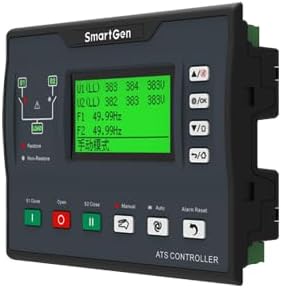
olusin 3.1: Iwaju View of HAT600PBI Controller. This image displays the front panel of the HAT600PBI controller, featuring an LCD screen that shows voltage and frequency readings, along with various control buttons for operation and navigation. The buttons include 'Close', 'Open', 'Manual', 'Auto', and 'Alarm Reset'.
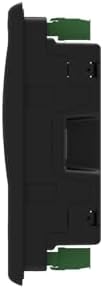
olusin 3.2: Apa View of HAT600PBI Controller. Àwòrán yìí fi hàn pé ẹ̀gbẹ́ profile of the HAT600PBI controller, highlighting its compact design and mounting features.

olusin 3.3: Ẹyìn View of HAT600PBI Controller. This image shows the rear panel of the HAT600PBI controller, detailing the numerous connection terminals for inputs, outputs, power supply, current monitoring, as well as USB and Ethernet communication ports.
4. Eto ati fifi sori
Installation of the HAT600PBI controller should be performed by qualified personnel. Ensure all local electrical codes and safety regulations are followed.
4.1 Iṣagbesori
Mount the controller in a suitable enclosure, ensuring adequate ventilation and protection from environmental factors. Refer to the physical dimensions for proper panel cutout.
4.2 Electrical Awọn isopọ
Connect the following to the appropriate terminals on the rear of the controller (refer to Figure 3.3 and Section 6 for detailed wiring diagrams):
- Ibi ti ina elekitiriki ti nwa: Connect the DC and AC power inputs.
- Voltage Awọn igbewọle: Connect the 2-way 3-phase voltage inputs for S1 and S2.
- Àwọn Ìwọ̀sí Lọ́wọ́lọ́wọ́: Connect current transformers (CTs) for load current monitoring.
- Awọn abajade Iṣakoso: Connect to the ATS switching mechanisms (e.g., circuit breakers, contactors).
- Awọn igbewọle Iranlọwọ/Awọn abajade: Connect any required auxiliary signals.
- Awọn ibudo Ibaraẹnisọrọ: Connect RS485, USB, or Ethernet cables for remote monitoring and configuration.
Ensure all connections are secure and correctly polarized. Incorrect wiring can damage the unit or connected equipment.
5. Awọn ilana Iṣiṣẹ
The HAT600PBI controller is designed for intuitive operation via its front panel LCD and push buttons.
5.1 Agbara Lori
Once all electrical connections are complete and verified, apply power to the controller. The LCD will illuminate and display the initial startup screen, followed by real-time system status.
5.2 Lilọ kiri lori Akojọ aṣayan
Use the navigation buttons (typically Up/Down arrows and OK/Enter) to scroll through menus and confirm selections. The LCD provides clear prompts for various settings and monitoring screens.
5.3 System iṣeto ni
Access the system settings menu to configure parameters such as:
- Iru eto: Select between Mains-Mains, Mains-Gen, Gen-Mains, or Gen-Gen based on your power sources.
- Master Power Source: Designate S1 or S2 as the primary power source.
- Ipo Gbigbe: Choose between Auto Transfer Auto Recover (ATAR) or Auto Transfer Non Recover (ATNR) based on desired behavior after power restoration.
- Èdè: Select the preferred display language.
Save all changes before exiting the configuration menu.
5.4 Monitoring Parameters
The controller continuously monitors and displays critical parameters:
- Voltage (L-L, L-N) for both S1 and S2.
- Frequency for both S1 and S2.
- Phase Sequence Status.
- Load Active Power, Reactive Power, Apparent Power, Power Factor, and Current.
Regularly check these values to ensure stable operation.
5.5 Manual Operation and Alarm Reset
Use the 'Manual' button to switch to manual control mode, allowing direct control of the transfer switches via 'Close' and 'Open' buttons. The 'Alarm Reset' button clears any active alarms displayed on the LCD.
6. Awọn aworan wiwa
Proper wiring is crucial for the safe and correct operation of the HAT600PBI controller. The following diagram illustrates typical application wiring. Always consult this diagram and any specific project documentation during installation.

Figure 6.1: Typical Application Wiring Diagrams. This comprehensive image provides multiple wiring diagrams for the HAT600PBI controller, detailing connections for different ATS configurations including SGG-N, SGG-M, Feiteng, Contactor, and Breaker applications. It shows connections for S1 and S2 power inputs, load, current inputs, and communication (RS485).
7. Itọju
Regular maintenance ensures the longevity and reliable operation of your HAT600PBI controller.
7.1 Iyẹwo nigbagbogbo
- Periodically inspect the controller for any visible damage, loose connections, or signs of overheating.
- Ensure the mounting is secure and free from excessive vibration.
- Check for dust accumulation, especially around ventilation openings.
7.2 Ninu
Use a soft, dry cloth to clean the exterior of the controller. Do not use abrasive cleaners or solvents. For internal cleaning, if necessary, disconnect power and use compressed air to remove dust.
7.3 famuwia imudojuiwọn
Check the SMARTGEN official website periodically for any available firmware updates. Follow the provided instructions carefully for any update procedures.
8. Laasigbotitusita
Apá yìí pèsè àwọn ìgbésẹ̀ ìṣàtúnṣe ìpìlẹ̀ fún àwọn ìṣòro tó wọ́pọ̀. Fún àwọn ìṣòro tó díjú, kan sí ìrànlọ́wọ́ ìmọ̀-ẹ̀rọ.
8.1 No Power to Controller
- Verify the DC and AC power supply connections are secure and providing the correct voltage.
- Check any external fuses or circuit breakers in the power supply circuit.
8.2 Incorrect Readings on LCD
- Rii daju voltage and current transformer (CT) connections are correct and securely fastened.
- Verify the CT ratios are correctly configured in the controller's settings.
- Ṣayẹwo awọn igbewọle voltage and frequency directly with a multimeter to compare against controller readings.
8.3 Automatic Transfer Failure
- Check the status of both power sources (S1 and S2) to ensure they are within acceptable parameters.
- Verify the system type and transfer mode settings are correctly configured.
- Inspect the control outputs and the connected ATS switching mechanisms for proper operation.
- Check for any active alarms that might be preventing transfer.
9. Awọn pato
| Paramita | Iye |
|---|---|
| Brand | SMARTGEN |
| Ohun elo | Irin |
| Iwọn Nkan | 0.8 kilo |
| Ifihan Iru | LCD |
| Awọn iwọn otutu ti nṣiṣẹ | Awọn iwọn Celsius 20 |
10. Atilẹyin ọja ati Support
For warranty information, technical support, or service inquiries, please contact your authorized SMARTGEN dealer or visit the official SMARTGEN website. Ensure you have your product model number (HAT600PBI) and purchase details available when seeking support.