
Ọrọ Iṣaaju
This manual provides detailed instructions for the assembly, operation, and maintenance of your Andonstar AD249S-Max 10.1-inch HDMI Digital Microscope. Designed for precision tasks such as electronics repair, soldering, and detailed observation of various specimens, this device offers high-resolution imaging and a versatile working environment. Please read this manual thoroughly before using the product to ensure proper function and longevity.
Ohun ti o wa ninu Apoti
Carefully unpack all components and verify that all items listed below are present. If any items are missing or damaged, please contact customer support.
- 10.1'' Microscope Monitor with Lens A (pre-installed)
- Lens L (for soldering and repairing)
- Lens D (for biological slides)
- Column and Metal Base
- Beam for stand assembly
- Dimu irin
- Soldering Helping Hands with rotatable clamps
- Soldering Mat
- Bottom Light Stage
- Slides Kit
- Observation Box
- Tweezers
- Isakoṣo latọna jijin
- 32GB Micro SD Kaadi
- Adapter agbara
- Yipada USB
- Okun USB
- Okun HDMI
- Itọsọna olumulo

Image: All components included with the Andonstar AD249S-Max digital microscope, laid out for inspection.
Ọja Awọn ẹya ara ẹrọ
Versatile 3-Lens System
- Lens L (60-240x): Optimized for soldering and repair work, providing a suitable working distance.
- Lens A (18-720x): Ideal for observing larger objects such as coins, plants, and stones.
- Lens D (1560-2040x): Designed for high-magnification viewing of biological slides.
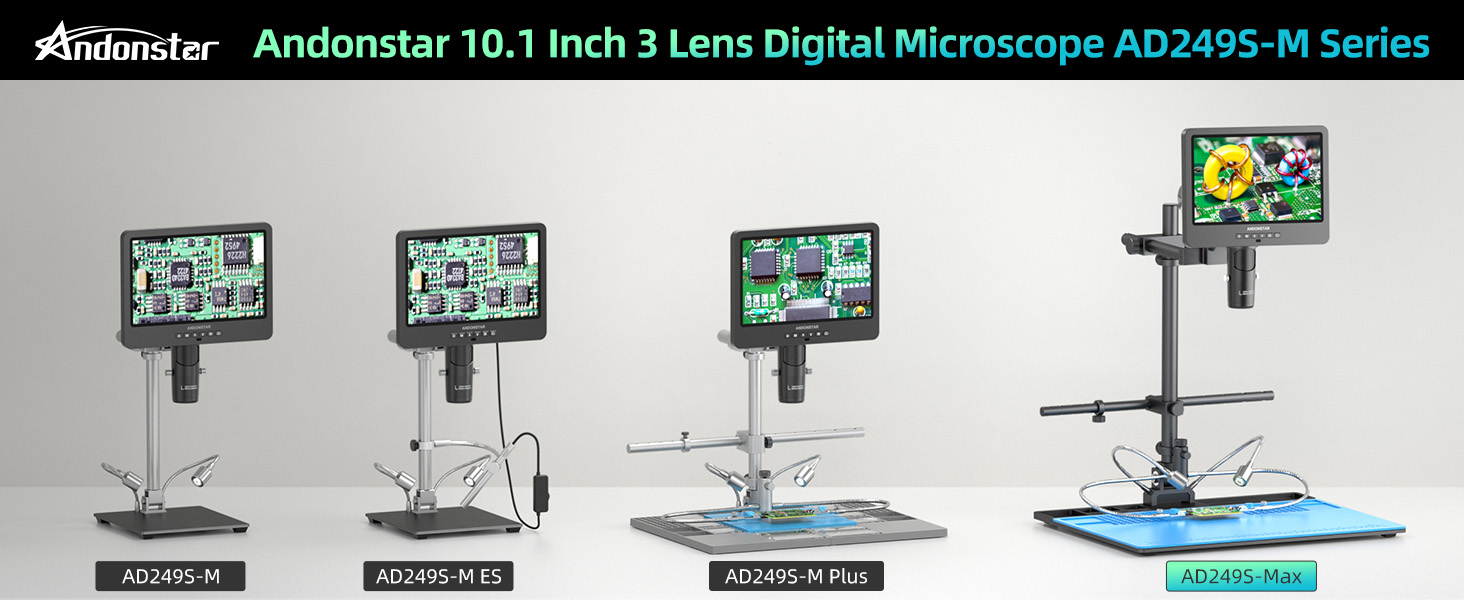
Image: An illustration of the three distinct lenses (L, A, D) and their recommended uses for various observation tasks.

Image: Visual comparison of 30x magnification (showing a coin) and 2000x magnification (showing a biological slide) as displayed on the microscope screen.
UHD 2160P Display and Output
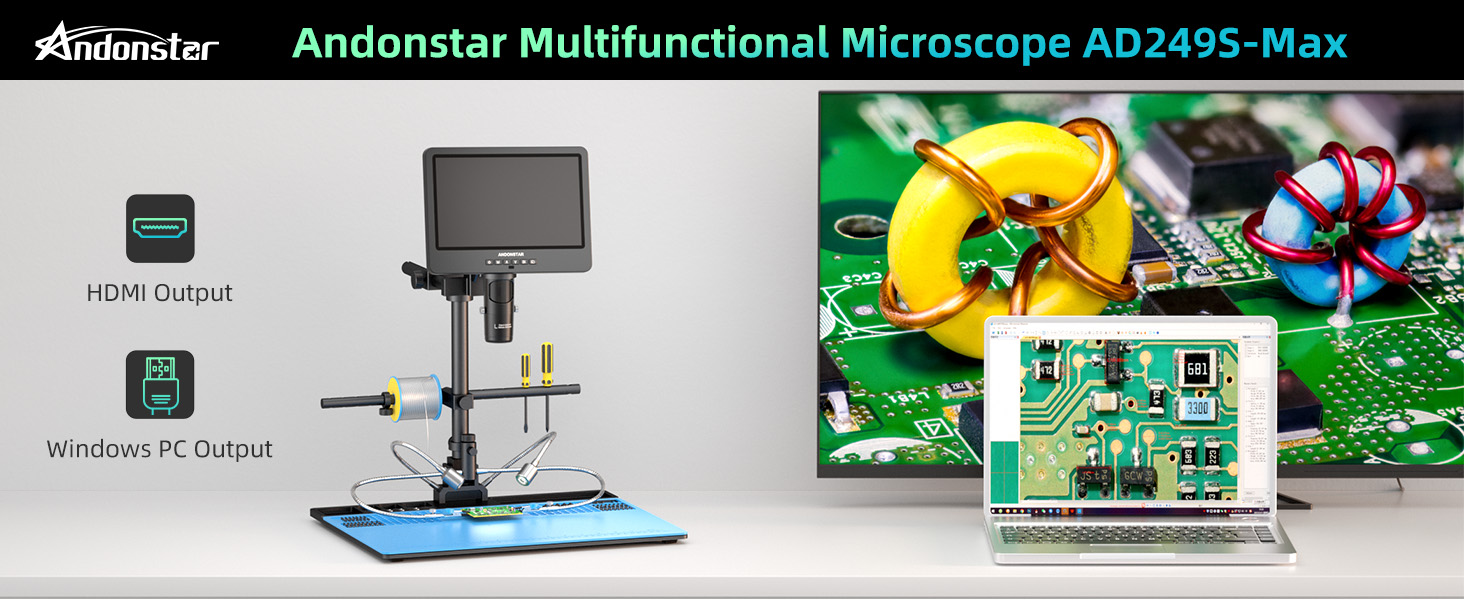
The microscope features a 10.1-inch LCD display for direct viewing. It supports ultra-high-definition 2160P video recording and offers HDMI output for seamless viewing on larger external screens, as well as USB output for PC connection.

Image: The microscope demonstrating its HDMI output to a large monitor and USB output to a laptop for PC software use.
Super Max Soldering Station
The AD249S-Max includes an upgraded oversized Max station, providing a significantly larger working area (370% increase compared to previous models). This station is equipped with a tool holder and flexible soldering helping hands with rotatable clamps, enhancing efficiency for professional soldering and repair tasks.
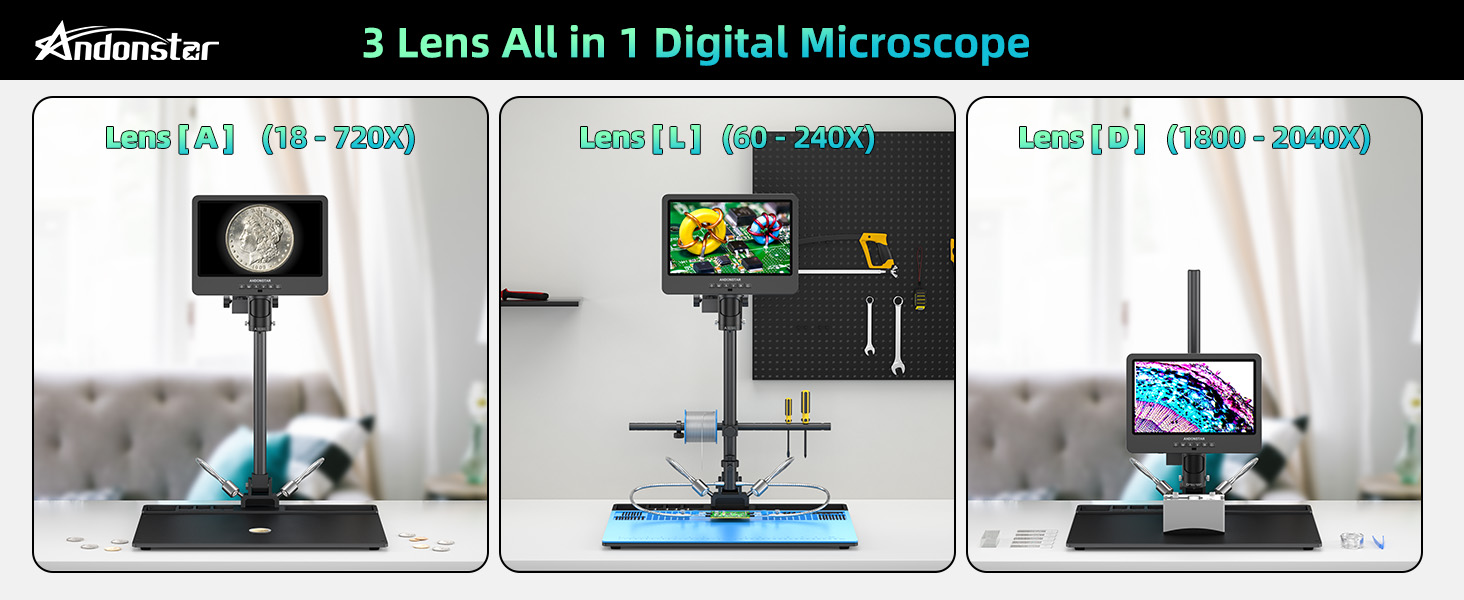
Image: A visual comparison illustrating the larger metal base area of the AD249S-Max soldering station compared to the standard AD249S-M.
Aworan: Alaye view of the integrated tool holder for easy access to tools and the flexible soldering helping hands with 360-degree rotatable clamps.
Awọn imọlẹ LED adijositabulu
Eight intensity levels of LED lighting are available to meet various image brightness requirements, ensuring optimal illumination for your observations.
Gbigbasilẹ Fọto ati Fidio
Capture and store images and videos of your micro-world observations directly onto the provided 32GB Micro SD card.
Ṣeto
Apejọ
- Attach the column to the metal base using the provided screws.
- Mount the microscope monitor assembly onto the column.
- Install the beam, tool holder, and soldering helping hands onto the column as desired for your workspace.
- Select the appropriate lens (L, A, or D) and screw it onto the microscope camera.
- Place the soldering mat onto the metal base.

Aworan: An loriview of the assembled microscope, highlighting its dimensions and the placement of components like the tool holder and soldering helping hands.
Adjusting the Boom Arm Stand
The innovative Max boom arm stand allows for 360-degree rotation and flexible adjustments in height and horizontal position. Use the bracket knob and thumb screws to secure the desired position for optimal viewing and working distance.

Image: Visual guide demonstrating the flexibility of the boom arm stand, including height, horizontal, and rotational adjustments.
Asopọ agbara
Connect the power adapter to the microscope and plug it into a suitable power outlet. Use the switch cable to power the device on or off.
Awọn ilana Iṣiṣẹ
Isẹ ipilẹ
- Titan/Apapa: Press the power button (1) on the monitor to turn the device on or off.
- Lilọ kiri akojọ aṣayan: Use the Mode/Menu button (2) to access settings and navigate through options.
- Fojusi: Rotate the focusing wheel on the microscope body to achieve a clear image.
- Ijinna Nkan: Rotate the bracket knob to adjust the distance between the lens and the object.
- Sun-un oni-nọmba: Use the Up/Down buttons (3, 4) to apply digital zoom to the image.
- Awọn imọlẹ LED ti n ṣatunṣe: Use the controls on the switch cable or remote to adjust the intensity of the LED lights.

Aworan: Iwaju ati ẹhin views of the microscope monitor, detailing the function of each button and port, including power, menu, zoom, SD card slot, USB, and HDMI.
Lens Exchange
To change lenses, carefully unscrew the currently installed lens from the microscope camera. Select the desired lens (L, A, or D) and screw it firmly into place. Ensure the lens is securely attached before operation.
Yiya Awọn fọto ati awọn fidio
Insert the provided 32GB Micro SD card into the SD card slot (10). Use the 'Take pictures' button (6) for still images or the 'OK/Start recording' button (5) to begin and end video recording. Captured media will be saved to the SD card.
Awọn iṣẹ iṣakoso latọna jijin
The remote control allows for convenient operation from a distance. Functions include image discoloration, digital zoom, and other menu navigations. Point the remote towards the remote signal receiver (7) on the monitor.
PC Connection and Measurement Software
To connect the microscope to a Windows PC and utilize the professional measurement software:
- Download and install the 'Microscope Measure' software from the official Andonstar website according to the provided instructions.
- Connect the microscope to your computer using the separate USB cable (not the one with the dimmer).
- On the microscope screen, when the mode box pops up, press the 'Down' and 'OK' buttons to select 'PC Camera'.
- Open the 'Microscope Measure' software on your PC, select 'Device', and then choose 'USB Camera' to display the image and access measurement, photo, and video capture functions.

Image: Step-by-step instructions for connecting the microscope to a Windows PC and using the 'Microscope Measure' software.
HDMI Ijade
Connect the provided HDMI cable from the microscope's HDMI port (12) to an HDMI input on a larger monitor or TV for an expanded view of your observations.
Itoju
- Keep the lenses clean using a soft, lint-free cloth specifically designed for optical surfaces. Avoid abrasive materials.
- Ṣe mimọ iboju atẹle nigbagbogbo pẹlu asọ ti o gbẹ.
- Store the microscope in a dry, dust-free environment when not in use.
- Rí i dájú pé gbogbo àwọn ìsopọ̀ wà ní ààbò ṣùgbọ́n má ṣe fi àwọn skru dí i jù.
Laasigbotitusita
- Ko si Agbara: Check if the power adapter is securely connected and the switch cable is turned on. Ensure the power outlet is functional.
- Ko si aworan loju iboju: Verify that the lens is correctly installed and the microscope is powered on. Adjust focus and object distance.
- Aworan blurry: Rotate the focusing wheel and adjust the bracket knob to find the optimal focus and working distance for the selected lens. Ensure the lens is clean.
- PC Software Connection Issues: Ensure you are using the correct USB cable (not the dimmer cable). Confirm 'PC Camera' mode is selected on the microscope. If installation issues arise, check your PC's security settings or firewall, as some systems may block executable files lati awọn orisun aimọ.
- Iṣakoso Latọna jijin Ko Dahun: Check the battery in the remote control. Ensure there are no obstructions between the remote and the microscope's IR receiver.
Awọn pato
| Ẹya ara ẹrọ | Ẹ̀kúnrẹ́rẹ́ |
|---|---|
| Orukọ awoṣe | AD249S-Max |
| Iwọn Ifihan | 10.1 inches |
| Ipinnu fidio | 2160P UHD |
| Magnification (on 28-inch HDMI monitor) | Lens A: 18-720x, Lens D: 1800-2040x, Lens L: 60-240x |
| Awọn aṣayan Ijade | HDMI, USB (PC) |
| Imọlẹ Orisun Orisun | LED (8 intensity levels) |
| Ibi ipamọ | Micro SD Card (up to 32GB included) |
| Ọja Mefa | 18.1"L x 14.6"W x 18.7"H |
| Iwọn Nkan | 1.13 ounces (microscope unit) |
| Ohun elo | Metal stand, various components |
Atilẹyin ọja ati Support
Andonstar provides professional after-sales service. For any inquiries, technical assistance, or support needs, please contact our customer service team. While specific warranty details are not provided in this manual, please refer to your purchase documentation or the official Andonstar webaaye fun alaye atilẹyin ọja.