
1. Alaye Aabo
Always prioritize safety when operating the paint sprayer. Failure to follow safety guidelines can result in injury or damage to the equipment.
- Wear appropriate protective gear, including gloves and safety goggles, during operation.
- Ensure adequate ventilation in the work area to prevent inhalation of paint fumes.
- Keep the sprayer away from heat sources, open flames, and sparks.
- Do not spray flammable materials near ignition sources.
- Always disconnect the battery before cleaning, maintenance, or when the sprayer is not in use.
- Follow local regulations for the proper disposal of used paint and cleaning materials.
- Pa awọn ọmọde ati awọn ohun ọsin kuro ni agbegbe iṣẹ.
2. Package Awọn akoonu
Verify that all items are present in the package before initial use:
- 1 x Cordless Paint Sprayer
- 2 x 21V 4.0Ah Litiumu-Ion Batiri
- 1 x Ṣaja Batiri
- 5 x Copper Nozzles (1.0mm, 1.5mm, 1.8mm, 2.0mm, 2.5mm; one pre-installed)
- 10 x Paint Filter Papers
- 1 x Ife Viscosity
- 1 x Abẹrẹ Mimọ
- 1 x Fẹlẹ ifọṣọ
- 1 x Itọsọna olumulo
- 1 x bata ti ibọwọ
3. Ọja Ipariview
The Huanyu Cordless Paint Sprayer is designed for efficient paint application on various surfaces. Its cordless design offers flexibility, and the adjustable settings allow for precise control over spray patterns and flow rates.

Image: Huanyu Cordless Paint Sprayer with two 21V 4.0Ah batteries, showing the main unit and power source.
4. Eto
4.1 Gbigba agbara batiri
Before first use, fully charge both 21V 4.0Ah Lithium-Ion batteries. A fully charged battery can support spraying approximately 10 pots of paint.
- So ṣaja pọ si iṣan agbara kan.
- Insert the battery into the charger. The indicator light on the charger will show red during charging.
- Ni kete ti o ba ti gba agbara ni kikun, ina atọka yoo tan alawọ ewe.
- Remove the battery from the charger once charging is complete.

Image: Two 21V 4.0Ah batteries, highlighting their power capacity.
Video: Demonstrates charging the battery and indicator light status (red for charging, green for full).
4.2 Paint Preparation
Proper paint viscosity is crucial for optimal spraying performance and to prevent blockages. Use the included viscosity cup to measure and adjust paint thickness.
- Pour paint into the viscosity cup and time how long it takes for the paint to flow out.
- Refer to the paint manufacturer's recommendations for appropriate viscosity. If the paint is too thick, dilute it with the recommended thinner (water for water-based paints, mineral spirits for oil-based paints).
- Use the provided paint filter papers to filter out any impurities or clumps from the paint before pouring it into the sprayer's container. This prevents nozzle blockages.
Video: Shows the process of measuring paint viscosity and filtering out impurities using the provided tools.
4.3 Apejọ
The sprayer body is detachable for easy assembly and cleaning.
- Ensure the suction pipe is correctly inserted into the container.
- Attach the container with the prepared paint firmly to the sprayer unit.
- Select the appropriate nozzle for your paint type and desired spray pattern (see section 5.3).
- Attach the chosen nozzle and cap nut securely to the sprayer head.
- Insert a charged battery into the battery slot until it clicks into place, ensuring a tight connection for proper contact.
5. Awọn ilana Iṣiṣẹ
Familiarize yourself with the controls before beginning your project.
5.1 Ṣíṣe àtúnṣe àwọn ìlànà ìfọ́nrán
The sprayer offers three adjustable spray patterns: horizontal, vertical, and circular. Rotate the air cap to switch between patterns.
- Horizontal (180°): Ideal for spraying wider surfaces, such as fences or large walls.
- Vertical (90°): Suitable for spraying taller objects or narrow surfaces.
- Circular (45°): Best for small areas, corners, or detailed work.

Image: Illustration of the three available spray patterns: vertical, horizontal, and circular, achieved by rotating the air cap.
5.2 Adjusting Spray Volume and Length
Control the paint flow rate and spray length using the adjustment knobs on the sprayer.
- Spray Volume Adjustment: Turn the knob to increase or decrease the amount of paint sprayed.
- Atunse Gigun Sokiri: Adjust this knob to control the width or length of the spray pattern.

Aworan: Isunmọ view of the sprayer showing the knobs for adjusting spray volume and spray length.
5.3 nozzle Yiyan
The sprayer comes with five copper nozzles of different sizes (1.0mm, 1.5mm, 1.8mm, 2.0mm, 2.5mm) to accommodate various paint types and project requirements.
- 1.0mm / 1.5mm: Suitable for dilution atomization spraying, such as solutions.
- 1.8mm / 2.0mm: Recommended for high atomization spraying, including general paints and topcoats.
- 2.5mm: Best for primers and latex paints, which are typically thicker.

Image: A selection of five durable copper nozzles, each with a different diameter for varied spray applications.
5.4 Ohun elo Examples
The Huanyu Cordless Paint Sprayer is versatile for both indoor and outdoor projects, including:
- Awọn odi
- Awọn ilẹkun
- Awọn ohun-ọṣọ
- Awọn pẹtẹẹsì
- Awọn minisita
- Odi
- Awọn iṣẹ ọwọ
- Awọn ọja onigi
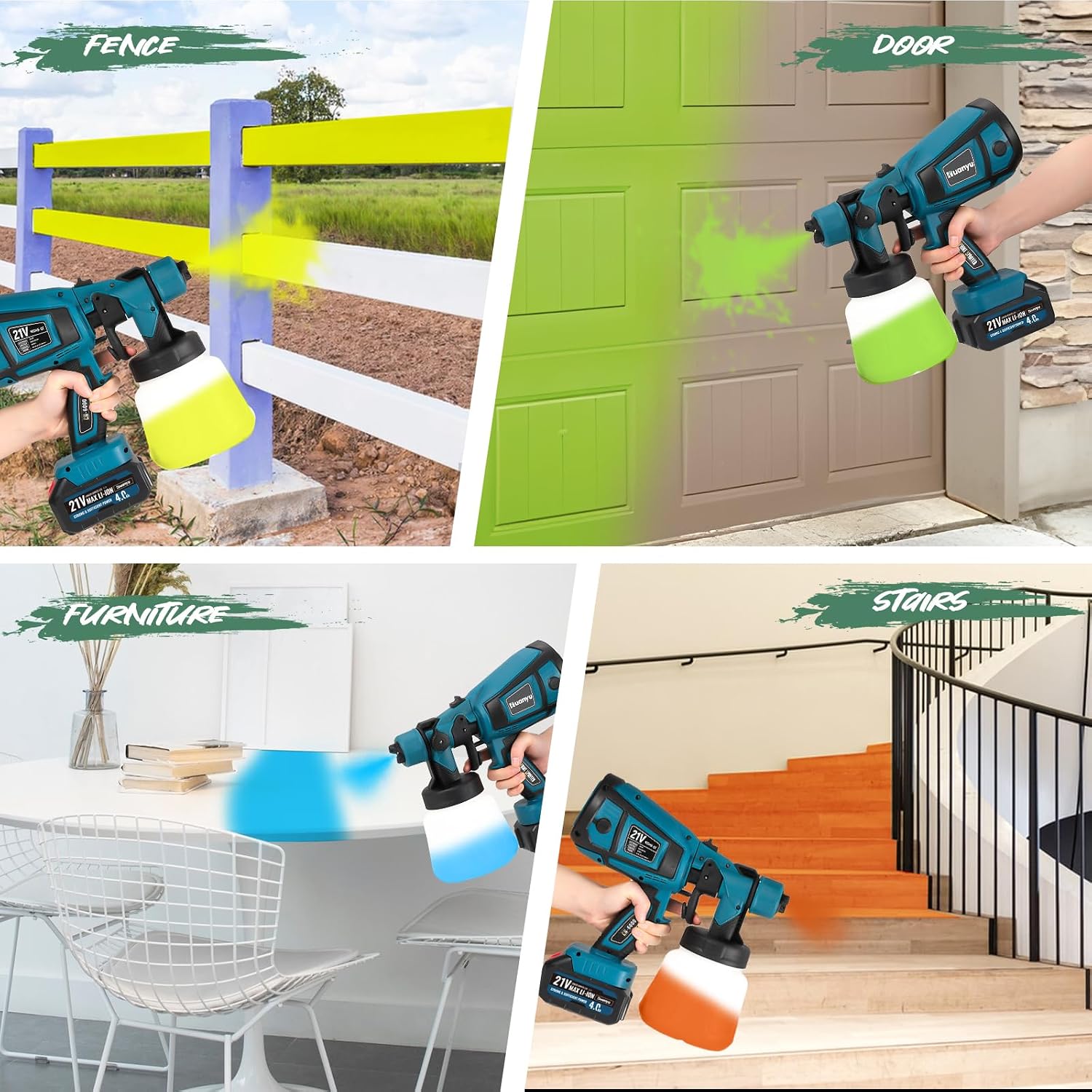
Aworan: Examples of the paint sprayer in use on various surfaces such as a fence, door, furniture, and stairs.
Video: Demonstrates the paint sprayer in action, showing its application on different surfaces and the ease of use.
6. Itọju
Thorough cleaning after each use is essential to prevent paint residue buildup and ensure the longevity and proper functioning of your sprayer.
6.1 Cleaning Ilana
- Disconnect the battery from the sprayer.
- Empty any remaining paint from the container.
- Disassemble the sprayer components: remove the container, nozzle, and air cap.
- Clean all disassembled parts with warm soapy water for water-based paints, or appropriate solvent for oil-based paints.
- Use the provided cleaning needle to clear any blockages in the nozzle and the small hole on the suction pipe.
- Use the cleaning brush to scrub paint residue from all surfaces.
- Rinse all parts thoroughly with clean water and allow them to dry completely before reassembly or storage.

Image: The paint sprayer disassembled into its main components, demonstrating its detachable design for easy cleaning.
Video: Shows how to clean the sprayer components, including clearing blockages in the nozzle and suction pipe.
7. Laasigbotitusita
Refer to this section for solutions to common issues encountered during operation.
| Isoro | Owun to le Fa | Ojutu |
|---|---|---|
| Insufficient Battery Power | Batiri ko gba agbara ni kikun. | Fully charge the battery before use. Ensure the charger indicator turns green. |
| Atomization Dispersion, Large Spray Particles | Paint viscosity is too high or impurities are present. | Measure paint viscosity and dilute if necessary. Filter out impurities using paint filter paper. |
| Less Paint Sprayed / No Spray | Suction pipe or nozzle is blocked. | Check if the suction pipe is blocked and clear it with the cleaning needle. Check if the nozzle is blocked and clear it. Ensure the small hole on the pipe is not blocked. |
| Sprayer kò tan | Battery not properly connected or discharged. | Ensure the battery is fully charged and firmly inserted. |
Video: Provides visual guidance for troubleshooting common issues like insufficient battery power, poor atomization, and blockages.
8. Awọn pato
Key technical details of the Huanyu Cordless Paint Sprayer:
- Brand: Huanyu
- Orukọ awoṣe: CN6000 (LXR-59-YYT)
- Orisun Agbara: Agbara Batiri
- Iru Batiri: 21V Max Li-Ion, 4.0Ah (2 batteries included)
- Iwọn ojò: 900 onigun centimeters
- Nozzles: 5 Copper Nozzles (1.0/1.5/1.8/2.0/2.5mm)
- Awọn ilana fun sokiri: 3 (Horizontal, Vertical, Circular)
- Ohun elo: Irin, Ṣiṣu
- Awọn iwọn ọja: 7.87"W x 10.24"H
- Ìwọ̀n Nkan: 5.26 iwon