
XTUGA IEM1100
XTUGA IEM1100 In-Ear Monitor System User Afowoyi
Awoṣe: IEM1100
Ọrọ Iṣaaju
Thank you for choosing the XTUGA IEM1100 UHF Single Channel In-Ear Monitor System. This manual provides comprehensive instructions for setting up, operating, and maintaining your new in-ear monitor system. Please read this manual thoroughly before using the product to ensure proper function and to maximize its performance and longevity.
Awọn iṣọra Aabo
Lati rii daju pe iṣẹ naa jẹ ailewu ati ti o dara julọ, tẹle awọn iṣeduro wọnyi:

Image: Text outlining important safety precautions for the in-ear monitor system.
- Please use in a ventilated environment, away from fire.
- Avoid contact with water when using the product.
- If the product is wireless, keep away from other interference sources.
- Please do not disassemble the equipment yourself. In case of problems, please contact us.
- Use the standard power supply if the device requires power supply. High voltage le ba ẹrọ naa jẹ.
- Do not use sharp objects to scratch the shell and surface of the device.
Ọja Pariview
Awọn ẹya ara ẹrọ eto

Image: The complete XTUGA IEM1100 In-Ear Monitor System, including the main transmitter unit, the portable belt-pack receiver, and in-ear headphones.
The XTUGA IEM1100 system includes the following main components:
- Ẹka Atagba: The main unit that sends the audio signal wirelessly.
- Belt-Pack Receiver: A portable receiver worn by the performer, which receives the audio signal.
- Awọn Agbekọri Ninu-Eti: For monitoring the audio signal from the receiver.
- Adapter agbara: For powering the transmitter unit.
- Eriali: Fun ifihan agbara alailowaya gbigbe ati gbigba.
- Awọn okun Olohun: For connecting audio sources to the transmitter.
- Ọran Ti N gbe: For convenient storage and transport of the system.
Detailed Component Views

Aworan: Alaye view of the transmitter unit, showing the LCD display, earphone output, volume knob, setting keys, power switch, DC power supply input, left and right channel inputs, and antenna interface.
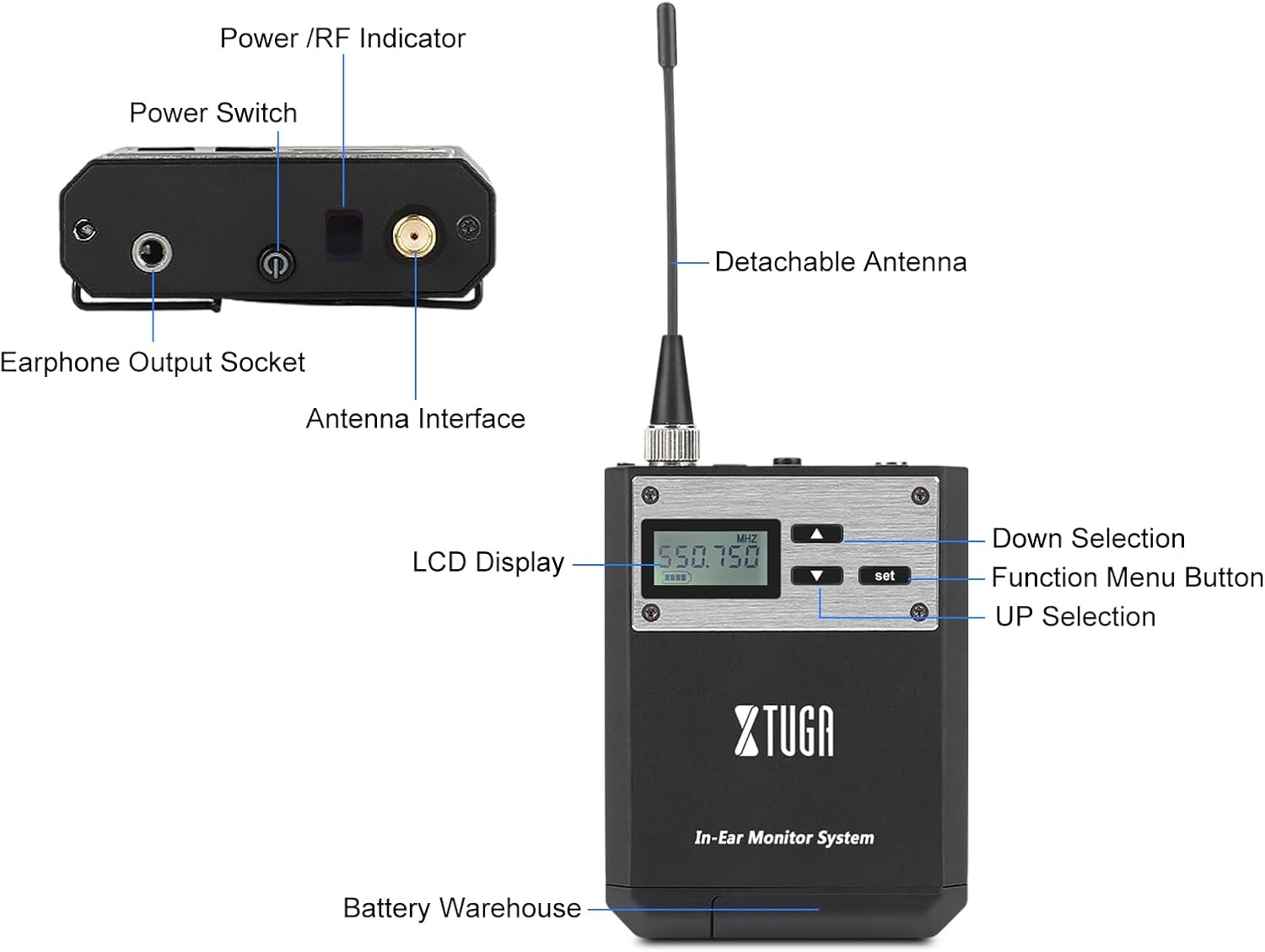
Aworan: Alaye view of the belt-pack receiver, highlighting the LCD display, power/RF indicator, power switch, earphone output socket, antenna interface, and battery compartment.
Key Awọn ẹya ara ẹrọ
- Whole Metal UHF Wireless System: Utilizes UHF band Phase Lock PLL technology with 40 selectable frequencies within a 32MHz band for flexible operation.
- Compact and Wireless Design: Offers tabletop stage monitoring with a wireless range of up to 250 feet (approx. 75 meters) and a frequency range of 550MHz-580Mhz. Designed to improve signal-to-noise ratio and dynamic range for optimal sound quality.
- Ìfihàn Ọ̀rẹ́ oníṣe: Features a clear digital LCD front panel display on the receiver for easy monitoring, along with power and RF receiving indicator lamps.
- Agbara to munadoko: The belt-pack receiver uses two AA batteries with an efficient power circuit for long service time.
- Ibamu Alagbara: One transmitter can connect to multiple receivers, making it suitable for group performances and various applications.
- Ikole ti o tọ: The housing is made from tough metal material, ensuring system strength and reliability.

Image: The brushed metal construction of the system, highlighting its durable and premium build quality.

Image: Illustration of the system's anti-interference capabilities, ensuring stable signal transmission even in challenging environments.

Image: A visual representation of the system's long-distance transmission capability, reaching up to 75 meters.

Image: Diagram illustrating the auto-choose frequency function, allowing users to freely select from 40 available frequencies for optimal signal clarity.
Eto Itọsọna
Tẹle awọn igbesẹ wọnyi lati ṣeto eto XTUGA IEM1100 rẹ:
- Connect Power and Antenna to Transmitter:
Connect the provided power adapter to the DC input on the rear of the transmitter unit. Screw the antenna securely into the antenna interface on the rear of the transmitter.
- Agbara Lori Atagba:
Press the power button on the front panel of the transmitter to turn it on. The LCD display will illuminate.
- Fi Awọn Batiri sinu Olugba:
Open the battery compartment on the belt-pack receiver and insert two AA batteries, ensuring correct polarity.
- Connect Antenna and Earphones to Receiver:
Screw the small antenna onto the antenna interface of the belt-pack receiver. Plug your in-ear headphones into the earphone output socket on the receiver.
- So ìdìpọ̀ ìgbànú mọ́ (Àṣàyàn):
For greater stability and convenience, attach the elastic back clip to the receiver.
Visual Setup Guide
Video: A comprehensive guide demonstrating the setup and basic operation of the XTUGA IEM1100 In-Ear Monitor System, including power connection, antenna installation, battery insertion, and earphone connection.
Awọn ilana Iṣiṣẹ
Ni kete ti eto ti ṣeto, tẹle awọn igbesẹ wọnyi fun iṣẹ:
- Adjusting Frequencies:
Both the transmitter and receiver allow for frequency adjustment. Use the "UP" and "DOWN" selection buttons on the units to cycle through the 40 available frequencies. Ensure both the transmitter and receiver are set to the same frequency for proper communication.
- Iṣatunṣe Iwọn didun:
On the transmitter, use the earphone volume knob to adjust the monitoring level for connected headphones. On the belt-pack receiver, use the volume controls to set your desired listening level for the in-ear headphones. There are 20 adjustable capacity gears for precise volume control.
- Nsopọ Orisun Olohun:
Connect your audio source (e.g., mixing console, instrument) to the Left Channel Input and Right Channel Input (XLR/TRS combo jacks) on the rear of the transmitter unit using appropriate audio cables.
- Ohun Abojuto:
With the audio source playing and both units powered on and tuned to the same frequency, you should hear the audio through your in-ear headphones connected to the receiver.
Laasigbotitusita
Ti o ba pade awọn ọran pẹlu eto XTUGA IEM1100 rẹ, tọka si awọn iṣoro ati awọn solusan ti o wọpọ wọnyi:
| Isoro | Owun to le Fa | Ojutu |
|---|---|---|
| Ko si ohun lati olugba. |
|
|
| kikọlu tabi aimi. |
|
|
| Ohùn tí kò pọ̀ tàbí tí kò dún dáadáa. |
|
|
If the problem persists, please contact XTUGA customer support for assistance.
Awọn pato
| Ẹya ara ẹrọ | Ẹ̀kúnrẹ́rẹ́ |
|---|---|
| Brand | XTUGA |
| Nọmba awoṣe | IEM1100 |
| Imọ-ẹrọ Ibaraẹnisọrọ Alailowaya | RF (UHF band) |
| Iwọn Igbohunsafẹfẹ | 550MHz-580Mhz (approx.) |
| Awọn Igbohunsafẹfẹ yiyan | 40 (within 32MHz band) |
| Alailowaya Ibiti | Titi di 250 ẹsẹ (isunmọ 75 mita) |
| Orisun Agbara olugba | 2 x AA batiri |
| Orísun Agbára Olùgbéjáde | DC 12V-18V |
| Gbigbe Eti | Ninu Eti |
| Fọọmù ifosiwewe | Ninu Eti |
| Package Mefa | 37 x 34 x 10 cm |
| Iwọn Nkan | 2.2 kg |
Atilẹyin ọja ati Support
Awọn ọja XTUGA jẹ apẹrẹ fun igbẹkẹle ati iṣẹ ṣiṣe. Fun alaye nipa agbegbe atilẹyin ọja, atilẹyin imọ-ẹrọ, tabi awọn ibeere iṣẹ, jọwọ tọka si kaadi atilẹyin ọja ti o wa pẹlu ọja rẹ tabi ṣabẹwo si XTUGA osise website. You can also contact XTUGA customer service directly for assistance.
Fun awọn ọja ati alaye diẹ sii, ṣabẹwo si Ile itaja XTUGA lori Amazon.
Ask a question about this manual
Ask about setup, troubleshooting, compatibility, parts, safety, or missing instructions. Manuals+ will review the question and use this page’s manual context to help answer it.