
1. Ifihan
Thank you for choosing the johgee 3-Zone Watering Timer. This device is designed to automate your garden, lawn, or greenhouse irrigation, providing precise and efficient watering. With three independent outlets, you can customize watering schedules for different areas without interference. This manual provides detailed instructions for installation, programming, operation, and maintenance to ensure optimal performance and longevity of your watering timer.
The johgee 3-Zone Watering Timer is ideal for various applications including drip irrigation systems, sprinkler controllers, and pond filling. Its robust design features a brass material interface and IPX5 waterproofing for durability and reliability in outdoor environments.
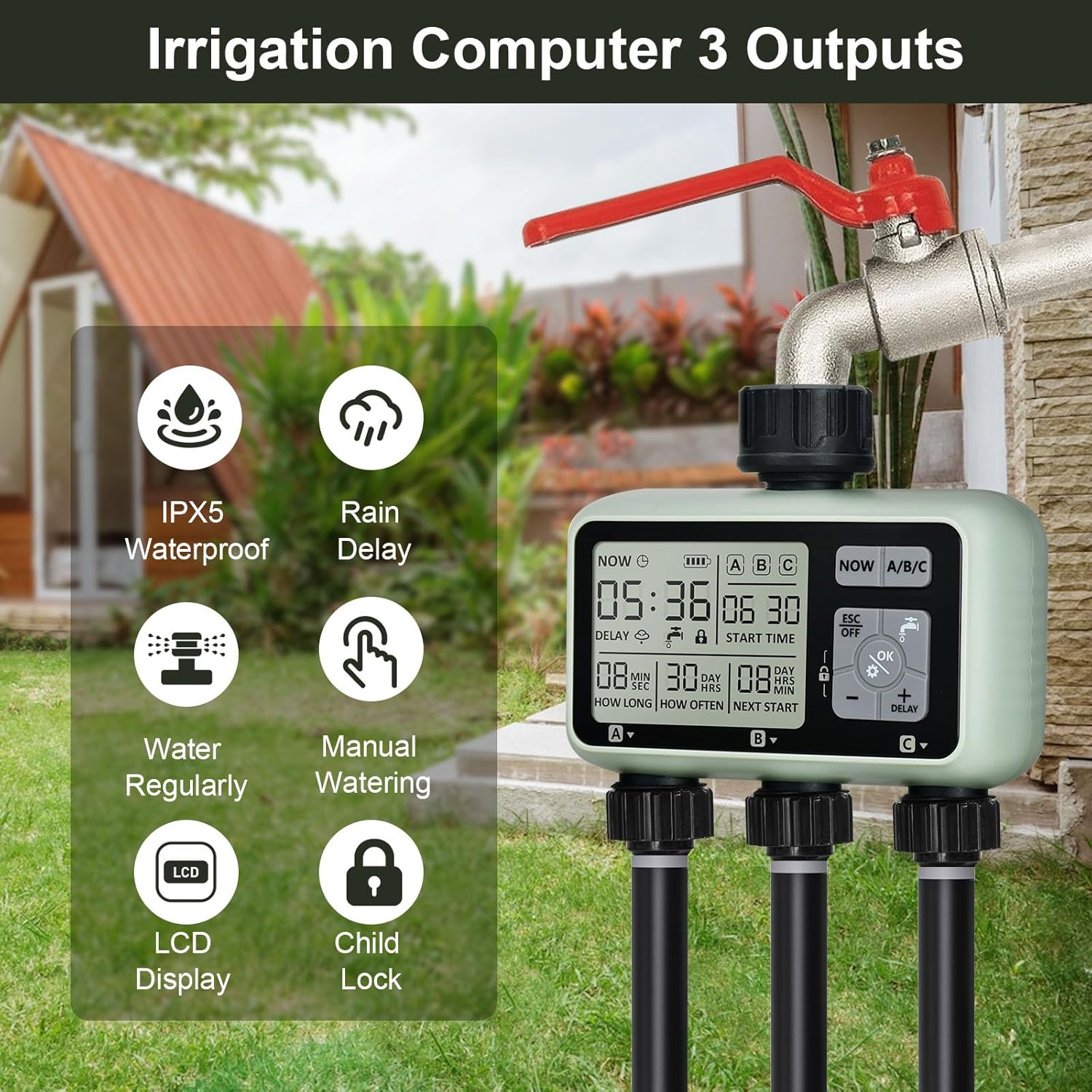
Aworan: Pariview of the johgee 3-Zone Watering Timer highlighting its key features such as IPX5 waterproofing, rain delay, regular watering, manual watering, LCD display, and child lock function.
2. Alaye Aabo
- Aabo Batiri: Use only two 1.5V alkaline batteries (AA size). Do not use lithium batteries. Ensure correct polarity when inserting batteries. Remove batteries if the timer will not be used for an extended period.
- Ipa omi: The timer is designed to withstand water pressure between 0.05-0.8 Mpa. Do not exceed recommended pressure.
- Iwọn otutu: Do not expose the timer to freezing temperatures. Drain water and store indoors during winter months to prevent damage.
- Aabo ọmọde: The timer includes a child-lock mode to prevent accidental operation. Keep the device out of reach of small children when not in use.
- Fifi sori: Ensure all connections are secure to prevent leaks. Do not overtighten connections.
3. Package Awọn akoonu
Jọwọ ṣayẹwo awọn akoonu package lati rii daju pe gbogbo awọn ohun kan wa:
- johgee 3-Zone Watering Timer (1 unit)
- Afowoyi Olumulo (iwe-ipamọ yii)
Note: 1.5V AA alkaline batteries are not included and must be purchased separately.
4. Ọja Ipariview
The johgee 3-Zone Watering Timer features a clear LCD display and intuitive controls for easy programming. Below is a diagram illustrating the main components and display elements.

Image: Labeled diagram of the timer's display, indicating the positions of Current Time, Irrigation Start Time, Irrigation Duration, Irrigation Frequency, Duration to Next Irrigation, and the three independent zones (Zone 1, Zone 2, Zone 3).
Awọn eroja Ifihan:
- Bayi: Han akoko lọwọlọwọ.
- Atọka Batiri: Ṣe afihan agbara batiri ti o ku.
- A/B/C: Indicates the currently selected watering zone.
- Àkókò Ibẹrẹ: The programmed time for irrigation to begin.
- BAWO LO SE GUN TO: The duration of each watering cycle (1 second to 360 minutes).
- BAWO NI O ṢE N WAYE SI: The frequency of watering (1 hour to 15 days).
- NEXT START: Countdown to the next scheduled watering cycle.
- ÌDÚRÙN: Indicates rain delay is active.
- Aami Titii Ọmọde: Indicates child lock mode is active.
Awọn bọtini Iṣakoso:
- Bayi: Ti a lo lati ṣeto akoko lọwọlọwọ.
- A/B/C: Selects the watering zone (Zone 1, Zone 2, or Zone 3) for programming.
- ESC/OFF: Exits current setting mode or turns off the timer.
- OK/Gear Icon: Confirms settings or enters programming mode.
- Water Faucet Icon: Activates or deactivates manual watering.
- Iyokuro (-): Decreases values or navigates backward.
- Plus (+)/DELAY: Increases values or activates rain delay.
- Aami Titiipa: Activates or deactivates child lock.
5. fifi sori
Follow these steps to install your johgee 3-Zone Watering Timer:
- Fi awọn batiri sii: Open the battery compartment cover on the back of the timer. Insert two new 1.5V AA alkaline batteries, ensuring correct polarity. Close the cover securely to maintain the IPX5 waterproof rating.
- Sopọ mọ Faucet: Screw the timer's inlet connector onto your outdoor hose faucet. The brass material interface ensures a secure and leak-proof connection. The 360-degree rotatable connector allows for flexible positioning.
- Awọn ọna asopọ: Attach your garden hoses or irrigation lines to the three independent outlets at the bottom of the timer. Ensure all connections are tight to prevent leaks.

Image: The battery compartment with two AA batteries inserted, demonstrating the correct battery placement.

Aworan: A alaye view of the 360-degree rotatable brass connection, emphasizing its durability and ease of installation.

Image: A visual guide showing the three main steps for setting up the watering timer: battery insertion, timer programming, and connecting to the water source and irrigation lines.
6. Eto ati siseto
The timer allows for individual programming of each of its three zones (A, B, C).
6.1. Eto Lọwọlọwọ Time
- Tẹ awọn Bayi bọtini. Ifihan akoko yoo filasi.
- Lo awọn + ati - awọn bọtini lati ṣatunṣe awọn wakati.
- Tẹ OK láti jẹ́rìí wákàtí náà kí o sì gbé e sí ìṣẹ́jú.
- Lo awọn + ati - awọn bọtini lati ṣatunṣe awọn iṣẹju.
- Tẹ OK to save the current time.
6.2. Programming Watering Schedules (for each Zone A, B, C)
Each zone can be programmed independently. Repeat these steps for Zone A, Zone B, and Zone C.
- Yan Agbegbe: Tẹ awọn A / B / C button to cycle through and select the desired zone (A, B, or C) you wish to program. The selected zone will be highlighted on the display.
- Tẹ Ipo Eto: Tẹ awọn OK button (with the gear icon). The 'START TIME' will begin to flash.
- Ṣeto Akoko Ibẹrẹ: Lo awọn + ati - Tẹ awọn bọtini lati ṣeto akoko ibẹrẹ ti o fẹ fun omi. OK to confirm and move to 'HOW LONG'.
- Ṣètò Àkókò Tí A Fi Agbe Omi: Lo awọn + ati - buttons to set the duration of watering (from 1 second to 360 minutes). Press OK to confirm and move to 'HOW OFTEN'.
- Ṣètò Ìwọ̀n Ìwọ̀n Agbe: Lo awọn + ati - buttons to set how often the watering occurs (from 1 hour to 15 days). Press OK lati jẹrisi.
- Fi Eto pamọ: Tẹ ESC to exit the programming mode and save the settings for the selected zone.

Image: The timer's display illustrating how different watering durations and frequencies can be set for each of the three zones independently.
7. Awọn ọna ṣiṣe
7.1. Automatic Watering
Once programmed, the timer will automatically activate the selected zones according to their set start times, durations, and frequencies. Ensure the faucet is open for water flow.
7.2. Afowoyi agbe
Manual mode allows for immediate watering without affecting the programmed schedule. This is useful for quick tasks like filling a bucket or spot watering.
- Tẹ awọn Omi faucet Aami bọtini.
- The display will show 'ON' and water will begin to flow from the currently selected zone.
- Láti dá omi ọwọ́ dúró, tẹ Omi faucet Aami button again. The display will show 'OFF'.

Image: A hand interacting with the timer's control panel, specifically pressing the manual watering button, while a hose sprays water, demonstrating the manual watering feature.
7.3. Rain Delay Mode
The rain delay function temporarily suspends the watering schedule to prevent overwatering during rainy periods, conserving water and protecting plants.
- Tẹ awọn + DELAY bọtini.
- The 'DELAY' icon will appear on the screen, and the next start time will be updated to reflect the delay.
- To cancel the rain delay, press the + DELAY button again until the 'DELAY' icon disappears.
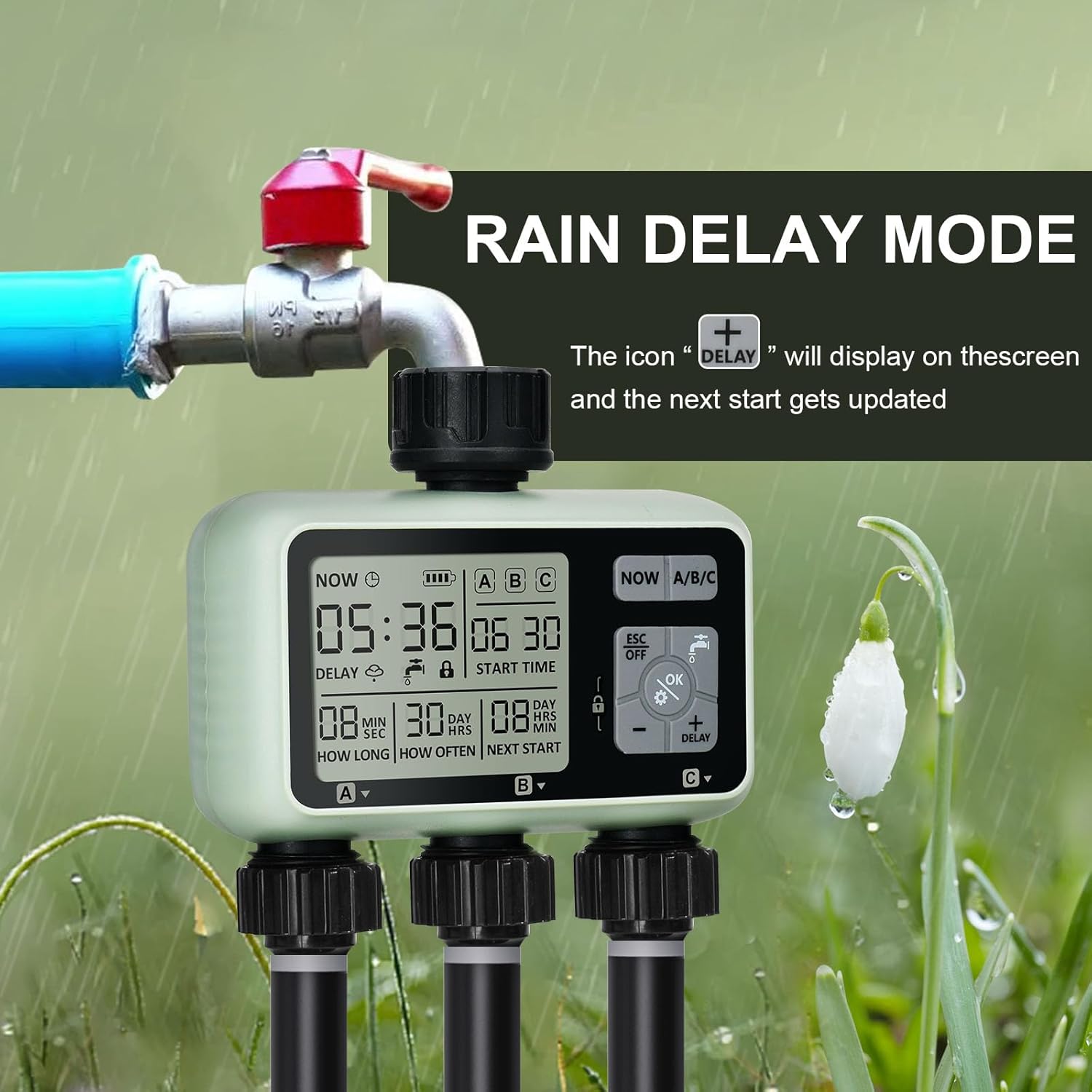
Image: The watering timer connected to a faucet, with the display showing the 'DELAY' icon, signifying that the rain delay function is active and the next watering cycle is postponed.
7.4. Child-Lock Mode
The child-lock mode prevents accidental changes to programming or activation by children or pets.
- Lati muu ṣiṣẹ, tẹ mọlẹ Titiipa Aami button for 3 seconds. The lock icon will appear on the display.
- Lati mu maṣiṣẹ, tẹ mọlẹ Titiipa Aami button for 3 seconds again. The lock icon will disappear.
8. Itọju
- Rirọpo Batiri: The intelligent power supply system will detect low battery and turn off the timer before the battery is completely empty. Replace batteries when the battery indicator on the display shows low power. Always use two new 1.5V AA alkaline batteries.
- Ninu: Clean the exterior of the timer with a soft, damp asọ. Ma ṣe lo abrasive ose tabi epo.
- Fifọ́ àlẹ̀: Periodically check the aluminum filter inside the inlet connection for debris. Clean if necessary to ensure proper water flow and prevent blockages.
- Ibi ipamọ igba otutu: Before the first frost, disconnect the timer from the faucet. Drain all water from the timer and store it indoors in a dry, frost-free location. Removing batteries during storage is recommended.

Image: A composite image highlighting the durable construction of the timer, including the brass hose connection, the clear and easy-to-use control panel, and the sealed battery cover designed to isolate moisture.
9. Laasigbotitusita
| Isoro | Owun to le Fa | Ojutu |
|---|---|---|
| Timer not watering at scheduled time. |
|
|
| Omi jijo lati awọn isopọ. |
|
|
| Ifihan ti ṣofo tabi baibai. |
|
|
| Agbe agbe ni ọwọ ko ṣiṣẹ. |
|
|
10. Awọn pato
| Brand | johgee |
| Nọmba awoṣe | 378 |
| Àwọ̀ | 3 Agbegbe |
| Ọja Mefa | 13 x 13.5 x 6.4 cm |
| Iwọn Nkan | 640 g |
| Ohun elo | Brass (interface), Reinforced Nylon (connector) |
| Mabomire Rating | IPX5 |
| Omi Ipa Ibiti | 0.05-0.8 Mpa |
| Orisun agbara | 2 x 1.5V AA Awọn batiri Alkaline (kii ṣe pẹlu) |
| Igba agbe | 1 iṣẹju-aaya si awọn iṣẹju 360 |
| Agbe Igbohunsafẹfẹ | 1 hour to 15 days |
| Nọmba ti Eto | 9 |
11. Atilẹyin ọja ati Support
For warranty information and customer support, please refer to the purchase platform or contact johgee customer service directly. Keep your purchase receipt as proof of purchase for any warranty claims.
Olupese: johgee
Ibi Iṣowo: johgee
For further assistance, please visit the official johgee store on Amazon or contact their support channels.