
1. Ifihan
This manual provides essential information for the proper setup, operation, and maintenance of your AQUANEAT Aquarium Air Pump, Model AP-104. This air pump is designed to enhance oxygen levels in aquariums up to 100 gallons, as well as small hydroponic setups, promoting a healthier environment for aquatic life.
2. Package Awọn akoonu
Jẹrisi pe gbogbo awọn paati wa ninu package rẹ:
- 1x AQUANEAT Air Pump (Model AP-104)
- 1x 8-foot Airline Tubing
- Àwọn fáfà Ṣíṣàyẹ̀wò 2x
- 2x 2-inch Air Stones
3. Awọn ẹya ara ẹrọ
The AQUANEAT AP-104 Air Pump offers several features for efficient and quiet operation:
- Tank Compatibility: Suitable for aquariums up to 100 gallons.
- Isẹ idakẹjẹ: Equipped with 4 rubber stabilizer feet to minimize vibration and noise.
- Ṣíṣàn Afẹ́fẹ́ Tí A Lè Ṣàtúnṣe: A control knob allows for precise adjustment of air volume.
- Awọn ile-iṣẹ meji: Features two air outlets for connecting multiple air stones, sponge filters, or bubble wands.
- Lilo Iwapọ: Ideal for freshwater, saltwater tanks, and small hydroponic systems.

Image: AQUANEAT Air Pump showing its compact dimensions of 5.25 inches (length) x 2.75 inches (width) x 2.25 inches (height).
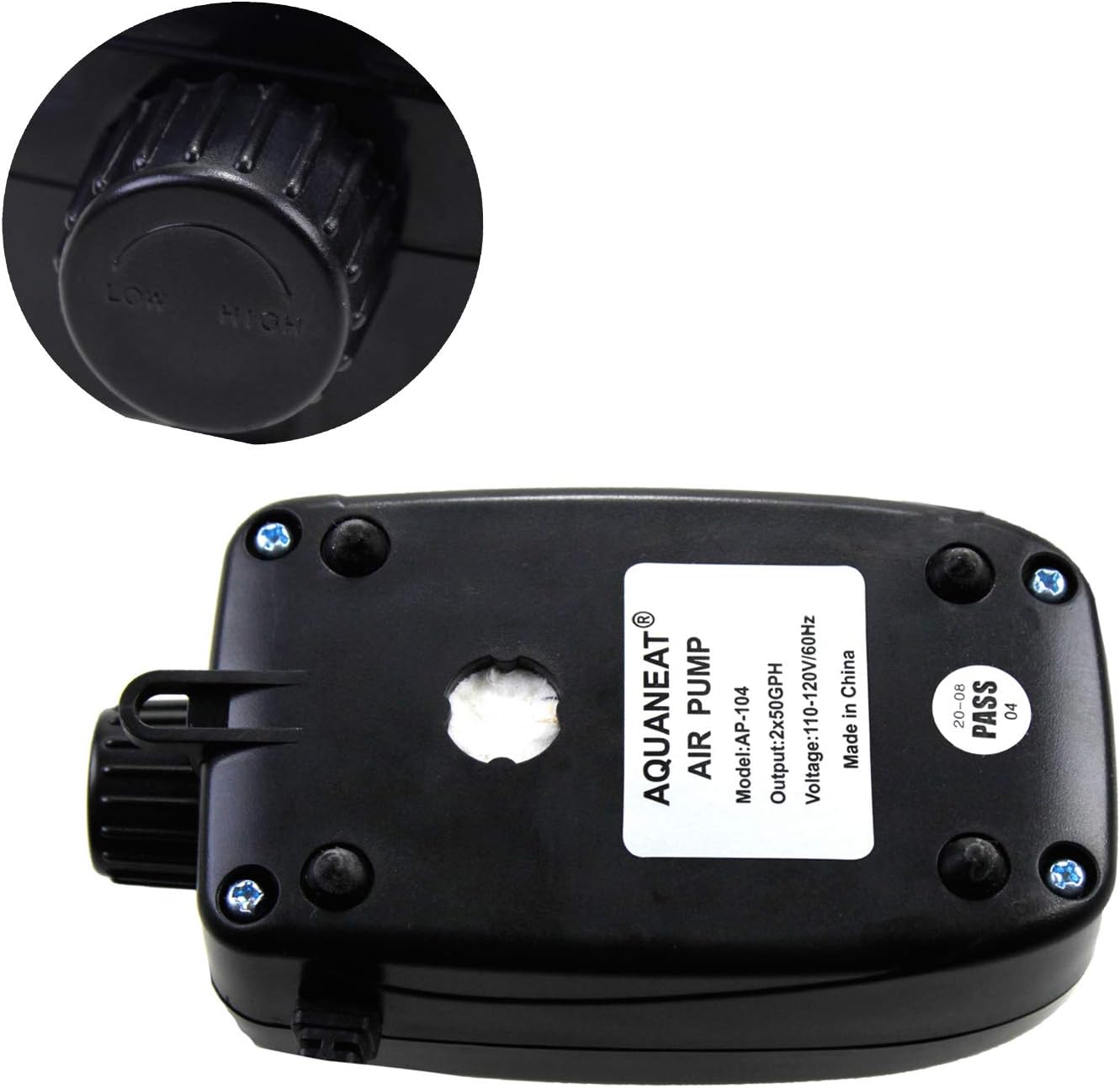
Aworan: Isalẹ view of the air pump, highlighting the adjustable control knob and product specifications label.
4. Awọn ilana iṣeto
Follow these steps to set up your AQUANEAT Air Pump:
- Múra Pọ́ọ̀pù: Cut the provided 8-foot airline tubing to the desired length for your setup.
- So Awọn eroja: Attach one end of the airline tubing to an air outlet on the pump. Connect an air stone to the other end of the airline tubing. If using both outlets, repeat this step for the second outlet.
- Gbe fifa soke: Ideally, place the air pump above the aquarium water level. This prevents water from siphoning back into the pump during a power outage.
- Fi Ààbò Ṣàyẹ̀wò Sílẹ̀ (tí ó bá pọndandan): If the air pump must be placed below the aquarium water level, install a check valve between the air pump and the air stone. This is crucial to prevent water from flowing back into the pump and causing damage. Ensure the check valve is oriented correctly to allow airflow towards the aquarium.
- Okun Agbara to ni aabo: Plug the pump into a standard 110V-120V/60Hz electrical outlet. Create a "drip loop" with the power cord to prevent water from running along the cord and into the outlet.

Image: Close-up of the power plug, illustrating the connection point for the air pump.
5. Awọn ilana Iṣiṣẹ
Once the pump is set up and plugged in, it will begin to operate. Adjust the airflow as follows:
- Adjust Air Volume: Use the control knob located on the pump to increase or decrease the air volume. Turn the knob towards "High" for more air and towards "Low" for less air.
- Observe Bubbles: Monitor the bubble output in your aquarium to ensure adequate oxygenation without creating excessive water turbulence that might stress fish.
6. Itọju
Regular maintenance ensures optimal performance and longevity of your air pump:
- Fífọ Òkúta Afẹ́fẹ́: Periodically clean or replace air stones as they can become clogged with algae or mineral deposits, reducing airflow.
- Àyẹ̀wò Ọpọn Tí A Fi Ń Ṣe Ọpọn: Check airline tubing for kinks, blockages, or cracks. Replace damaged tubing to maintain efficient air delivery.
- Ìta Pọ́ọ̀pù: Keep the exterior of the pump clean and dry. Avoid submerging the pump in water.
- Asẹ afẹfẹ: Some air pumps have an internal air filter. Refer to the manufacturer's guidelines for checking and replacing this filter if applicable to your model.
7. Laasigbotitusita
If you encounter issues with your air pump, consider the following common solutions:
- No Air Output:
- Ensure the pump is plugged in and the power outlet is functional.
- Check for kinks or blockages in the airline tubing.
- Verify that the air stone is not clogged. Clean or replace if necessary.
- If a check valve is installed, ensure it is not blocked or installed backward.
- Afẹfẹ ti o dinku:
- Adjust the air volume control knob to a higher setting.
- Inspect air stones and tubing for partial blockages.
- Ensure the pump's air intake is not obstructed.
- Ariwo Pupọ:
- Ensure the pump is placed on a flat, stable surface. The rubber feet are designed to minimize vibration.
- Check if the pump is touching any other objects that could ampàwọn ìgbìn lílágbára.
- Verify that the air stone or tubing is not causing excessive back pressure.
8. Awọn pato
| Sipesifikesonu | Ẹ̀kúnrẹ́rẹ́ |
|---|---|
| Orukọ awoṣe | AP-104 |
| Brand | AQUANEAT |
| Àwọ̀ | Dudu |
| Ohun elo | Ṣiṣu |
| Awọn iwọn Ọja (L x W x H) | 5.25" x 2.75" x 2.25" |
| Iwọn Nkan | 0.47 kilo |
| Orisun agbara | Okun Itanna |
| Voltage | 110V-120V / 60Hz |
| Ipo Isẹ | Laifọwọyi |
| Hose Gigun | 8 Ẹsẹ |
9. Atilẹyin ọja ati Support
This AQUANEAT product comes with a 30-ọjọ atilẹyin ọja. For any questions, technical support, or warranty claims, please visit the official AQUANEAT store on Amazon:


