
1. Ifihan
The PGST WiFi Home Alarm Security System (Model PG108-4GUS-F) is a comprehensive wireless security solution designed to protect your home or apartment. This system supports both 2.4GHz WiFi and 2G/3G/4G cellular networks, providing reliable alerts and control. It is compatible with popular smart home platforms like Amazon Alexa and Google Home for convenient voice control. The system is designed for easy DIY installation and offers expandability with up to 100 wireless accessories.

Image: The PGST WiFi Home Alarm Security System main unit with various connected accessories like motion sensors, door sensors, remote controls, and RFID tags.
2. Package Awọn akoonu
The 24-piece kit includes the following components:
- Alarm system PG-108 (Main Control Panel) x 1
- Wireless PIR Detector (Motion Sensor) x 5
- Door Sensor x 10
- PE-513 Siren x 1
- Iṣakoso latọna x 3
- RFID Tag x 3
- SOS Button x 1
- Type C cable + Adapter x 1

Image: Visual representation of the 24-piece kit contents, including the main panel, motion sensors, door sensors, remote controls, RFID tags, and siren.
3. Eto
3.1 Agbara-ibẹrẹ ati Asopọ Nẹtiwọọki
- Connect the alarm host to a power source using the provided Type C cable and adapter. The system includes a backup battery.
- For WiFi connection: Download the 'Smart Life' or 'Tuya' app on your smartphone. Follow the in-app instructions to connect the alarm host to your 2.4GHz WiFi network. (Note: 5G WiFi is not supported).
- For 4G/GSM connection: Insert a compatible GSM SIM card (not included) into the alarm host. This enables phone calls and SMS alerts.

Image: The alarm panel connected to a WiFi router and a diagram showing SIM card insertion for 4G/GSM connectivity.
3.2 Setting Keypad Lock Password
To set or change the keypad lock password:
- Lilö kiri si Akojọ aṣyn > Eto > Ọrọigbaniwọle > Olumulo.
- Enter your desired 4-digit password.
- Jẹrisi ọrọ igbaniwọle.
To turn the keypad lock on or off:
- Lilö kiri si Akojọ aṣyn > Eto > Yipada > Titiipa oriṣi bọtini.
- Select 'on' or 'off' as desired.
Video: Instructions on how to set the keypad lock password and enable/disable the keypad lock feature on the PGST alarm system.
3.3 Pairing Accessories
The PGST system allows pairing of various wireless accessories. Follow these general steps for pairing:
Video: Detailed guide on connecting various accessories like remote controls, RFID cards, infrared sensors, door magnetic sensors, and smoke alarms to the PGST alarm system.
3.3.1 Sisopọ Iṣakoso latọna jijin
- On the main panel, navigate to Akojọ aṣyn > Awọn sensọ > Latọna jijin > Fi kun.
- Press any button on the remote control. The panel will confirm successful learning.

Image: A white remote control with four buttons: lock, unlock, home, and SOS.
3.3.2 RFID Card Pairing
- On the main panel, navigate to Akojọ aṣyn > Awọn sensọ > RFID > Fi kun.
- Tap the RFID card against the RFID reader area on the main panel. The panel will confirm successful learning.

Image: Two black RFID tags with metal keyrings, used for arming/disarming the system.
3.3.3 Infrared Motion Sensor Pairing
- Turn on the infrared sensor switch. Wait approximately 30 seconds for the red light to flash rapidly twice.
- On the main panel, navigate to Akojọ aṣyn > Awọn sensọ > Sensọ > Fi kun.
- Select 'System Alarm' or 'Stay Arm Active' for the sensor type.
- Trigger the motion sensor (e.g., by moving in front of it). The panel will confirm successful learning.

Image: A white wireless PIR motion detector mounted on a wall, illustrating its 32ft (10m) range and 110-degree field of view.
3.3.4 Door Magnetic Sensor Pairing
- Open the switch on the door magnetic sensor.
- On the main panel, navigate to Akojọ aṣyn > Awọn sensọ > Sensọ > Fi kun.
- Select 'Door Alarm' or 'Stay Arm Active' for the sensor type.
- Separate the two parts of the door sensor. The panel will confirm successful learning.
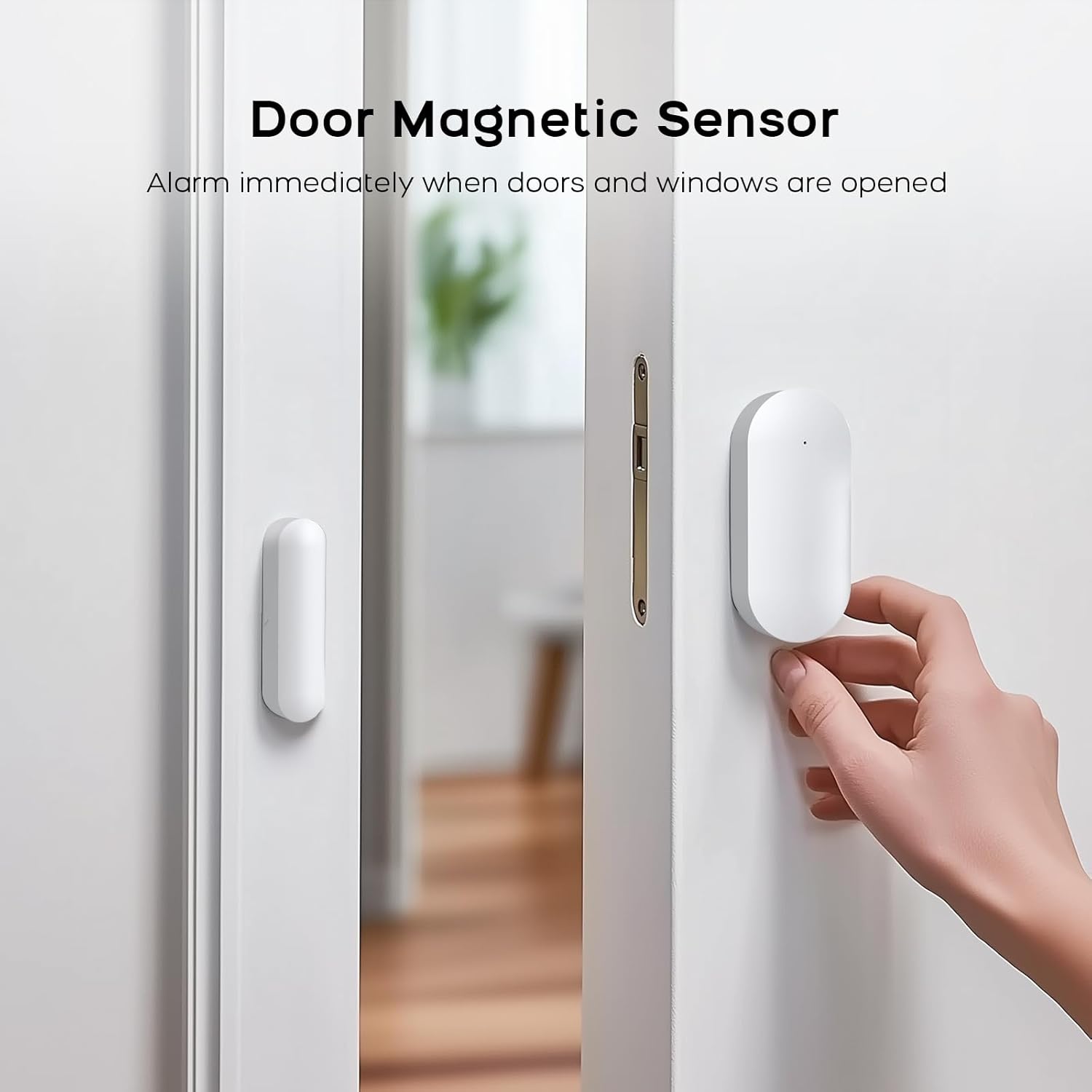
Image: A white door magnetic sensor installed on a door and its frame, designed to trigger an alarm when the door is opened.
3.3.5 Smoke Alarm Pairing
- On the main panel, navigate to Akojọ aṣyn > Awọn sensọ > Sensọ > Fi kun.
- Select 'Fire Alarm' or '24 Hours Active' for the sensor type.
- Press the test button on the smoke alarm. The panel will confirm successful learning.
4. Awọn ilana Iṣiṣẹ
4.1 Ṣíṣe ohun ìjà àti kíkó ẹ̀rọ náà kúrò
The system can be armed or disarmed using the main control panel, remote control, RFID tags, or the mobile app.
- Apa: Activates all sensors. Any triggered sensor will initiate an alarm.
- Tu silẹ: Deactivates the alarm system.
- Apa ile: Activates perimeter sensors (e.g., door/window sensors) while allowing free movement within the property (motion sensors are typically inactive in this mode).
4.2 Iṣẹ́ Pajawiri SOS
In an emergency, press the SOS button on the main panel or the remote control. The system will immediately trigger an alarm and send alerts to pre-configured contacts.
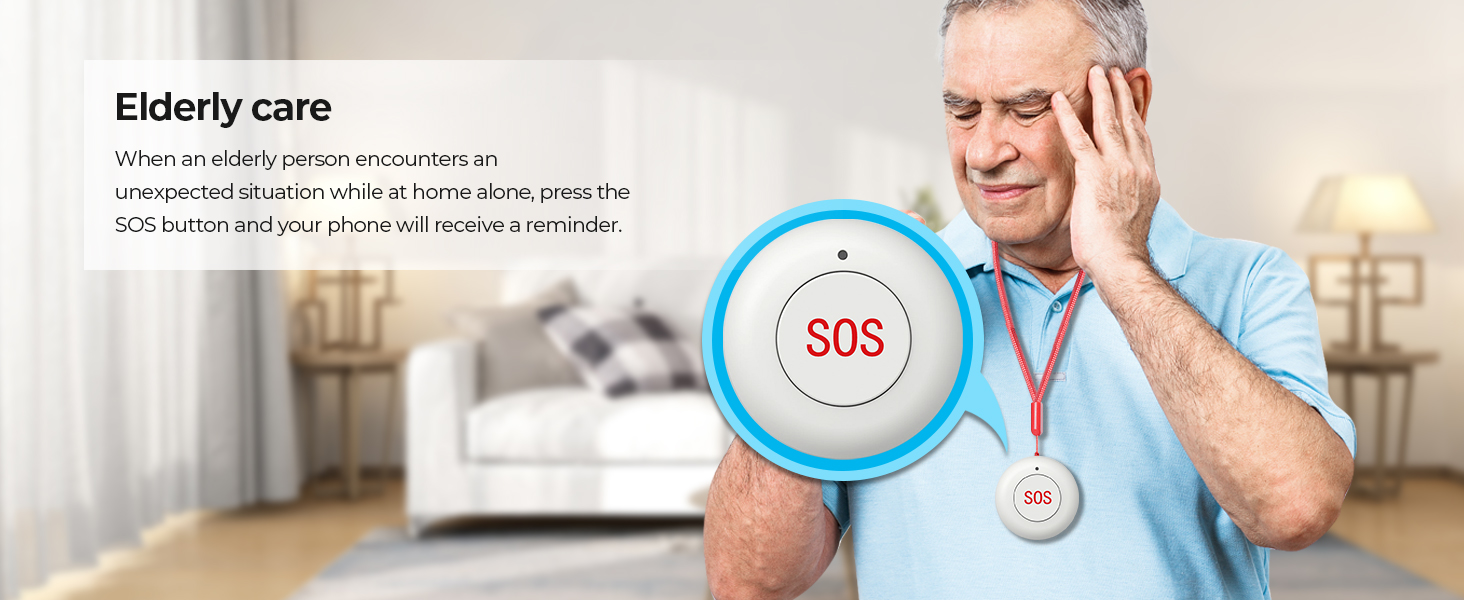
Image: An elderly person with an SOS pendant, highlighting the emergency alert feature.
4.3 Mobile App Iṣakoso
Use the 'Smart Life' or 'Tuya' app to remotely control your alarm system. This includes arming/disarming, receiving notifications, checking sensor status, and adjusting settings from anywhere.

Image: A smartphone showing the 'Smart Life' app, demonstrating remote control and monitoring capabilities.
4.4 Voice Iṣakoso Integration
The system is compatible with Amazon Alexa and Google Home. Link your alarm system to these platforms to enable voice commands for arming and disarming.
- Example command: "Alexa, arm my home!"
- Example command: "OK Google, disarm the alarm system."

Image: Two children using a smart speaker to control the alarm system with voice commands, illustrating smart home integration.
4.5 Pínpín Ìdílé
The system supports linking up to 5 phone numbers to share alerts and control with family members, ensuring everyone is informed and can manage the system.

Image: An illustration depicting multiple family members connected to and receiving notifications from the alarm system.
5. Itọju
5.1 Itọju Gbogbogbo
- Keep the main control panel and sensors clean by wiping them with a soft, dry cloth. Avoid using abrasive cleaners or solvents.
- Ensure all components are installed in dry environments, away from direct sunlight, extreme temperatures, and high humidity.
- Regularly check that all sensors are securely mounted and free from obstructions.
5.2 Itọju batiri
- The main control panel has a built-in backup lithium polymer battery. Ensure it is regularly charged by keeping the panel connected to AC power.
- Wireless sensors are battery-powered. Replace batteries promptly when low battery alerts are received to ensure continuous protection.
6. Laasigbotitusita
6.1 System Not Connecting to WiFi
- Ensure your WiFi network is 2.4GHz. The system does not support 5G WiFi.
- Ṣayẹwo ọrọ igbaniwọle WiFi rẹ fun deede.
- Move the alarm host closer to your WiFi router to improve signal strength.
- Restart your router and the alarm host.
6.2 Sensors Not Triggering Alarm
- Verify that the sensors are correctly paired with the main panel (refer to Section 3.3).
- Check the battery level of the sensors. Replace if necessary.
- Ensure the main panel is armed in the correct mode (e.g., 'Arm' for all sensors, 'Home Arm' for perimeter sensors).
- For door/window sensors, ensure the two parts are aligned correctly and within the specified gap.
- For motion sensors, ensure there are no obstructions in its field of view.
6.3 No App Notifications
- Ensure the alarm host is connected to WiFi or has an active 4G/GSM SIM card.
- Check your smartphone's notification settings for the 'Smart Life' or 'Tuya' app to ensure notifications are enabled.
- Rí i dájú pé fóònù rẹ ní ìsopọ̀ ìkànnì ayélujára tó ń ṣiṣẹ́.
6.4 eke Awọn itaniji
- Review sensor placement. Motion sensors should be placed away from heat sources, direct sunlight, and areas with pets if not pet-immune.
- Ensure door/window sensors are firmly attached and not easily dislodged.
- Adjust sensor sensitivity if applicable (check individual sensor manuals).
7. Awọn pato
| Ẹya ara ẹrọ | Ẹ̀kúnrẹ́rẹ́ |
|---|---|
| Brand | PGST |
| Nọmba awoṣe | PG108-4GUS-F |
| Orisun agbara | AC power with battery backup |
| Batiri Cell Type | Litiumu polima |
| Asopọmọra Technology | Wireless (2.4GHz WiFi, 2G/3G/4G) |
| Awọn ẹrọ ibaramu | Smartphone, Tablet, Personal Computer |
| Smart Home ibamu | Smart Home Compatible (Alexa, Google Home) |
| Ọna Iṣakoso | App, Remote, Keypad |
| Iru Itaniji | Motion, Door/Window Open, Fire |
| Item Dimensions (Main Unit) | 2.3 x 2 x 1.8 inches |
| Ọna fifi sori ẹrọ | Dabaru-Ni |
| Unit Count (for 24-Kits-F) | 24.0 Iṣiro |
8. Atilẹyin
8.1 Imọ Support
PGST is committed to providing reliable products and services. We offer lifetime technical support for our products. If you encounter any issues or have questions regarding your PGST WiFi Home Alarm Security System, please contact our support team.
8.2 onibara Service
Our customer service team aims for quick response within 365 days to address your inquiries and concerns. For assistance, please refer to the contact information provided with your product packaging or visit the official PGST webojula.

Image: Icons representing PGST's commitment to a professional team, lifetime technical support, and quick response times.