
1. Ifihan
This manual provides comprehensive instructions for the safe and efficient operation, installation, and maintenance of your DATOUBOSS 12V 200Ah LiFePO4 Deep Cycle Battery. Please read this manual thoroughly before using the battery to ensure proper function and longevity.

Àwòrán 1.1: Batiri DATOUBOSS 12V 200Ah LiFePO4, àfihànasing its compact design and terminal posts.
2. Awọn ilana aabo
Adhering to these safety guidelines is crucial for preventing damage to the battery and ensuring user safety.
- Má ṣe lo ọ̀nà ìdènà: Avoid connecting the positive and negative terminals directly. This can cause severe damage to the battery and pose a fire hazard.
- No modification or disassembly: Do not attempt to modify, disassemble, or open the battery casing without authorization. Unauthorized alterations void the warranty and can lead to dangerous situations.
- Yago fun awọn ipo ti o buruju: Do not expose the battery to fire, water, or extreme temperatures outside the specified operating range.
- Use appropriate charger: Always use a standard charger that is compatible with the output voltage and chemistry of a lithium iron phosphate battery.
- Ààbò BMS: The integrated Battery Management System (BMS) provides protection against overcharge, deep discharge, overcurrent, overvoltage, and extreme temperatures. However, proper handling is still required.

Image 2.1: Illustration of the built-in BMS (Battery Management System) providing multiple security protections, including overcharge, over-discharge, overvoltage, overcurrent, overload, kukuru circuit, ati aabo otutu.
3. Awọn ẹya Ọja
The DATOUBOSS 12V 200Ah LiFePO4 battery offers advanced performance and reliability:
- Premium LiFePO4 Cells: Constructed with automotive-grade lithium iron phosphate cells for high energy density, stable performance, and increased power output.
- BMS 200A ti a ti sopọpọ: Features a robust Battery Management System that ensures optimal charging and discharging, automatic balancing, and comprehensive protection against various electrical faults.
- Igbesi aye Iyika ti o gbooro: Designed for deep cycling with over 5000 cycles and an expected lifespan exceeding 10 years, significantly outperforming lead-acid batteries.
- Iṣeto Rọ: Supports both series and parallel connections, allowing for system customization up to 4P4S (51.2V 800Ah) to meet diverse voltage ati awọn ibeere agbara.
- Ibi iwọn otutu ti o tobi: Operates effectively in a broad range of temperatures, from -20°C to 65°C (-4°F to 150°F) for discharge and 0°C to 45°C (32°F to 113°F) for charge.
- Apẹrẹ iwuwo fẹẹrẹ: Weighs approximately 18 kg (40.2 lbs), making it considerably lighter than comparable lead-acid batteries.
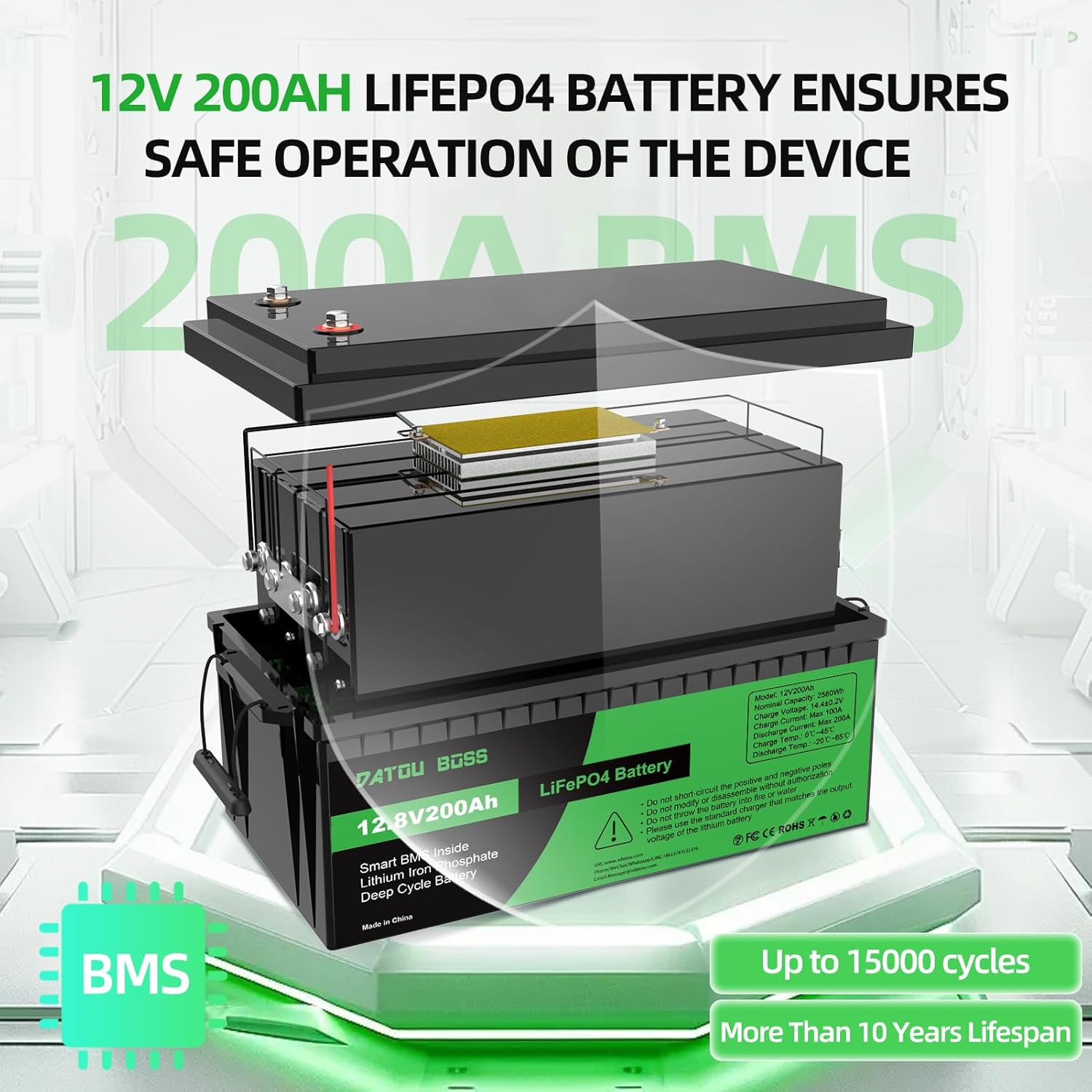
Aworan 3.1: exploded view illustrating the internal components of the 12V 200Ah LiFePO4 battery, highlighting the BMS and indicating a lifespan of up to 15,000 cycles and over 10 years.

Aworan 3.2: Pariview of key features including advanced BMS, long life over 10 years, serial and parallel connection capability, large capacity, wide application range, and environmental friendliness.
4. Eto
Proper setup is essential for the battery's performance and safety.
4.1 Fifi sori ti ara
- Ensure the battery is placed on a stable, flat surface in a well-ventilated area.
- Keep the battery away from direct sunlight, heat sources, and flammable materials.
- The battery terminals are M8 size. Use appropriate M8 connectors for secure connections.

Image 4.1: Detailed dimensions of the battery (52.6cm x 22cm x 23.5cm or 20.7in x 8.7in x 9.3in) and its weight (18.25 kg), along with an M8 terminal illustration.
4.2 Àwọn ìsopọ̀ onípele àti onípele
The DATOUBOSS LiFePO4 battery supports both series and parallel connections to achieve desired voltage and capacity. Always ensure all batteries are of the same model and state of charge before connecting.
- Isopọ ti o jọra: Connect positive terminals together and negative terminals together to increase total capacity (Ah) while maintaining the same voltage (V).
- Asopọmọra jara: Connect the positive terminal of one battery to the negative terminal of the next battery to increase total voltage (V) nígbàtí ó ń pa agbára kan náà mọ́ (Ah).
- The system can be configured up to 4 batteries in series and 4 batteries in parallel (4P4S) for a maximum power of 4.096 kWh (51.2V 800Ah).
5. Awọn ilana Iṣiṣẹ
Follow these guidelines for optimal performance and longevity of your battery.
5.1 Gbigba agbara
- Ensure the charger is specifically designed for LiFePO4 batteries and matches the battery's voltage.
- The recommended charging temperature range is 0°C to 45°C (32°F to 113°F).
- The maximum continuous charging current is 100A. Do not exceed this limit.
5.2 Gbigbe
- The recommended discharging temperature range is -20°C to 65°C (-4°F to 150°F).
- The maximum continuous discharging current is 200A. Avoid exceeding this limit to prevent damage.
- The BMS will automatically cut off power if the battery is discharged below its safe voltage iye to.

Image 5.1: Illustration demonstrating the battery's ability to cope with extreme temperature variations, with excellent continuous discharge performance from -4°F to 150°F.
5.3 Awọn ohun elo
This battery is suitable for a wide range of applications:
- Recreational Vehicles (RVs): Pese agbara to gbẹkẹle fun awọn ohun elo inu ati awọn eto.
- Awọn ọna agbara oorun: Ideal for off-grid solar energy storage, compatible with MPPT controllers and inverters.
- Awọn ohun elo Omi: Powers trolling motors, fishfinders, and electric outboard motors.
- Household Backup: Can be integrated into home backup power systems to run essential appliances.
- Awọn lilo miiran: Suitable for ATVs, golf carts, camping setups, and various outdoor power needs.

Aworan 5.2: Examples of common applications for the battery, including trolling motors, fishfinders, electric outboard motors, ATVs, and golf carts.

Image 5.3: An illustration of a home backup power supply system utilizing multiple DATOUBOSS batteries (e.g., 51.2V 800Ah system) connected to solar panels and an inverter to power various household appliances.
6. Itọju
DATOUBOSS LiFePO4 batteries are designed for minimal maintenance due to their robust chemistry and integrated BMS.
- Ayẹwo igbagbogbo: Máa ṣàyẹ̀wò àwọn ẹ̀rọ batiri lẹ́ẹ̀kọ̀ọ̀kan fún ìbàjẹ́ tàbí àwọn ìsopọ̀ tí ó bàjẹ́. Mú kí ó mọ́ tónítóní bí ó bá ṣe pàtàkì.
- Ibi ipamọ: If storing the battery for an extended period, ensure it is charged to approximately 50% state of charge and stored in a cool, dry place.
- Ko si agbe: Unlike lead-acid batteries, LiFePO4 batteries do not require watering or electrolyte checks.
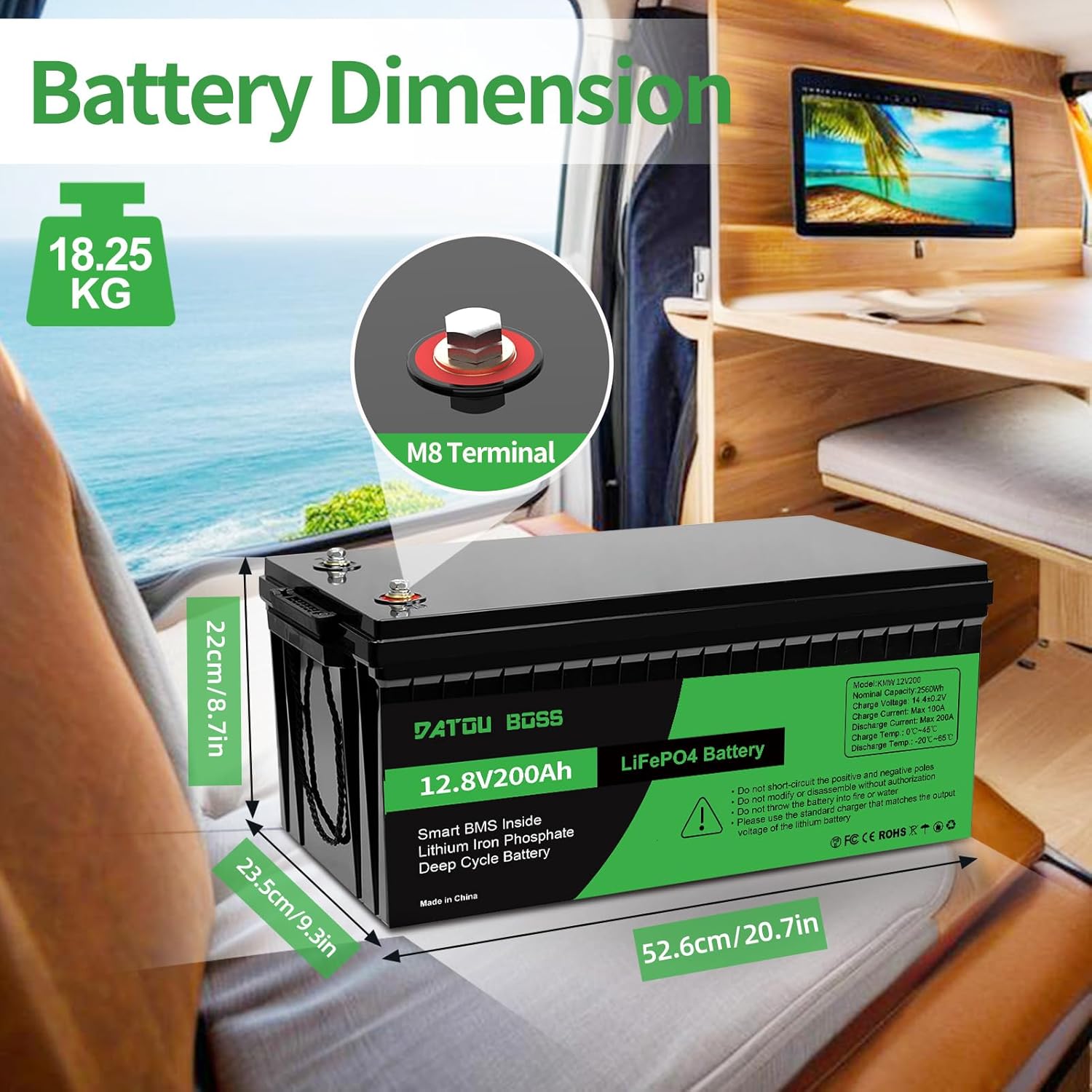
Image 6.1: A comparison highlighting the advantages of the DATOUBOSS LiFePO4 battery over traditional lead-acid batteries, including lighter weight, 200A BMS, 100% Depth of Discharge (DOD), 10,000+ cycles, 10+ years expected lifespan, and environmental protection.
7. Laasigbotitusita
The integrated BMS handles most common issues. If you encounter problems, consider the following:
- Ko si Ijade agbara: Check all cable connections to ensure they are secure and correctly polarized. Verify the battery's state of charge. The BMS may have activated a protection mode (e.g., over-discharge).
- Awọn ọran gbigba agbara: Ensure the charger is compatible with LiFePO4 batteries and functioning correctly. Check the charging temperature is within the specified range (0°C to 45°C).
- Idaabobo lọwọlọwọ: If the battery suddenly stops providing power during high load, the BMS may have activated overcurrent protection. Reduce the load and restart the system.
- Idaabobo iwọn otutu: If the battery is operating in extremely hot or cold conditions, the BMS may temporarily disable charging or discharging to protect the cells. Allow the battery to return to its optimal temperature range.
- Iwa Alailẹgbẹ: If the battery exhibits any unusual behavior not covered here, disconnect it from all loads and chargers and contact customer support.

Image 7.1: Visual representation of the powerful BMS protections, including overcharge, high temperature cut-off, short circuit, over-discharge, overcurrent, and low temperature protection, ensuring 5000-15000 deep cycles and a 10-year lifespan.
8. Awọn pato
| Sipesifikesonu | Iye |
|---|---|
| Orukọ ọja | LiFePO4 batiri |
| Ti won won Agbara | 200 Ah / 2560Wh |
| Oṣuwọn Voltage | 12.8V |
| Voltage Ibiti | 10V - 14.6V |
| O pọju Lemọlemọfún Ngba agbara lọwọlọwọ | 100A |
| O pọju Lemọlemọfún gbigba silẹ lọwọlọwọ | 200A |
| Ngba agbara Voltage | 14.4V ± 0.2V |
| Awọn iwọn (LxWxH) | 52.6 x 23.5 x 22 cm (20.7 x 9.3 x 8.7 inches) |
| Iwọn | 18 kg (40.2 lbs) |
| Gbigba agbara otutu | 0°C si 45°C (32°F si 113°F) |
| Gbigba agbara otutu | -20°C si 65°C (-4°F si 150°F) |
| Igbesi aye iyipo | 5000+ cycles (up to 15,000) |
| BMS | Integrated 200A BMS |

Image 8.1: A summary table of the DATOUBOSS LiFePO4 battery's key specifications, including rated capacity, voltage, current limits, dimensions, weight, and temperature ranges.
9. Atilẹyin ọja ati Support
For warranty information, technical support, or any inquiries regarding your DATOUBOSS 12V 200Ah LiFePO4 Battery, please refer to the product packaging or contact DATOUBOSS customer service directly. Keep your purchase receipt for warranty claims.