
Voktta A38IDCE0130-003
Voktta USB Rechargeable Soldering Iron Instruction Manual
Model: A38IDCE0130-003
1. Alaye Aabo
Please read all safety instructions carefully before using the Voktta USB Rechargeable Soldering Iron. Failure to follow these instructions may result in electric shock, fire, or serious injury.
- Awọn iwọn otutu giga: The soldering iron tip reaches very high temperatures (up to 450°C / 842°F). Avoid direct contact with the tip to prevent burns.
- Afẹfẹ: Use the soldering iron in a well-ventilated area to avoid inhaling fumes produced during soldering.
- Idaabobo Oju: Always wear safety glasses to protect your eyes from solder splashes or fumes.
- Jeki kuro lati awọn ọmọde: This product is not a toy. Keep it out of reach of children and unauthorized persons.
- Proper Stand Usage: Always place the hot soldering iron in its designated stand when not in use to prevent accidental contact or damage to surfaces.
- Agbara Pa: Disconnect the power and allow the iron to cool completely before cleaning, storing, or changing tips.
- Awọn ohun elo ina: Pa awọn ohun elo ti o le jona mọ kuro ni agbegbe ti a fi sora.
- Aabo Batiri: Do not expose the battery to extreme temperatures or disassemble it. Use only the provided charging cable.
2. Ọja Ipariview
The Voktta USB Rechargeable Soldering Iron is a portable and versatile tool designed for various electronic repair and DIY projects. It features an adjustable temperature range, quick heating, and a built-in battery for cordless operation.
Awọn ẹya pataki:
- Adijositabulu otutu: Temperature range of 200-450°C (392-842°F), switchable between Celsius and Fahrenheit.
- Alapapo iyara: Heats up in approximately 10 seconds and reaches maximum temperature in about 30 seconds.
- Ifihan LCD: High-resolution screen displays current temperature status.
- Iṣẹ Ailokun: Built-in 800 mAh battery provides approximately 30 minutes of continuous use after a 1.5-hour charge via USB-C.
- Apẹrẹ Ergonomic: Features a non-slip, heat-resistant handle for comfortable and safe use.
- Ceramic Heating Core: Ensures stable and efficient heating.
Awọn akoonu idii:
- USB Electric Soldering Iron x 1
- Soldering Tip x 3 (various types)
- Rosin x 1
- Soldering Iron Holder (with sponge) x 1
- Okun gbigba agbara USB Iru-C x 1
- Soldering Wire x 1
- Toolbox x 1
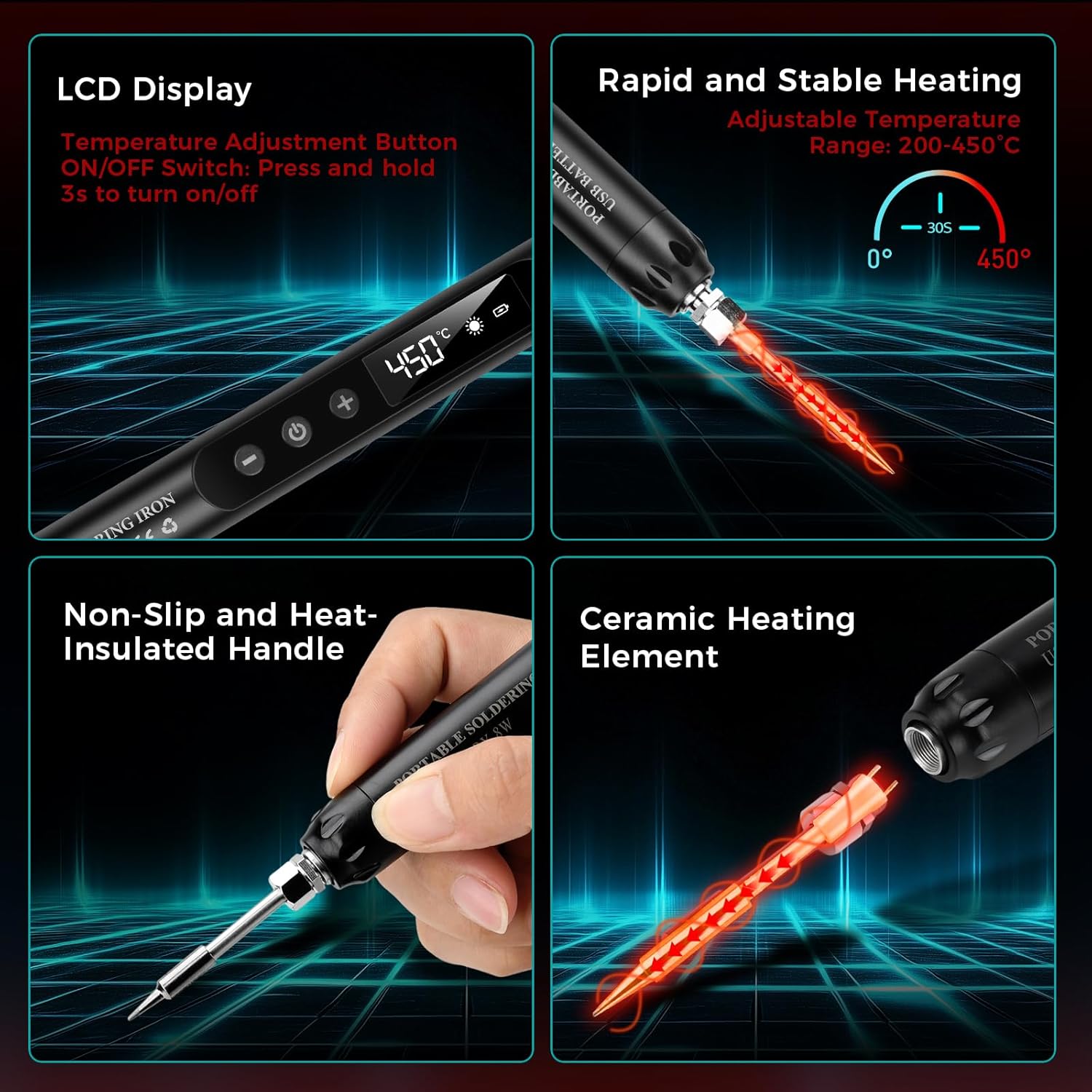
Aworan: Pariview of the soldering iron's key features including the LCD display, rapid heating, non-slip handle, and ceramic heating element.

Aworan: Examples of common applications for the soldering iron, such as repairing circuit boards, jewelry, and other small electronic components.
3. Eto
3.1 Gbigba agbara akọkọ
Before first use, fully charge the soldering iron. Connect the provided USB Type-C charging cable to the soldering iron's charging port and to a compatible USB power source (e.g., wall adapter, computer USB port, power bank).
- A ina pupa indicates that the device is charging.
- A ina alawọ ewe tọkasi wipe batiri ti gba agbara ni kikun.
- Charging typically takes about 1.5 hours.

Image: The soldering iron connected to a USB power source, illustrating the charging indicator lights (red for charging, green for fully charged).
3.2 Attaching a Soldering Tip
Ensure the soldering iron is cool and powered off before changing tips. Carefully screw the desired soldering tip onto the heating element. Do not overtighten.
3.3 Preparing the Work Area
- Ensure your workspace is clean, well-lit, and well-ventilated.
- Place the soldering iron stand on a stable, heat-resistant surface.
- Moisten the sponge in the soldering iron holder with a small amount of water. This sponge is used for cleaning the tip.
- Have your solder wire, rosin, and components ready.
4. Awọn ilana Iṣiṣẹ
4.1 Titan / Pa a
To power on the soldering iron, press and hold the power button for approximately 3 seconds until the LCD screen illuminates. To power off, press and hold the power button again for 3 seconds.
4.2 Siṣàtúnṣe iwọn otutu
Once powered on, use the '+' and '-' buttons to adjust the desired temperature. The temperature range is 200-450°C (392-842°F). The LCD screen will display the current temperature.

Image: The soldering iron's LCD screen displaying the temperature and controls for adjustment and unit conversion.
4.3 Yipada awọn iwọn otutu
The soldering iron supports both Celsius (°C) and Fahrenheit (°F). Refer to the product's specific instructions or button labels for switching between these units, typically by a short press of a dedicated button or a combination of temperature adjustment buttons.
4.4 Soldering Process
Follow these steps for effective soldering:
- Moisten the Sponge: Ensure the cleaning sponge is damp.
- Agbara Tan: Turn on the soldering iron and set the desired temperature. Allow it to heat up.
- Apply Rosin Flux: If necessary, apply a small amount of rosin flux to the components or PCB pads to improve solder flow.
- Gbona Apapọ: Touch the hot soldering iron tip to both the component lead and the PCB pad simultaneously. Heat them for a few seconds.
- Waye Solder: While heating, touch the solder wire to the heated joint (not directly to the iron tip). The solder should melt and flow smoothly around the joint.
- Remove Solder and Iron: Once enough solder has flowed, remove the solder wire first, then remove the soldering iron. Allow the joint to cool naturally without disturbance.
- Mọ Imọran naa: Wipe the hot soldering iron tip on the moist sponge to remove excess solder and oxidation.
- Agbara Pa: When finished, turn off the soldering iron and place it securely in its stand to cool.

Image: A step-by-step visual guide demonstrating the proper soldering technique.
5. Itọju
5.1 Cleaning the Soldering Tip
Regular cleaning of the soldering tip is crucial for optimal performance and longevity. Wipe the hot tip on a moist sponge frequently during use to remove excess solder and oxidation. For stubborn residue, use a brass wire cleaner (not included) or specialized tip cleaner.
5.2 Replacing Soldering Tips
Ensure the iron is cool and unplugged. Unscrew the old tip and screw in a new one. Only use compatible replacement tips.
5.3 Itọju Batiri ati Ibi ipamọ
- Avoid fully discharging the battery frequently. Recharge when the battery indicator is low.
- Store the soldering iron in a cool, dry place when not in use, preferably in its toolbox.
- If storing for extended periods, charge the battery to about 50% to prolong its lifespan.
6. Laasigbotitusita
- Irin Ko Alapapo:
- Check if the iron is powered on (LCD screen should be lit).
- Rí i dájú pé batiri náà ti gba agbára. So mọ́ orísun agbára kan kí o sì ṣàyẹ̀wò àmì ìgba agbára náà.
- Verify the soldering tip is securely attached.
- Solder Not Melting or Poor Joints:
- Mu iwọn otutu ti a ṣeto pọ si.
- Clean the soldering tip thoroughly; a dirty tip cannot transfer heat effectively.
- Ensure you are heating both the component lead and the pad, not just the solder.
- Use fresh solder wire.
- Batiri Ko Ngba agbara:
- Check the USB Type-C cable for damage and ensure it's properly connected.
- Try a different USB power source or wall adapter.
7. Awọn pato
| Nọmba awoṣe | A38IDCE0130-003 |
| Orisun agbara | Agbara Batiri |
| Wattage | 8 watt |
| Adijositabulu otutu | 200-450°C (392-842°F) |
| Agbara Batiri | 800 mAh (Itumọ ti) |
| Akoko gbigba agbara | Isunmọ. wakati meji 1.5 |
| Akoko Iṣiṣẹ | Isunmọ. Awọn iṣẹju 30 (tẹsiwaju) |
| Alapapo Time | 10 seconds to heat, 30 seconds to max temperature |
| Mu Ohun elo | Ṣiṣu, Roba |
| Iwọn Nkan | 210 giramu |
| Package Mefa | 24 x 9.4 x 3.7 cm |
8. Atilẹyin ọja ati Support
This Voktta product is covered by a standard manufacturer's warranty against defects in materials and workmanship. Please refer to your purchase documentation for specific warranty terms and duration.
For technical support, warranty claims, or replacement parts, please contact the retailer or manufacturer directly. Keep your proof of purchase for warranty validation.