
GUSTARD R30
Ìwé Ìtọ́sọ́nà Olùlò DAC fún GUSTARD R30
Awoṣe: R30
Ọrọ Iṣaaju
This manual provides detailed instructions for the setup, operation, and maintenance of your GUSTARD R30 Fully-Discrete R2R Network Streamer DAC. Please read this manual thoroughly before using the device to ensure optimal performance and longevity.
Akojọ apoti
Nigbati o ba ṣii package, jọwọ rii daju pe gbogbo awọn nkan wọnyi wa pẹlu:
- GUSTARD R30 Mainframe
- Okun agbara
- Okun USB
- Isakoṣo latọna jijin
- Kaadi atilẹyin ọja

Iwaju Panel Loriview
The front panel of the GUSTARD R30 features essential controls and a display for real-time status and operations.
- Bọtini agbara: Toggles between standby and active states. The R30 can remain in standby mode when the rear power switch is ON.
- Agbegbe Ifihan: Shows the current input channel, encoding format, and sampling rate. Displays menu items when in the setup menu.
- Ifihan iwọn didun: Indicates the current volume level, ranging from -63.5dB to 0dB. 'FIXED' indicates bypass mode. Displays menu options during configuration.
- '-' Bọtini: Normally decreases volume. Cycles through options in the menu.
- Bọtini jia: Short press switches inputs. Long press enters/exits the menu. Short press navigates items in the menu.
- '+' Bọtini: Normally increases volume. Cycles through options in the menu.

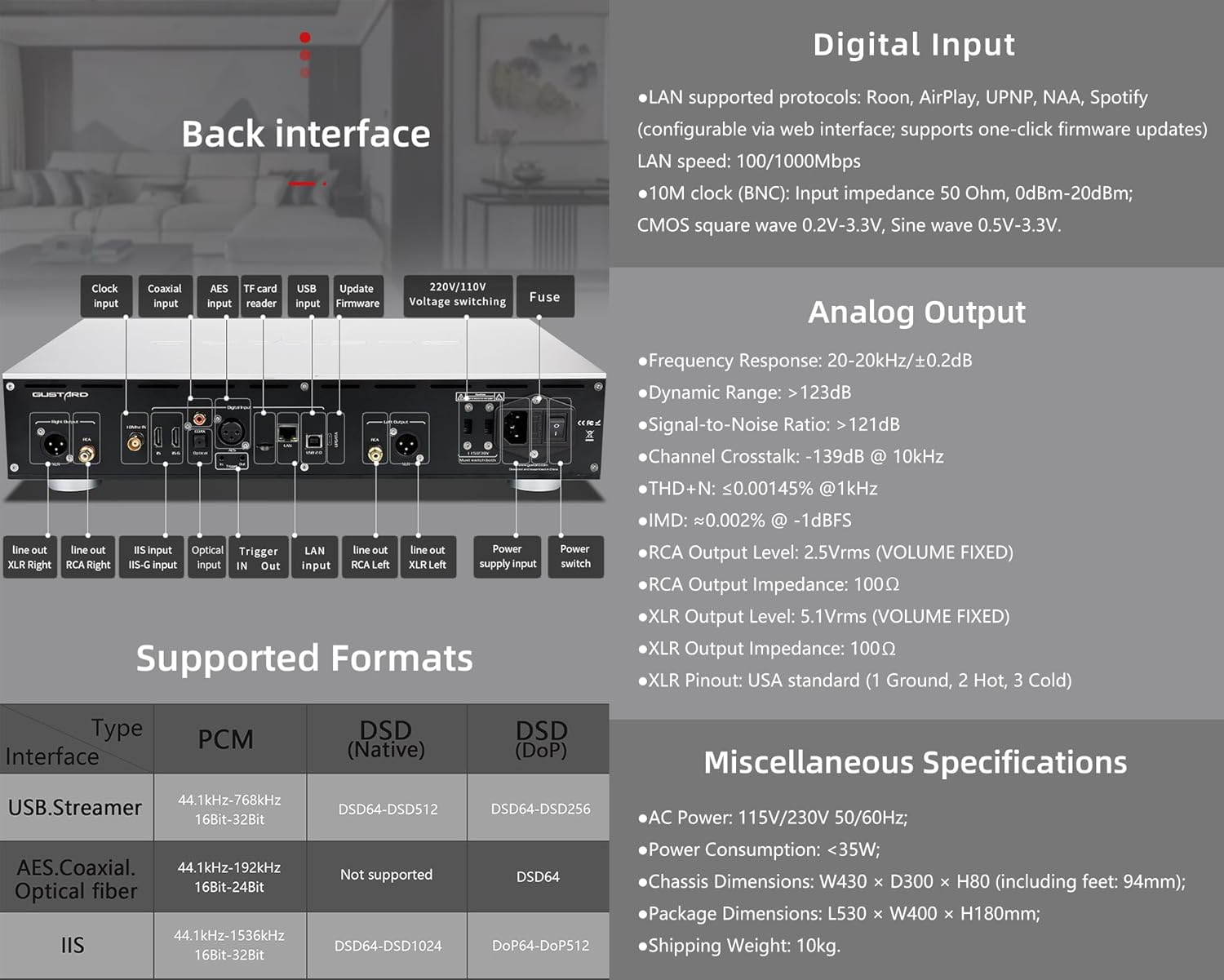
Pada Panel Loriview
The rear panel provides various input and output connections for the GUSTARD R30.
- Iṣawọle aago: For external 10MHz clock synchronization.
- Iṣawọle Coaxial: Ìbáṣepọ̀ ohùn oní-nọ́ńbà.
- Iṣawọle AES: Ìbáṣepọ̀ ohùn oní-nọ́ńbà.
- Input USB: For connecting to a computer or other USB audio source.
- LAN Input: For network streaming functionality.
- Oluka Kaadi TF: Fun awọn imudojuiwọn famuwia.
- Ṣe imudojuiwọn Firmware: USB port for firmware updates.
- 220V/110V Voltage Yipada: Selector for power voltage.
- Fiusi: Fiusi agbara.
- Line Out XLR Right/Left: Balanced analog audio outputs.
- Line Out RCA Right/Left: Unbalanced analog audio outputs.
- IIS Input (IIS-G): Digital audio input with Gustard pinout.
- Iṣawọle Opitika: Ìbáṣepọ̀ ohùn oní-nọ́ńbà.
- Nfa Wọle/Jade: For 12V trigger control.
- Iṣagbewọle Ipese Agbara: AC power connection.
- Agbara Yi pada: Agbára ìyípadà pàtàkì.
Important: Ensure both voltage switches are set to the same voltage when operating the 220V/110V voltage switch, otherwise, it may damage the internal transformer upon powering on.
Display & Panel Controls
The R30 utilizes a large OLED display for real-time status monitoring and functional operations. The diagram below illustrates the main interface display states.
1. Ifihan OLED
The display shows the input channel, external clock indication, encoding format, sampoṣuwọn ling, ati iwọn didun.
2. Input Channel Selection
The R30 features 7 input channels. On the main interface, each press of the Gear Button cycles through available channels in this sequence: COAX → AES → OPT → USB → STREAMER → IIS(G) → IIS(M*).
***Note: IIS(G) is for fixed Gustard pinout configuration and cannot be adjusted. IIS(M*) supports adjustable pinout configuration.
3. Atunse iwọn didun
- When the main interface is displayed, pressing the "+" or "-" buttons directly adjusts the analog volume attenuation function of the passive preamplifier. Attenuation ranges from 0dB to -63.5dB (total 63.5dB attenuation).
- Pressing "+" at 0dB activates Fixed Output mode (bypassing attenuation circuit), displaying 'FIXED' indicator.
- When 'FIXED' is displayed, pressing "-" first exits bypass mode before controlling the attenuation level.

Akojọ Akojọ aṣyn
On the main screen, long press the Gear Button to enter the settings menu (hereinafter referred to as the menu button). In this state, the menu button can sequentially switch the menu items to be modified. "+" and "-" buttons are used to adjust the currently selected menu options. When the screen is in the settings menu, long press the menu button again to return to the main screen.
Eto akojọ:
- PCM àlẹmọ
- DSD àlẹmọ
- Ipo NOS
- REF CLOCK
- IIS MODE
- AGBARA
- TRIGGER CH.
- TRIGGER VOL.
- Afihan

Awọn iṣẹ Akojọ aṣyn
Access the menu by pressing the Menu Button on the main interface. Each menu option is detailed below.
1. PCM FILTER (PCM Digital Filter Adjustment)
The R30 employs a self-developed high-performance PCM oversampling digital filter module with three filter types:
- VIVID (Default): Similar to the FAST roll-off type of traditional digital filter, but with better ringing characteristics, very small pre-ringing, and fast convergence post-ringing. It aims for a broad soundstage and sound restoration. Recommended for most music styles.
- GENTLE: Similar to the SLOW roll-off type of traditional digital filter, offering a soft listening experience.
- KỌKỌ: A hybrid digital filter, balancing characteristics between Vivid and Gentle for a good listening experience.
2. DSD FILTER (DSD Digital Filter Adjustment)
The DSD filter has 4 built-in bandwidth options: 47K (Default), 50K, 60K, 70K.
3. NOS MODE (No Oversampling Filter Mode)
When enabled, the PCM signal bypasses the oversampling filter entirely, decoded straight through the R-2R decoder module. This preserves micro-details and timing integrity. When enabled, there may be a slight clicking sound when the playback data format switches between PCM and DSD.
- DISABLE (Default)
- MU
4. REF CLOCK (Reference Clock Selection)
The GUSTARD-K2, low-noise clock synthesizer, achieves ultra-low jitter performance. The R30 offers two clock options:
- INTERNAL (Default): Uses the built-in OCXO internal reference.
- EXT. 10MHz: Selects an external 10MHz reference source. It is recommended to connect to GUSTARD C16 or C18 reference 10M master clocks.
If the external clock is lost, powered off, or its frequency deviation is greater than +/-150ppm, "EXT ERR" will be displayed and flash.
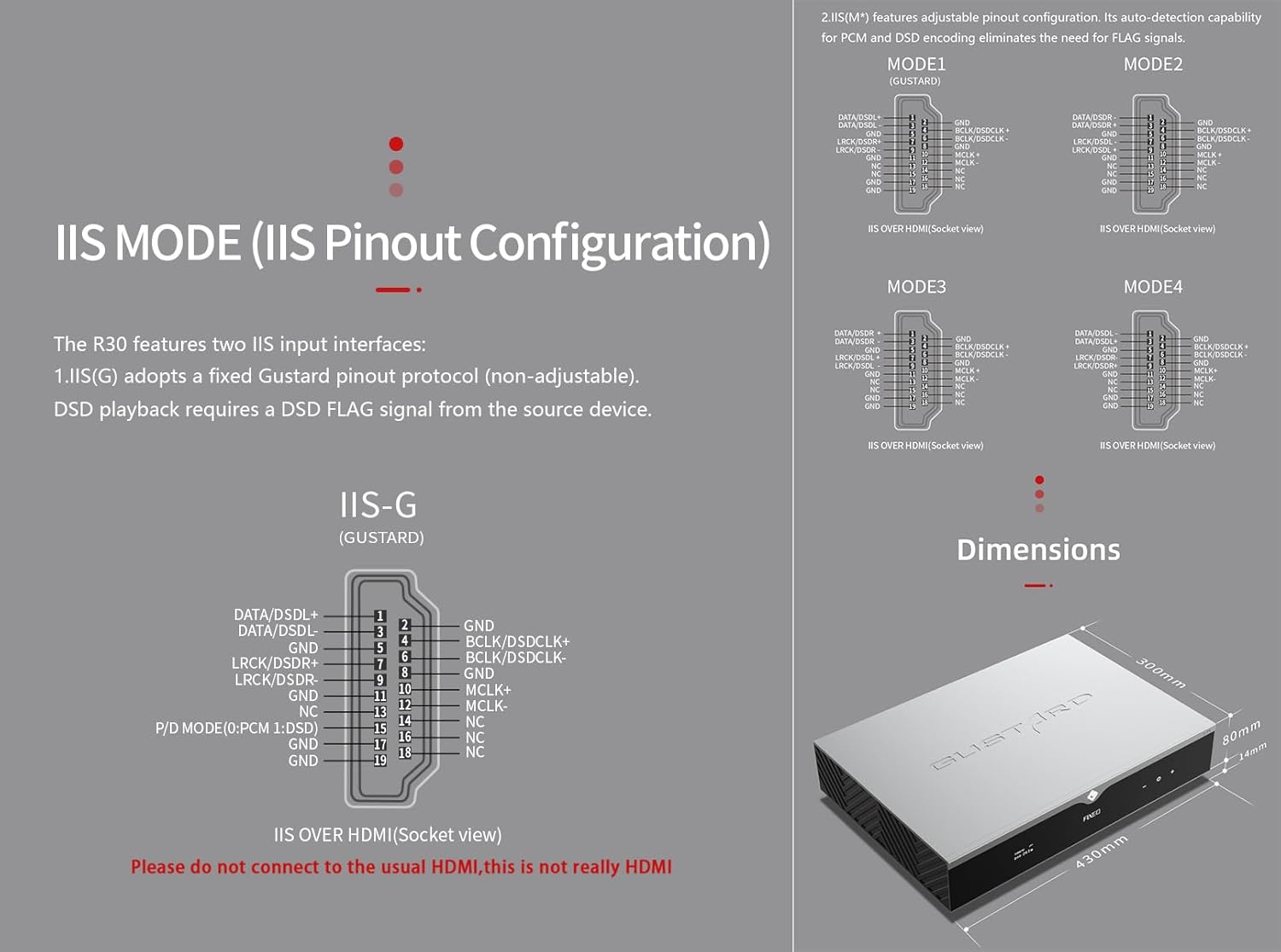
5. IIS MODE (IIS Pinout Mode Selection)
The R30 features two IIS input interfaces:
- IIS(G): Fixed Gustard pinout protocol (non-adjustable). DSD playback requires a DSD FLAG signal from the source device.
- IIS(M*): Features adjustable pinout configuration. Its auto-detection capability for PCM and DSD encoding eliminates the need for FLAG signals.
IIS(M*) adjustable Pinout mode IIS input has four Pinouts: MODE1 (Default), MODE2, MODE3, MODE4. MODE1 is compatible with the GUSTARD mode. If you are connecting to a GUSTARD front end such as U12, U16, U18, S16, S26, etc., you can match them with MODE1, which is the former works in the Gustard output mode.
Please do not connect to the usual HDMI, this is not really HDMI.
6. PHASE (Phase Setting)
This function offers two options:
- NON-inverted (Default): When non-inverted, the RCA output of R30 is normal phase, and the XLR balanced output is American standard polarity output (1 ground, 2 hot, 3 cold).
- Yipada: When inverted, only the RCA output is reverse phase, and the XLR balanced output is Japanese/European standard polarity output (1 ground, 2 cold, 3 hot).
7. TRIGGER CH. (Linkage Trigger Start Channel Selection)
The R30 can be triggered by an external 12V linkage signal and automatically turn on from standby mode. When the 12V trigger signal ceases or drops to 0V, automatic standby activation occurs. When the R30 is working, it is switched to the input channel of this setting by the 12V trigger linkage signal.
- LAST (Default): The input channel that was in use before entering standby last time.
- Other options include COAX, AES, OPT, USB, STREAMER, IIS(G), IIS. Selecting any channel activates it upon receiving a 12V trigger signal.
8. TRIGGER VOL. (Link Trigger Boot Volume Selection)
The R30 can be powered on from standby via an external 12V trigger signal and automatically set to the selected volume level. Alternatively, during operation, a 12V trigger signal switches the output to the preset volume. This option configures the output volume after trigger activation.
- LAST (Default): The volume used before entering standby.
- TITUN: Fixed full-scale output bypassing attenuation.
- -20dB: Output at a volume attenuated to -20dB.
- -30dB: Output at a volume attenuated to -30dB.
- -40dB: Output at a volume attenuated to -40dB.
9. DISPLAY (Screen Brightness Settings)
Long-term high-brightness use of OLED screens can cause screen burn-in or ghosting. Therefore, the R30 is designed to always select automatic screen off, or manually select automatic screen off, which can also reduce interference.
- AUTO (Default): Automatically reduce brightness.
- AOTO PA: Automatically turn off the screen.
Isakoṣo latọna jijin Iṣakoso
When operating DAC products, press and hold the DAC button for over 3 seconds to enter DAC control mode. AMP/STREAM modes control other Gustard products.
- Duro die: Press once to activate R30 from standby. Press once during operation to enter standby.
- Akojọ: Press to access R30's setup menu.
- Pad with 4 direction keys: Up/Down navigates menu items. Left/Right adjusts selected options. Center press activates/deactivates mute.
- Pada: Returns to main interface.
- Vol-: Decreases output volume on main interface.
- Vol+: Increases output volume on main interface.
Awọn akọsilẹ:
- Operational range varies with angle.
- Obstructions between remote and sensor may cause malfunction.
- Remove batteries if unused for more than 1 month.
- Thoroughly clean battery compartment if leakage occurs.
- May accidentally trigger other IR-controlled devices.

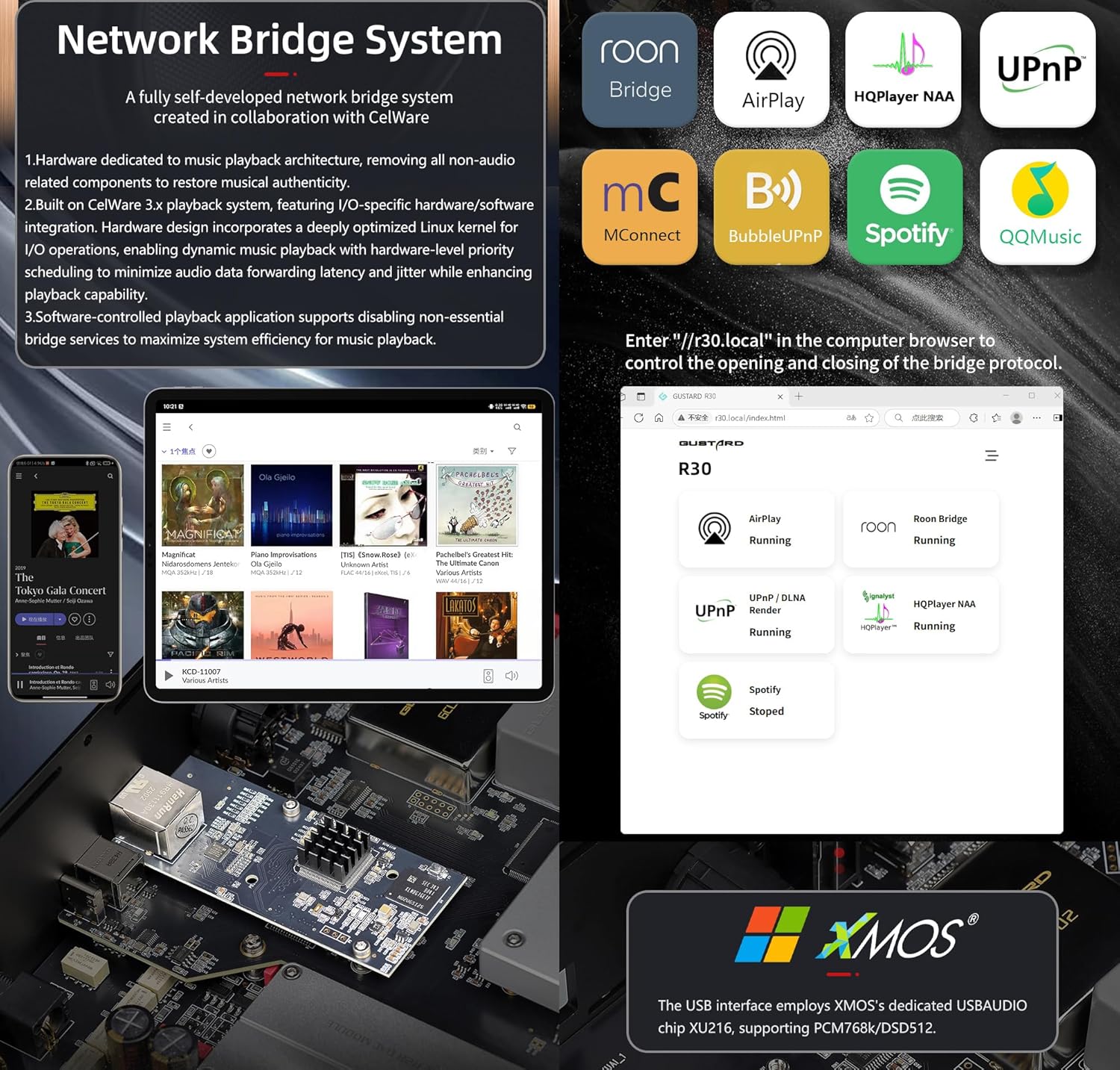
Network Bridge Streamer Quick Start
After connecting R30's RJ45 port to your local network:
- Select the STREAMER channel and await system boot (approximately 1 minute, until "DSD 24.5MHz" appears).
- Access R30's configuration page via: http://R30.local (as shown below). Disable unused streaming protocols on the web interface to maximize system efficiency. Firmware updates are also performed here.
(Mobile/tablet operation pending until dedicated app release)
You can turn off streaming protocols that are not frequently used through the web page to maximize system music playback performance. At the same time, the online upgrade of the Streamer is also operated on the web oju-iwe.
(After the dedicated Streamer APP is launched, the above operations can be performed in the APP)
Official Product Video: GUSTARD R30 - User Manual
Awọn pato ọja
Digital Input Support Formats:
| Iru | PCM | DSD (Ibibi) | DSD (DoP) |
|---|---|---|---|
| USB.Streamer | 44.1kHz-768kHz 16Bit-32Bit | DSD64-DSD512 | DSD64-DSD256 |
| AES.Coaxial.Optical fiber | 44.1kHz-192kHz 16Bit-24Bit | Ko ṣe atilẹyin | DSD64 |
| IIS | 44.1kHz-1536kHz 16Bit-32Bit | DSD64-DSD1024 | DoP64-DoP512 |
Iṣẹ Analog:
- Frequency Response: 20-20kHz/±0.2dB
- Iwọn Yiyi:> 123dB
- Eto Ifihan-si-Noise:> 121dB
- Channel Crosstalk: -139dB @ 10kHz
- THD+N: ≤ 0.00145% @1kHz
- IMD: ≈0.002% @ -1dBFS
- RCA Output Level: 2.5Vrms (VOLUME FIXED)
- RCA Output Impedance: 100Ω
- XLR Output Level: 5.1Vrms (VOLUME FIXED)
- XLR Output Impedance: 100Ω
- XLR Pinout: USA standard (1 Ground, 2 Hot, 3 Cold)
Awọn pato miiran:
- AC Power: 115V/230V 50/60Hz
- Lilo agbara: <35W
- Chassis Dimensions: W430 × D300 × H80 (including feet: 92mm)
- Package Dimensions: L530 × W400 × H180mm
- Shipping Weight: 10kg (with package)
- 10MHz BNC Input: Input impedance 50 Ohm, 0dBm-20dBm; CMOS square wave 0.2V-3.3V, Sine wave 0.5V-3.3V.
- Trigger: IN- 12V Typ. OUT- 12V Typ.
Awọn ofin atilẹyin ọja
Thank you for choosing GUSTARD HIFI products. To safeguard your rights and interests, please read the following warranty terms carefully. You can promptly obtain comprehensive after-sales service provided by GUSTARD.
Atilẹyin ọja
You will enjoy a 2-year free warranty and lifetime maintenance after the date of purchasing GUSTARD's HIFI product.
* Olupese jẹ awọn ẹru nikan lati oluile China. Apakan ẹru ati owo-ori ti a ṣejade lati okeokun yoo jẹ ipinnu nipasẹ olumulo pẹlu idunadura oniṣowo.
Iṣẹ atilẹyin ọja ọfẹ
GUSTARD R30 from the purchasing ní àsìkò ìdánilójú ọ̀fẹ́, olùlò náà lo ọjà náà ní àsìkò déédé, ọjà náà sì kùnà nítorí dídára ẹ̀yà ara tàbí ìṣòro ìṣelọ́pọ́.
Ni ikọja Iṣẹ atilẹyin ọja
Belonging to one of the following circumstances, products are no longer provided warranty service:
- Awọn ọja lati ọjọ rira ti kọja akoko atilẹyin ọja ti a ti pinnu tẹlẹ.
- Awoṣe, awọn koodu iwọle ati ọjọ rira ko baramu ọja gangan ati kaadi atilẹyin ọja.
- Without GUSTARD technician permission, unauthorized modifications to the circuit, components or self-repaired product.
- Bibajẹ ti o ṣẹlẹ nipasẹ awọn ipa aye ti a ko le koju.
- Ni ikọja lilo idasilẹ ti ibajẹ ayika.
- Bibajẹ nitori lilo ti ko tọ tabi ibi ipamọ aibojumu. Pẹlu ṣugbọn kii ṣe opin si: voltage jẹ ga ju lati sun awọn iyika tabi irinše; Bumping ati Abajade ni ibajẹ ikarahun tabi inu; bibajẹ nitori omi, epo, omi ati eruku pupọ; ifoyina ọja tabi ipata, ati bẹbẹ lọ.
- Ni ikọja akoko atilẹyin ọja, gẹgẹbi ibajẹ paati ẹni kọọkan, irisi nitori ibajẹ eniyan, awọn iyipada famuwia yori si ailagbara lati ṣiṣẹ nipasẹ awọn olumulo laigba aṣẹ. GUTARD ṣe adehun lati gba awọn idiyele itọju to tọ (ayafi awọn paati agbegbe nla tabi igbimọ iyika ti o jo kọja atunṣe). Ẹru ati awọn idiyele itọju, awọn idiyele ohun elo nilo olumulo lati ru.
Ibi iwifunni
Olupese: Shenzhen Goshide Technology Co., LTD
Adirẹsi: Room 302, Building 1, No. 28, Huimin 1st Road, Guanlan Sub-district, Longhua District, Shenzhen City, Guangdong Province
Tẹli: + 86-18682080102
Webojula: http://www.gustard.com
Imeeli: service@gustard.com
Ask a question about this manual
Ask about setup, troubleshooting, compatibility, parts, safety, or missing instructions. Manuals+ will review the question and use this page’s manual context to help answer it.