
1. Ifihan
Thank you for choosing the HMF 1608-02 Portable Document Safe. This safe is designed to provide secure storage for your valuable documents, cash, and other small items. It features a robust steel sheet body, an electronic lock with a customizable code, and an emergency key override. For added security, an anti-theft metal cable is included. Please read this manual carefully before initial use to ensure proper setup and operation.
2. Awọn ilana aabo
- Keep Emergency Keys Secure: Store the emergency keys in a safe location, separate from the safe itself, and not inside the safe.
- Mimu Batiri: Use only the specified battery type. Do not mix old and new batteries or different types of batteries. Remove batteries if the safe will not be used for an extended period.
- Yago fun Ọrinrin: Do not expose the safe to water or high humidity.
- Ibi ti o yẹ: Ensure the safe is placed on a stable, flat surface.
- Awọn ọmọde: Keep the safe and its keys out of reach of children.
3. Package Awọn akoonu
Jọwọ ṣayẹwo pe gbogbo awọn nkan wa ninu package:
- HMF 1608-02 Portable Document Safe
- Emergency Keys (2 pieces)
- Anti-theft Metal Cable
- Ilana Afowoyi (iwe yii)
4. Ọja Ipariview
Familiarize yourself with the components of your HMF 1608-02 safe.

Nọmba 4.1: Ode view of the HMF 1608-02 safe, highlighting the electronic keypad for code entry, the central rotary knob for locking/unlocking, and the emergency keyhole.

Nọmba 4.2: Inu ilohunsoke view of the HMF 1608-02 safe when open. The bottom is lined with foam for protection, and the battery compartment for the electronic lock is visible on the inside of the lid.

Nọmba 4.3: The safe's interior, showcasing its capacity to hold various items such as a smartphone, camera lens, and banknotes, with a protective foam base.
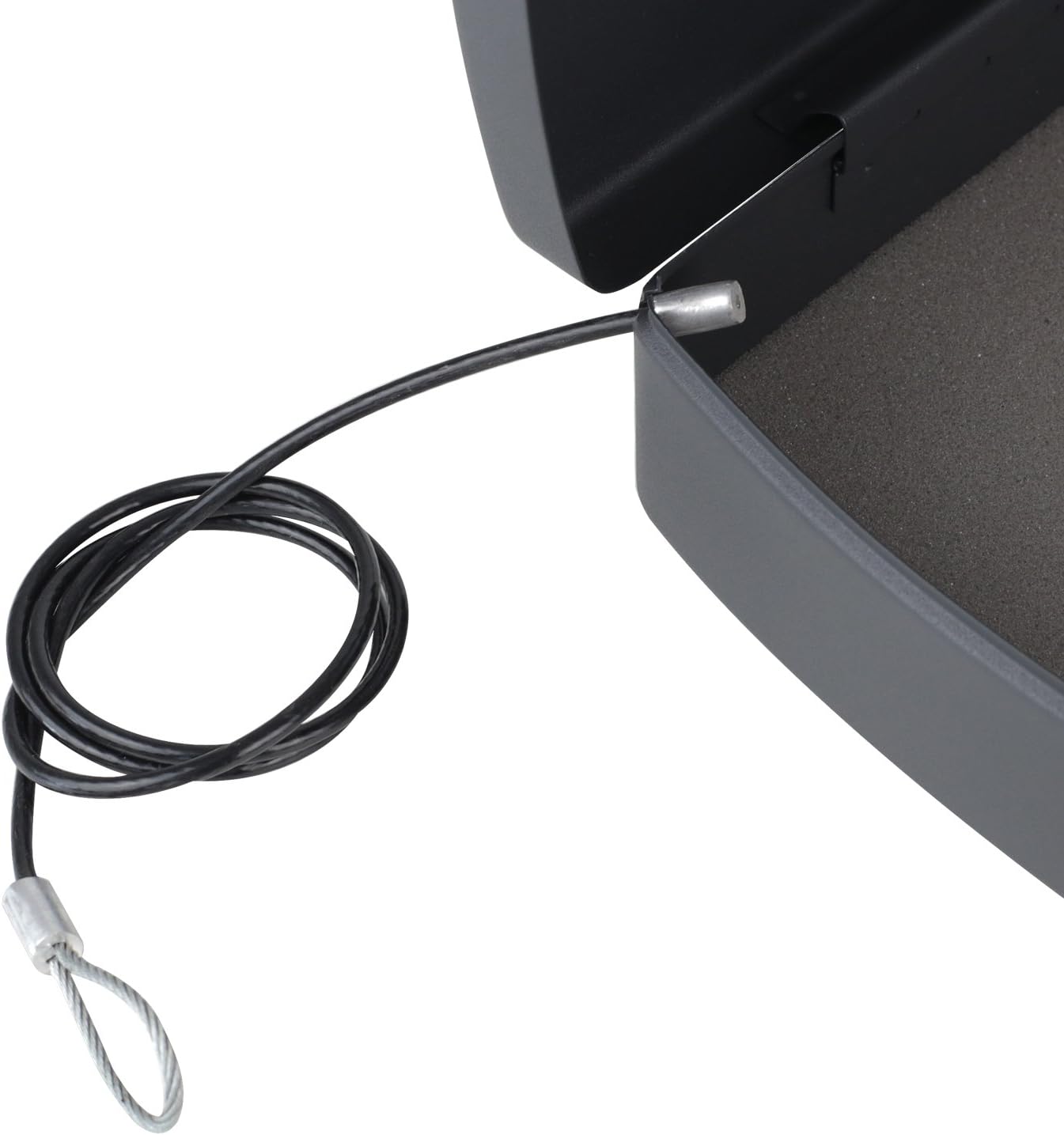
Nọmba 4.4: Detail of the anti-theft metal cable, designed to secure the safe to a fixed object, providing an additional layer of protection.

Nọmba 4.5: The integrated carrying handle on the front of the safe, demonstrating its portability and ease of transport.
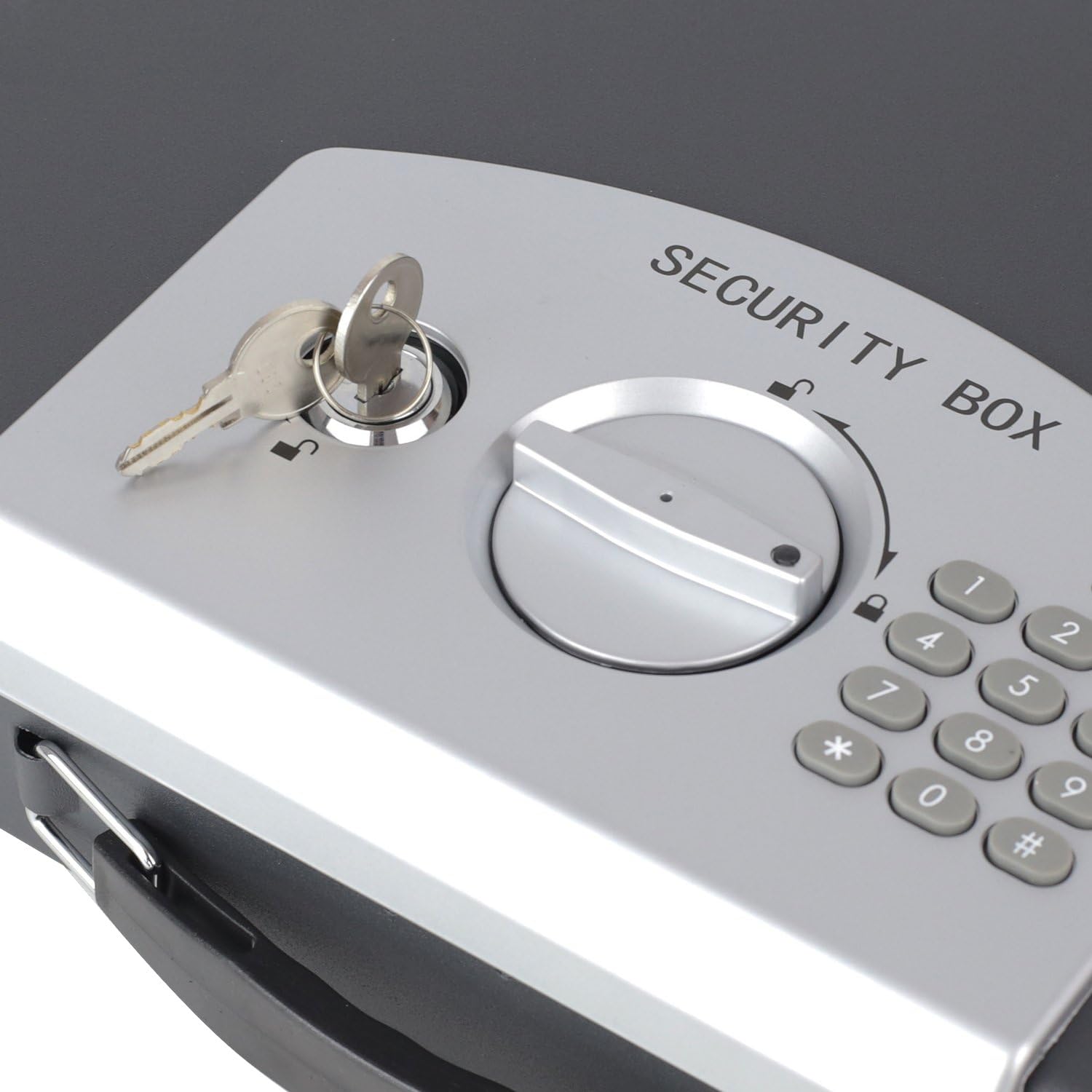
Nọmba 4.6: A alaye view of the emergency keyhole, located on the control panel, which allows manual access to the safe.
5. Eto
5.1 Fifi sori batiri
- Open the safe using the emergency key (refer to section 5.3 if needed).
- Locate the battery compartment on the inside of the safe's lid (refer to Figure 4.2).
- Ṣii ideri iyẹwu batiri naa.
- Insert the required batteries (typically 4x AA, not included) according to the polarity indicators (+/-).
- Pa ideri batiri naa ni aabo.
5.2 Setting the Electronic Code
After installing batteries, you can set your personal electronic code.
- With the safe door open, locate the small red or green reset button on the inside of the door, near the battery compartment.
- Tẹ bọtini atunto naa. O yẹ ki o gbọ ariwo kan, ati pe ina itọkasi lori bọtini itẹwe yoo tan imọlẹ.
- Within 5 seconds, enter your desired personal code (3-8 digits) on the keypad.
- Confirm your code by pressing the '#' button.
- The indicator light will flash, and you will hear a confirmation beep, indicating the new code is set.
- Test the new code: With the door still open, enter your new code and press '#'. The safe should indicate it's unlocked. If it doesn't, repeat the steps.
5.3 Lilo Bọtini Pajawiri
The emergency key provides manual access to the safe in case of battery failure or forgotten code.
- Locate the emergency keyhole on the control panel (refer to Figure 4.6).
- Fi ọ̀kan lára àwọn kọ́kọ́rọ́ pajawiri tí a pèsè sínú ihò kọ́kọ́rọ́ náà.
- Turn the key clockwise (or counter-clockwise, depending on the lock) while simultaneously turning the rotary knob on the control panel to the unlock position.
- The safe door will open.
- Remove the key after opening.
6. Ṣiṣẹ
6.1 Opening with Electronic Code
- Enter your personal electronic code (3-8 digits) on the keypad.
- Press the '#' button.
- If the code is correct, a green indicator light will illuminate, and you will hear a beep.
- Within 5 seconds, turn the rotary knob clockwise (or counter-clockwise) to the unlock position and open the safe door.
6.2 Closing the Safe
- Pa ẹnu-ọna ailewu duro.
- Turn the rotary knob counter-clockwise (or clockwise) to the lock position. The safe is now secured.
6.3 Using the Anti-Theft Cable
The included metal cable can be used to secure the safe to a fixed object, deterring opportunistic theft.
- Locate the cable attachment point on the safe (refer to Figure 4.4).
- Thread the loop end of the metal cable through a secure, fixed object (e.g., a desk leg, a heavy piece of furniture).
- Attach the other end of the cable to the designated slot on the safe.
- Ensure the cable is taut and the safe cannot be easily moved.
7. Itọju
7.1 Batiri Rirọpo
When the batteries are low, the indicator light may flash red or the keypad may not respond. Replace batteries promptly to avoid being locked out.
- Open the safe using either the electronic code or the emergency key.
- Open the battery compartment on the inside of the lid.
- Yọ awọn batiri atijọ kuro ki o si sọ wọn nù ni ifojusọna.
- Fi awọn batiri titun sii, ni idaniloju polarity ti o pe.
- Pa abala batiri naa.
7.2 Ninu
Nu ita ti ailewu pẹlu asọ, damp asọ. Ma ṣe lo abrasive ose tabi olomi, bi awọn wọnyi le ba ipari tabi itanna irinše.
8. Laasigbotitusita
- Safe does not open with electronic code:
- Rii daju pe awọn batiri ti fi sori ẹrọ daradara ati pe wọn ko dinku. Rọpo ti o ba wulo.
- Verify you are entering the correct code.
- Ensure you press '#' after entering the code and turn the knob within 5 seconds.
- Keypad is unresponsive or indicator light is dim:
- Batteries are likely low. Replace them immediately.
- Safe locks after multiple incorrect attempts:
- The safe may enter a lockout mode after 5 incorrect code entries. Wait for the lockout period to expire (typically a few minutes) or use the emergency key to open.
- Emergency key does not work:
- Ensure the key is fully inserted and turned correctly while simultaneously operating the rotary knob.
9. Awọn pato
- Awoṣe: HMF 1608-02
- Ohun elo: Alloy Irin
- Àwọ̀: Dudu
- Titiipa Iru: Itanna, Bọtini
- Exterior Dimensions (L x W x H): 33 cm x 29.5 cm x 7.5 cm (13.0 ni x 11.6 ni x 3.0 in)
- Interior Dimensions (L x W x H): 30 cm x 22.5 cm x 5.5 cm (11.8 ni x 8.9 ni x 2.2 in)
- Ìwúwo: 1.9 kg (4.19 lbs)
- Document Compatibility: A4 format
- Awọn ẹya pataki: Portable, Anti-theft protection (via cable), Carrying handle
10. Atilẹyin ọja ati Support
HMF products are manufactured to high-quality standards. For warranty information or technical support, please refer to the contact details provided at the point of purchase or visit the official HMF webojula. Jọwọ ṣe idaduro ẹri rira rẹ fun awọn iṣeduro atilẹyin ọja.