Ọrọ Iṣaaju
The TASCAM DR-100MKII is a high-performance linear PCM recorder designed for professional audio recording. This manual provides essential information for setting up, operating, maintaining, and troubleshooting your DR-100MKII to ensure optimal performance and longevity.
Key Awọn ẹya ara ẹrọ
- High-resolution 24-bit/96kHz linear PCM (WAV) and MP3 recording.
- Robust aluminum chassis for durability in demanding environments.
- Dual XLR/TRS combo inputs with +4dBu line level and +48V phantom power.
- Independent left/right rotary input gain controls for precise level adjustment.
- Four built-in microphones: two unidirectional and two omnidirectional.
- Dedicated line output separate from headphone output for high-quality audio routing.
- Digital input for lossless connection from external playback devices.
- Mechanical switches for reliable and quick operation.
- Supports SD/SDHC memory cards (2GB SD card included).
- Includes RC-10 wired/wireless remote control.
- Dual battery power system (dedicated Li-ion and AA batteries).
Ṣeto
1. Fifi sori batiri
The DR-100MKII supports both a dedicated Li-ion rechargeable battery (BP-L2, included) and two AA dry cell batteries. For extended operation, both can be used simultaneously.
- Wa awọn yara batiri lori pada ti awọn kuro.
- Ṣii ideri batiri naa.
- Insert the BP-L2 Li-ion battery into its designated slot, ensuring correct polarity.
- Insert two AA batteries into their respective slots, observing the polarity markings.
- Pa ideri batiri naa ni aabo.

olusin 1: Ẹyìn view of the DR-100MKII, showing the battery compartment and various switches for mic gain, auto/limiter, and speaker.
2. Fifi sori Kaadi SD
The DR-100MKII uses SD or SDHC memory cards for recording. A 2GB SD card is included.
- Locate the SD card slot on the bottom of the unit.
- Gently push the SD card into the slot until it clicks into place. Ensure the card is inserted with the correct orientation.
- Láti yọ ọ́ kúrò, tẹ káàdì náà sínú rẹ̀ títí yóò fi yọ jáde díẹ̀, lẹ́yìn náà fa á jáde.

olusin 2: Isalẹ view of the DR-100MKII, highlighting the SD card slot and the built-in omnidirectional microphones.
3. Connecting Microphones and Line Inputs
The DR-100MKII offers versatile input options, including XLR/TRS combo jacks and a dedicated line input.
- XLR/TRS Inputs: Located on the bottom of the unit, these inputs support balanced XLR microphones (with +48V phantom power if needed) or 1/4-inch TRS line-level devices. The locking mechanism ensures secure connections.
- Line 2 Input: A 3.5mm stereo mini-jack input is available on the side for connecting external line-level devices.
- Input oni nọmba: A dedicated digital input terminal allows for lossless connection from compatible digital audio sources.
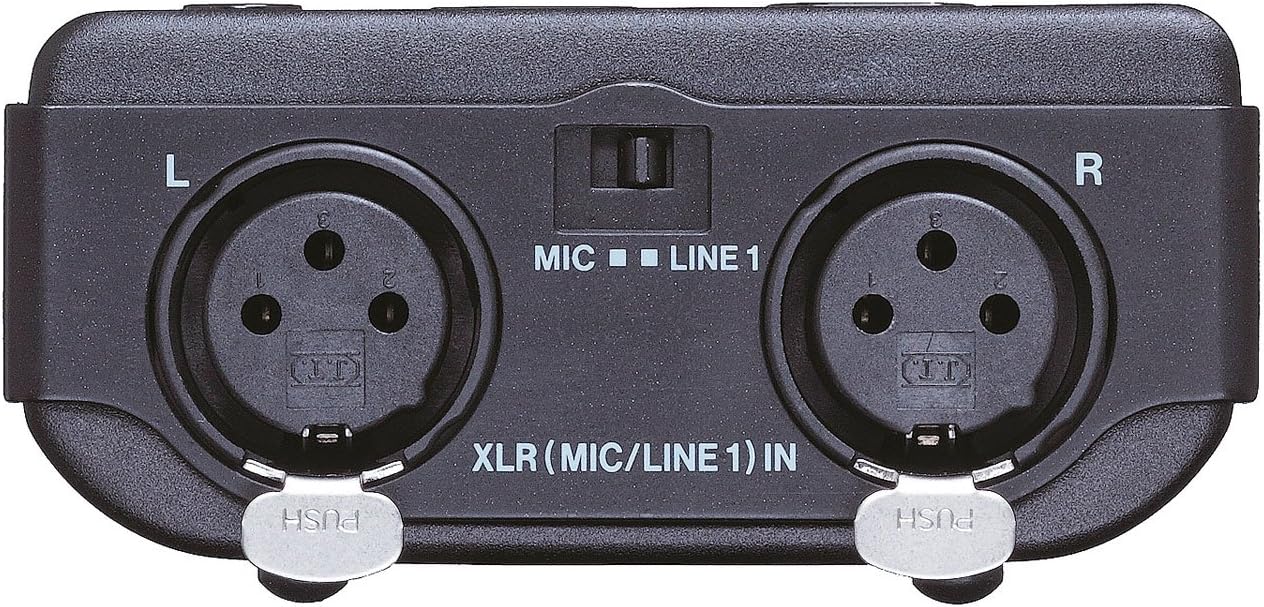
olusin 3: Isunmọ view of the DR-100MKII's bottom, showing the locking XLR (MIC/LINE 1) inputs for professional audio connections.

olusin 4: Apa view of the DR-100MKII, displaying the USB port, DC IN 5V, headphone output, and Line 2 input/output jacks.
4. Connecting Headphones and Line Output
- Agbekọri Ijade: Connect your headphones to the 3.5mm headphone jack on the side for monitoring audio.
- Ijade laini: A dedicated 3.5mm stereo mini-jack line output is available for connecting the DR-100MKII to external mixers, amplifiers, or other audio devices. This output is independent of the headphone output.
5. Agbara lori / Paa
To power on the unit, slide the power switch located on the side. To power off, slide the switch to the OFF position.
Ṣiṣẹ
1. Ipilẹ Gbigbasilẹ
The DR-100MKII can record in WAV (linear PCM) or MP3 formats.
- Yan Orisun Iṣawọle: Use the INPUT switch to select between the built-in microphones (UNI MIC L/R, OMNI MIC L/R) or external inputs (XLR/LINE 1, LINE 2).
- Adjust Input Level: Use the large rotary input volume controls (L and R) on the top of the unit to set the recording level. Monitor the level meters on the LCD to avoid clipping.
- Press RECORD: Tẹ awọn Igbasilẹ button to start recording. The button will illuminate.
- Duro Gbigbasilẹ: Tẹ awọn DURO bọtini lati pari gbigbasilẹ.

olusin 5: Iwaju view of the DR-100MKII, showing the main display, control buttons, and built-in unidirectional microphones.

olusin 6: Top view of the DR-100MKII, illustrating the large rotary input volume dials for precise left and right channel gain adjustment.
2. Advanced Recording Functions
- Auto Gain Control & Limiter: These functions automatically adjust the recording level to prevent distortion. Enable them via the switches on the back of the unit.
- Igbasilẹ ṣaaju: Captures audio from 2 seconds before the RECORD button is pressed.
- Idaduro Igbasilẹ: Delays recording start slightly to avoid capturing button press noise.
- Ajọ-Kekere: Reduces unwanted low-frequency noise (e.g., wind, rumble). Settings: OFF/40/80/120Hz.
- Àṣejù: Allows recording new audio over an existing file, ṣiṣẹda titun kan file.
3. Sisisẹsẹhin
- Yan File: Use the navigation buttons to select the desired audio file lati akojọ.
- Press PLAY/PAUSE: Tẹ awọn ERE/SINMI bọtini lati bẹrẹ ṣiṣiṣẹsẹhin.
- Ṣatunṣe iwọn didun ṣiṣiṣẹsẹhin: Use the volume controls on the side of the unit.
- Tún/Ṣípo: Access these functions through the menu for continuous playback of a file or a specific section.
- VSA (Variable Speed Audition): Adjust playback speed without changing the pitch, useful for transcription or learning.
4. File Isakoso
- Iṣẹ́ Àmì: Add marks at specific points in a recording for easy navigation.
- Track Increment: Automatically or manually split recordings into new files. Auto track increment can be based on file size or input level.
- Divide Function: Split a WAV file into two at a desired point.
- Iyara Tag: Ni kiakia tag files for identification.
5. Using the Remote Control (RC-10)
The included RC-10 remote control can be used wirelessly (infrared) or wired for precise operation, minimizing handling noise during recording.
- Isẹ Alailowaya: Point the remote at the DR-100MKII's IR receiver.
- Isẹ ti firanṣẹ: Connect the remote to the REMOTE/DIGITAL IN port on the side of the unit using the provided cable.

olusin 7: Angled view of the DR-100MKII, showing the REMOTE/DIGITAL IN port on the side, used for the RC-10 remote control and digital audio input.
Itoju
1. Ninu
Mu ese kuro pẹlu asọ ti o gbẹ. Ma ṣe lo awọn olutọpa abrasive tabi awọn olomi, nitori wọn le ba ipari jẹ.
2. Itọju batiri
- Yọ awọn batiri kuro ti ẹyọ naa ko ba ni lo fun akoko ti o gbooro sii lati ṣe idiwọ jijo.
- Recharge the Li-ion battery regularly to maintain its capacity.
3. Ìtọ́jú Káàdì SD
- Always format new SD cards with the DR-100MKII before first use.
- Avoid removing the SD card during recording or playback to prevent data corruption.
Laasigbotitusita
| Isoro | Owun to le Fa | Ojutu |
|---|---|---|
| Ẹka ko ni agbara lori. | Awọn batiri ti dinku tabi fi sii lọna ti ko tọ. | Replace or recharge batteries. Check polarity. |
| No sound during recording/playback. | Input/output levels too low; incorrect input source selected; headphone/line cables not connected properly. | Adjust input/output levels. Verify input source. Check cable connections. |
| Recording level is too low/high. | Input gain not set correctly. | Adjust the rotary input volume controls. Consider using Auto Gain or Limiter. |
| Cannot record to SD card. | SD card full, write-protected, or corrupted. | Paarẹ ti ko wulo files, unlock the card, or format the card (will erase all data). |
| Isakoṣo latọna jijin ko ṣiṣẹ. | Remote batteries depleted; IR path blocked; wired connection loose. | Replace remote batteries. Ensure clear line of sight for IR. Check wired connection. |
Awọn pato
| Ẹya ara ẹrọ | Sipesifikesonu |
|---|---|
| Nọmba awoṣe | DR-100MKII |
| Media Gbigbasilẹ | SD card (64MB to 2GB), SDHC card (4GB to 32GB) |
| Awọn ọna kika gbigbasilẹ | WAV (16/24-bit, 44.1/48/96kHz), MP3 (32-320kbps) |
| Awọn igbewọle | XLR/TRS combo (MIC/LINE 1), 3.5mm stereo mini-jack (LINE 2), Digital In |
| Awọn abajade | 3.5mm stereo mini-jack (LINE OUT), 3.5mm stereo mini-jack (Headphone) |
| Awọn gbohungbohun | Built-in unidirectional x2, built-in omnidirectional x2 |
| Phantom Agbara | +48V (selectable) |
| Ibi ti ina elekitiriki ti nwa | Dedicated Li-ion battery (BP-L2), 2 x AA batteries, AC adapter (optional PS-P520) |
| Igbesi aye Batiri (Isunmọ.) | 7 hours (digital recording) |
| Awọn iwọn (W x H x D) | Nǹkan bíi 80 x 153 x 35 mm (3.15 x 6.02 x 1.38 inches) |
| Iwọn | Approx. 860 g (1.9 lbs) including batteries |
| Ifihan | 128 x 64 backlit dot matrix LCD |
| Ibudo USB | USB 2.0 Mini-B type |
Atilẹyin ọja ati Support
For warranty information, technical support, and service, please refer to the official TASCAM website or contact your local TASCAM distributor. Keep your purchase receipt as proof of purchase for warranty claims.
Online resources, including updated manuals and software, may be available on the TASCAM support page.


