1. Ifihan
This manual provides essential information for the safe and efficient operation of your COTEC SP-1500-212 Pure Sine Wave Inverter. Please read these instructions thoroughly before installation and use to ensure proper functionality and to prevent damage to the unit or connected devices.
1.1 Abo Alaye
Máa tẹ̀lé àwọn ìlànà ààbò wọ̀nyí láti dín ewu ìkọlù iná mànàmáná, iná, tàbí ìpalára kù:
- Ensure proper ventilation around the inverter. Do not block ventilation openings.
- Do not expose the inverter to rain, moisture, or excessive heat.
- Connect the inverter only to a 12VDC battery system.
- Rí i dájú pé gbogbo àwọn ìsopọ̀ náà wà ní ìdúróṣinṣin àti ní ààbò láti dènà ìgbóná ara àti ìbúgbà.
- Maṣe ṣii inverter casing. Ko si awọn ẹya ti o le lo ninu.
- Always disconnect the battery before performing any maintenance or wiring.
- Ikilọ: Product may contain materials cautioned by California Proposition 65.
2. Awọn ẹya Ọja
The COTEC SP-1500-212 Inverter is designed with advanced features for reliable power conversion:
- Ìjáde ìgbì omi sínì mímọ́ fún àwọn ẹ̀rọ itanna onímọ̀lára.
- Power ON / OFF remote control capability (Green Terminal).
- Input & output fully isolation for enhanced safety.
- Temperature & load controlled cooling fan for optimal performance.
- Olumulo ore-ni wiwo.
- Type 1 Indoor Aluminum Enclosure.
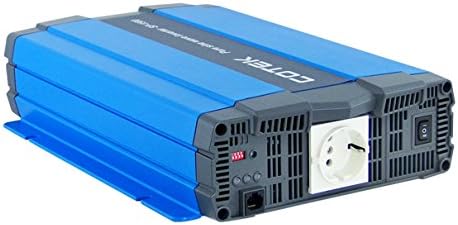
olusin 2.1: Angled view of the COTEC SP-1500-212 Pure Sine Wave Inverter, showcasing its blue and gray casing and output socket.
3. Eto ati fifi sori
Proper installation is crucial for the inverter's performance and safety. Follow these guidelines carefully.
3.1 Ibi
Install the inverter in a dry, well-ventilated area, away from direct sunlight, heat sources, and flammable materials. Ensure there is adequate space around the unit for airflow, especially around the cooling fan vents.
3.2 DC Input Connection (12VDC)
Connect the inverter to a 12VDC battery bank using appropriate gauge cables. Ensure correct polarity: connect the positive (+) terminal of the inverter to the positive (+) terminal of the battery, and the negative (-) terminal of the inverter to the negative (-) terminal of the battery. Use fuses or circuit breakers on the DC input line as recommended by local electrical codes and the inverter's specifications.

olusin 3.1: Iwaju view of the inverter showing the DC input terminals (red for positive, black for negative) and the chassis ground screw.
3.3 AC Output Connection (230VAC)
Connect your AC appliances to the inverter's 230VAC output socket. Ensure the total power consumption of all connected devices does not exceed the inverter's rated output power (1500W continuous). Avoid connecting high-surge devices that exceed the inverter's surge capacity.

olusin 3.2: Ẹyìn view of the inverter displaying the 230VAC output socket, power switch, and indicator lights.
3.4 Asopọ Iṣakoso Latọna jijin
The inverter supports a remote control function via the Green Terminal. Refer to the remote control unit's manual for specific wiring and operation instructions. This allows for convenient power ON/OFF control from a distance.
3.5 Ilẹ-ilẹ
Proper grounding is essential for safety. Connect the chassis ground terminal of the inverter to a reliable earth ground or the vehicle chassis (for mobile applications) using a suitable ground wire.
4. Awọn ilana Iṣiṣẹ
Once properly installed, operating the inverter is straightforward.
4.1 Titan / Pa a
- Lati Fi agbara: Ensure all DC and AC connections are secure. Flip the main power switch on the inverter to the 'ON' position. The indicator lights will illuminate, signifying the inverter is operational.
- Lati Paarẹ: Disconnect all AC loads from the inverter. Flip the main power switch to the 'OFF' position.
4.2 Load Management
Always ensure that the total wattage of all appliances connected to the inverter does not exceed its continuous power rating. Overloading the inverter can cause it to shut down or sustain damage. For inductive loads (e.g., motors, refrigerators), consider their surge power requirements, which can be several times their continuous rating.
4.3 LED Atọka
The inverter features LED indicators to display its operational status and any fault conditions. Consult the detailed specifications or the manufacturer's full manual for a complete explanation of each indicator's meaning (e.g., power, fault, overload, low battery).
5. Itọju
Itọju deede ṣe iranlọwọ rii daju igbesi aye gigun ati iṣẹ ti o dara julọ ti oluyipada rẹ.
- Ninu: Máa fọ ìta inverter náà lẹ́ẹ̀kọ̀ọ̀kan pẹ̀lú aṣọ gbígbẹ tí ó rọ. Má ṣe lo àwọn ohun èlò ìfọmọ́ omi tàbí àwọn ohun èlò ìfọ́ omi. Rí i dájú pé àwọn ihò afẹ́fẹ́ kò ní eruku àti ìdọ̀tí.
- Awọn isopọ: Periodically check all DC and AC connections to ensure they remain tight and free from corrosion. Loose connections can lead to overheating and power loss.
- Afẹfẹ: Ensure the area around the inverter remains clear to allow for proper airflow and cooling.
6. Laasigbotitusita
Apá yìí ń yanjú àwọn ìṣòro tó wọ́pọ̀ tó o lè bá pàdé pẹ̀lú ẹ̀rọ ìyípadà rẹ.
| Isoro | Owun to le Fa | Ojutu |
|---|---|---|
| Inverter ko tan | No DC input power; Loose battery connections; Blown fuse/breaker; Low battery voltage | Check battery connections; Verify battery voltage; Check DC fuses/breakers; Recharge or replace battery. |
| Ko si AC jade | Overload; Over-temperature; Low/High input voltage; Fault condition | Reduce AC load; Allow inverter to cool; Check battery voltage; Cycle power to reset. |
| Inverter tiipa nigbagbogbo | Overload; Poor ventilation; Low battery voltage; High ambient temperature | Reduce load; Improve ventilation; Recharge battery; Move inverter to cooler location. |
| Fan runs constantly or loudly | High internal temperature; Heavy load | Ensure adequate ventilation; Reduce load if possible. This is normal operation under certain conditions. |
7. Awọn pato
Detailed technical specifications for the COTEC SP-1500-212 Pure Sine Wave Inverter.
| Sipesifikesonu | Iye |
|---|---|
| Orukọ awoṣe | SP-1500-212 |
| Iṣagbewọle Voltage | 12 Volts DC |
| O wujade Voltage | 230 folti AC |
| Agbara Tesiwaju | 1500W |
| Iwajade Waveform | Wave Sine Sure |
| Ọja Mefa | 17 x 10 x 6 inches |
| Iwọn Nkan | 11.56 iwon |
| Olupese | Cotek |
| Orisun agbara | Agbara Batiri |
| Àwọ̀ | Buluu |

Figure 7.1: Manufacturer's detailed specifications table for the SP-1500 series, including electrical parameters and environmental conditions.

Figure 7.2: Mechanical drawings providing dimensional information for the COTEC SP-1500 series inverter.
8. Idasonu ọja
When the inverter reaches the end of its service life, it should be disposed of responsibly. Do not dispose of electronic waste with general household waste. Follow local regulations for the recycling of electronic products. Contact your local waste management authority for information on proper disposal and recycling options.


