Ọrọ Iṣaaju
The Cambridge Audio Azur 851N is a high-performance digital preamplifier and network player designed to deliver exceptional audio quality from various digital sources. It functions as a digital preamplifier, a network player for streaming audio, and a high-performance Digital-to-Analog Converter (DAC). This manual provides essential information for setting up, operating, and maintaining your Azur 851N.
Alaye Aabo
Please read all safety instructions before operating this unit. Keep this manual for future reference.
- Ibi ti ina elekitiriki ti nwa: Only use the power cable supplied with the unit. Ensure the voltage ibaamu ti agbegbe rẹ ipese agbara.
- Afẹfẹ: Má ṣe dí àwọn ihò afẹ́fẹ́ kankan. Jẹ́ kí àyè tó wà ní àyíká ẹ̀rọ náà fún afẹ́fẹ́ tó yẹ.
- Ọrinrin: Ma ṣe fi ẹrọ naa han si ojo, ọrinrin, ṣiṣan, tabi sisọ. Ma ṣe gbe awọn nkan ti o kun fun awọn olomi, gẹgẹbi awọn vases, sori ẹyọ.
- Ooru: Maṣe gbe nitosi awọn orisun ooru gẹgẹbi awọn imooru, awọn iforukọsilẹ ooru, awọn adiro, tabi awọn ohun elo miiran (pẹlu ampliifiers) ti o gbe ooru jade.
- Ṣiṣẹ: Maṣe gbiyanju lati ṣiṣẹ ọja yi funrararẹ. Tọkasi gbogbo iṣẹ si oṣiṣẹ oṣiṣẹ ti o peye.
Ohun ti o wa ninu Apoti
Carefully unpack your Azur 851N. The package should contain the following items:
- Azur 851N Network Player
- Okun agbara
- 3 x AAA batiri
- Isakoṣo latọna jijin
- Okun Iṣakoso Bus
- Wi-Fi Dongle
Ọja Pariview
The Azur 851N integrates multiple audio components into one unit, offering versatile connectivity and high-fidelity sound processing.
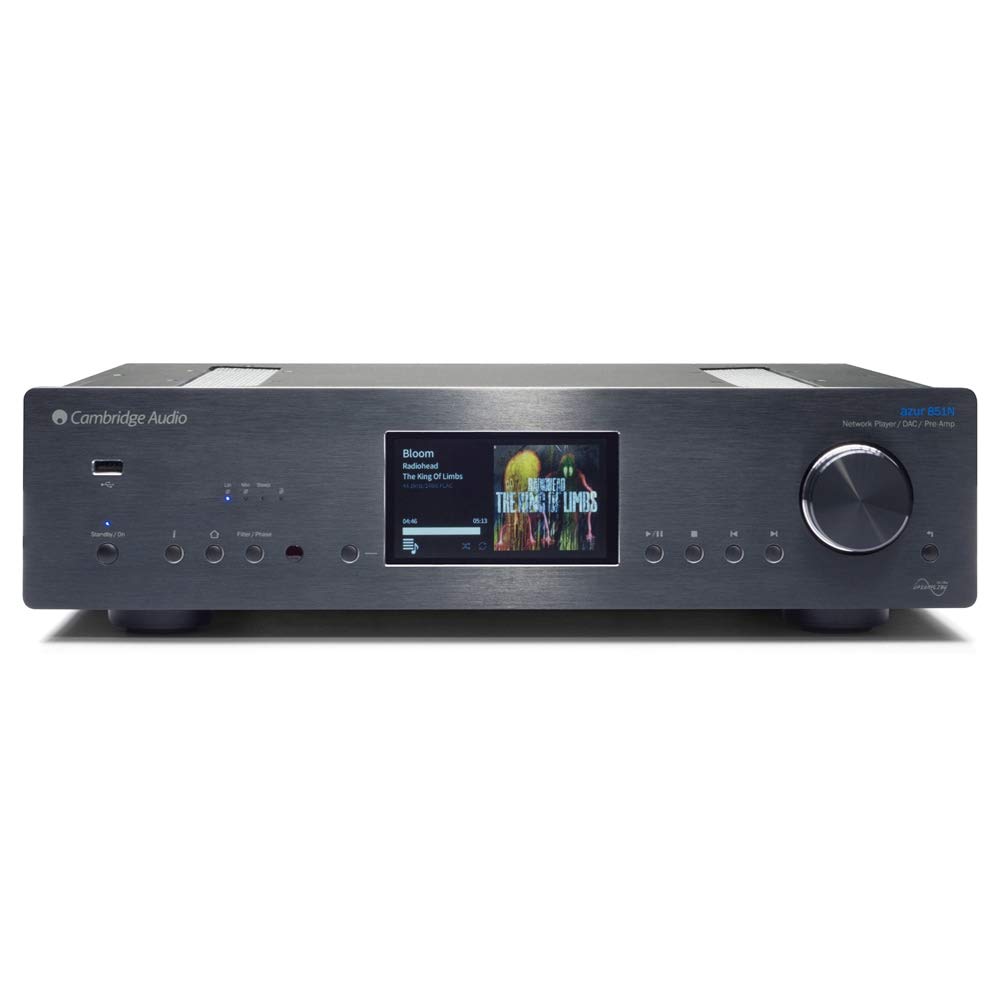
Iwaju view of the Cambridge Audio Azur 851N, showing the display, control knob, and various buttons.
Awọn ẹya pataki:
- Digital Preampolutọpa: Connects directly to power ampliifiers tabi ese ampalifiers.
- Ẹrọ Nẹtiwọọki: Streams audio via wired Ethernet or Wi-Fi.
- High-Performance DAC: Features Twin Analog Devices AD1955 24-bit DACs.
- Advanced Upsampling: 2nd generation ATF2 soke-sampling to 24-bit/384kHz with selectable filter modes.
- Asopọmọra gbooro: Includes AES/EBU, S/PDIF coaxial, TOSLINK optical, USB Type B, Balanced XLR, and Unbalanced RCA outputs.
- Ṣiṣanwọle Alailowaya: Supports UPnP, Internet Radio, Spotify, Tidal, Apple AirPlay, and Bluetooth (via BT100 receiver).
- Ohun elo Iṣakoso: Compatible with Cambridge Audio's control app for Apple and Android devices.
Ṣeto
1. Ti ara Placement
Place the Azur 851N on a flat, stable surface away from direct sunlight, heat sources, and excessive moisture. Ensure there is adequate ventilation around the unit to prevent overheating.
2. Awọn isopọ
Before making any connections, ensure the Azur 851N and all other audio components are powered off.
- Awọn igbewọle Olohun oni nọmba: Connect your digital sources (CD players, media servers, etc.) to the 1 x AES/EBU, 2 x S/PDIF coaxial, or 2 x TOSLINK optical inputs.
- USB Audio Input (Type B): Connect your computer to this input for high-resolution audio playback. Select USB Audio profile 1.0 or 2.0 as required.
- Analogue Audio Outputs: Connect the Balanced XLR or Unbalanced RCA analogue audio outputs to your amplifier tabi ti nṣiṣe lọwọ agbohunsoke.
- Àjọlò: For the most stable network connection, connect an Ethernet cable from your router to the Ethernet port on the 851N.
- Wi-Fi: Insert the supplied Wi-Fi dongle into an available USB port on the rear panel for wireless network connectivity.
- Ọkọ ayọkẹlẹ Iṣakoso: Use the Control Bus Cable to connect to other compatible Cambridge Audio components for integrated control.
3. Asopọ agbara
Once all audio and network connections are made, connect the supplied power cable to the Azur 851N and then to a suitable wall outlet.
Awọn ilana Iṣiṣẹ
1. Agbara Tan / Paa
Press the power button on the front panel or the remote control to turn the unit on or off. The display will illuminate upon power-up.
2. Network Oṣo
Upon first power-up or after a factory reset, the unit may guide you through network setup. Follow the on-screen prompts to connect to your wired or wireless network. For Wi-Fi, select your network and enter the password using the front panel controls or the remote.
3. Awọn iṣẹ ṣiṣanwọle
- UPNP: Wọle si orin files stored on your local network via UPnP servers.
- Redio Ayelujara: Browse and play thousands of internet radio stations.
- Spotify Sopọ: Stream music directly from the Spotify app on your device.
- Tidal: Access your Tidal subscription for high-fidelity streaming.
- Apple AirPlay: Stream audio wirelessly from Apple devices.
- Bluetooth: Pair your Bluetooth device (via BT100 dongle) to stream audio.
4. USB Media Sisisẹsẹhin
Connect a USB storage device (thumb drive or external hard drive) to the USB A ports on the front or rear panel. The 851N will scan the device for compatible audio files. Navigate through folders and select tracks using the front panel controls or the remote.
5. Control App Usage
Download the Cambridge Audio StreamMagic app from the Apple App Store or Google Play Store. This app provides a comprehensive interface for controlling the Azur 851N, browsing music libraries, and managing streaming services.
6. Digital Filter Modes
The Azur 851N features 2nd Generation ATF2 up-sampling with selectable digital filter modes: Linear Phase, Minimum Phase, or Steep. Experiment with these settings to find the sound profile that best suits your preferences and audio content.
Itoju
To ensure the longevity and optimal performance of your Azur 851N, follow these maintenance guidelines:
- Ninu: Use a soft, dry, lint-free cloth to clean the unit's exterior. Do not use abrasive cleaners, waxes, or solvents.
- Afẹfẹ: Regularly check that the ventilation openings are clear of dust and debris.
- Agbara Pa: Disconnect the unit from the power outlet if it will be unused for an extended period.
Laasigbotitusita
If you encounter issues with your Azur 851N, refer to the following common solutions:
| Isoro | Owun to le Fa / Solusan |
|---|---|
| Ko si agbara | Ensure the power cable is securely connected to the unit and the wall outlet. Check the power switch. |
| Ko si ohun jade | Verify correct audio cable connections to your amplifier. Ensure the correct input source is selected on the 851N and your amplifier. Check volume levels. |
| Awọn oran asopọ nẹtiwọki | For wired connections, check the Ethernet cable. For Wi-Fi, ensure the dongle is inserted, the network is selected, and the password is correct. Restart your router and the 851N. |
| USB media playback problems | Ensure the USB device is formatted correctly (FAT32 or NTFS). Check for compatible audio file formats. Some external hard drives may require external power. |
| Isakoṣo latọna jijin ko ṣiṣẹ | Check and replace batteries. Ensure there are no obstructions between the remote and the unit's IR sensor. |
If the problem persists after attempting these solutions, please contact Cambridge Audio customer support.
Awọn pato
| Ẹya ara ẹrọ | Ẹ̀kúnrẹ́rẹ́ |
|---|---|
| Awọn oluyipada D/A | Twin Analog Devices AD1955 24-bit DACs |
| Ajọ Digital | 2nd generation ATF2 soke-sampling to 24-bit/384kHz (Linear Phase, Minimum Phase, Steep modes) |
| Ajọ Analogue | 2-pole differential Bessel with DC servo (XLR and RCA outputs) |
| Awọn igbewọle Audio Digital | 1 x AES/EBU, 2 x S/PDIF coaxial, 2 x TOSLINK optical |
| USB Audio Input | USB Type B (USB Audio profile 1.0 or 2.0 selectable) |
| Analogue Audio wu | Balanced XLR and Unbalanced RCA |
| Compatibility (UPnP, Local USB) | Linear PCM 16-24 bit, 11.025-192kHz |
| Compatibility (USB Audio 1.0) | Linear PCM 16-24 bit, 44.1-96kHz |
| Compatibility (USB Audio 2.0) | Linear PCM 16-24 bit, 44.1-192kHz or DSD x64 |
| Compatibility (TOSLINK, S/PDIF, AES3/EBU) | 16-24 bit, 32-192kHz |
| Bluetooth | BT100 Bluetooth receiver: A2DP plus aptX |
| Redio Ayelujara | 16-24 bit, 11.025-192kHz |
| Awọn ọna kika ohun | ALAC, WAV, FLAC, AIFF, DSD (x64), WMA, MP3, AAC, HE AAC, AAC+, OGG Vorbis |
| Àjọlò | IEEE 802.3, 10 Mimọ-T tabi 100 Mimọ-T |
| Wi-Fi | IEEE 802.11 b/g or n (2.4GHz) |
| Iduro Agbara Agbara | 0.5W |
| Awọn iwọn (H x W x D) | 115 x 430 x 360mm (4.5 x 16.9 x 14.7 inches) |
| Iwọn | 8.1kg (17.9 lbs) |
Atilẹyin ọja ati Support
Cambridge Audio products are designed and built to high standards. For warranty information and technical support, please refer to the documentation included with your product or visit the official Cambridge Audio webojula. Jeki ẹri rira rẹ fun awọn iṣeduro atilẹyin ọja.


