1. Ifihan
This manual provides essential information for the safe and efficient operation of your COTEK SP-4000-124 Pure Sine Wave Inverter. This high-frequency inverter is designed to convert 24VDC battery power into 120VAC household electricity, offering a pure sine wave output suitable for sensitive electronics. Please read this manual thoroughly before installation and use.
2. Awọn ilana aabo
Adherence to these safety guidelines is crucial to prevent personal injury and damage to the inverter or connected equipment.
- Installation must be performed by qualified personnel in accordance with all applicable electrical codes.
- Má ṣe fi inverter hàn sí òjò, ọrinrin, tàbí àwọn iwọn otutu tó le koko.
- Rii daju pe fentilesonu to dara ni ayika ẹrọ oluyipada lati ṣe idiwọ igbona.
- Connect the inverter only to a 24VDC power source. Connecting to a different voltage le fa ipalara.
- Always disconnect the DC power source before performing any maintenance or wiring.
- Rii daju pe ẹrọ oluyipada ti wa ni ilẹ daradara.
- Maṣe ṣii inverter casing. Ko si awọn ẹya ti o le lo ninu.
3. Awọn ẹya Ọja
The COTEK SP-4000-124 Inverter incorporates advanced features for reliable power conversion:
- Pure sine wave output for compatibility with all AC loads.
- Power ON/OFF remote control capability via green terminal.
- Input and output are fully isolated for enhanced safety.
- Temperature and load-controlled cooling fan for optimal thermal management.
- User-friendly interface with 3-color LED status indicators.
- Output frequency (50/60 Hz) selectable via DIP switch.
- O wu voltage selectable via DIP switch.
- Power saving mode adjustable by variable resistor.
- Comprehensive input protection: Reverse Polarity (Fuse), Under Voltage, Lori Voltage.
- Robust output protection: Short Circuit, Overload, Over Temperature.
- Type 1 Indoor Aluminum Enclosure.
- E13 / UL / CE / FCC approved.
4. Ọja Ipariview
Familiarize yourself with the physical components and connections of your inverter.

This image displays the COTEK SP-4000-124 Pure Sine Wave Inverter, showcasing its robust blue casing and overall design from an elevated, angled perspective.
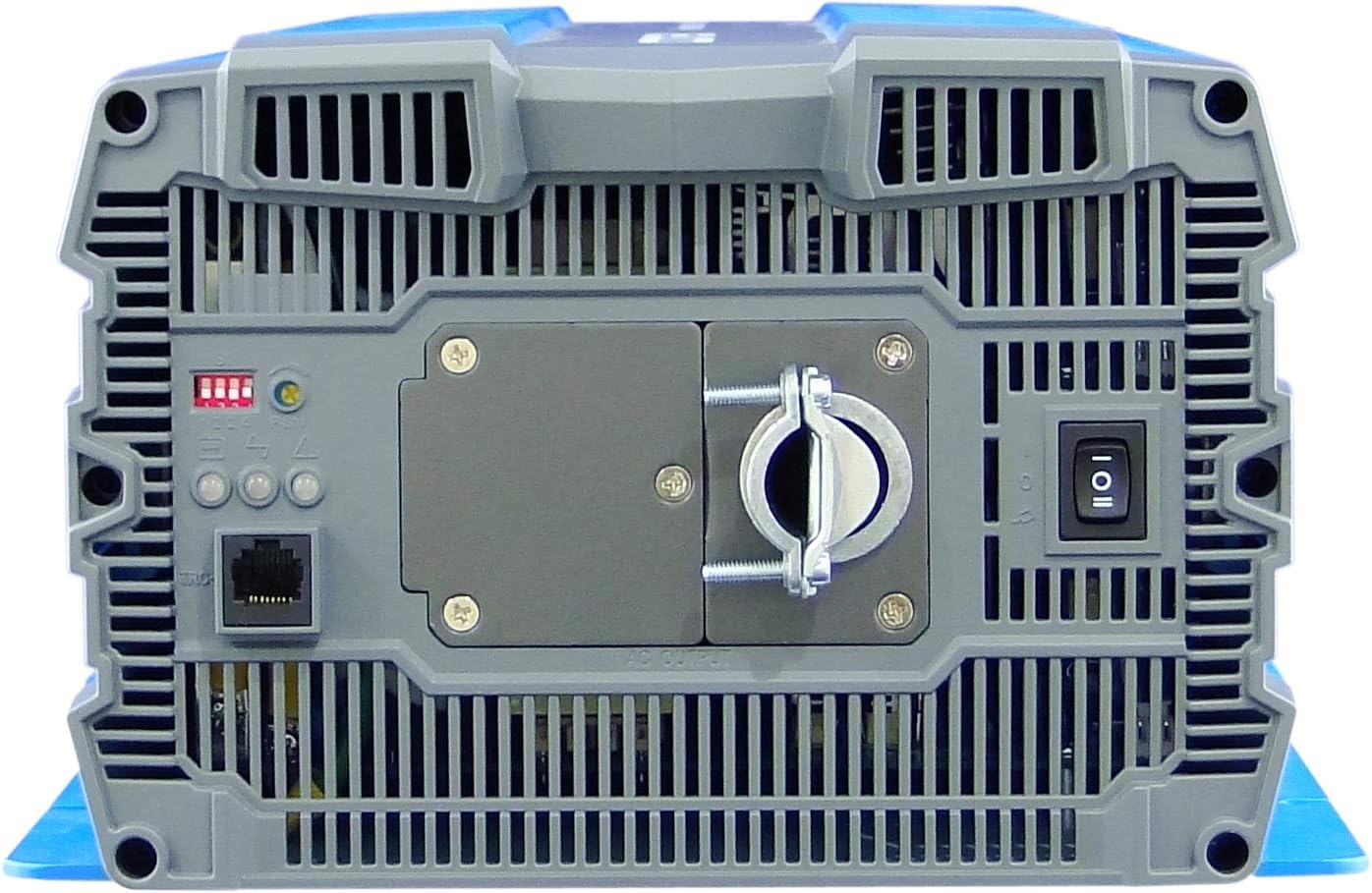
This image shows the rear panel of the COTEK SP-4000-124 Inverter, featuring the hardwire AC output terminal, the main power switch, and a set of LED status indicators and DIP switches for configuration.
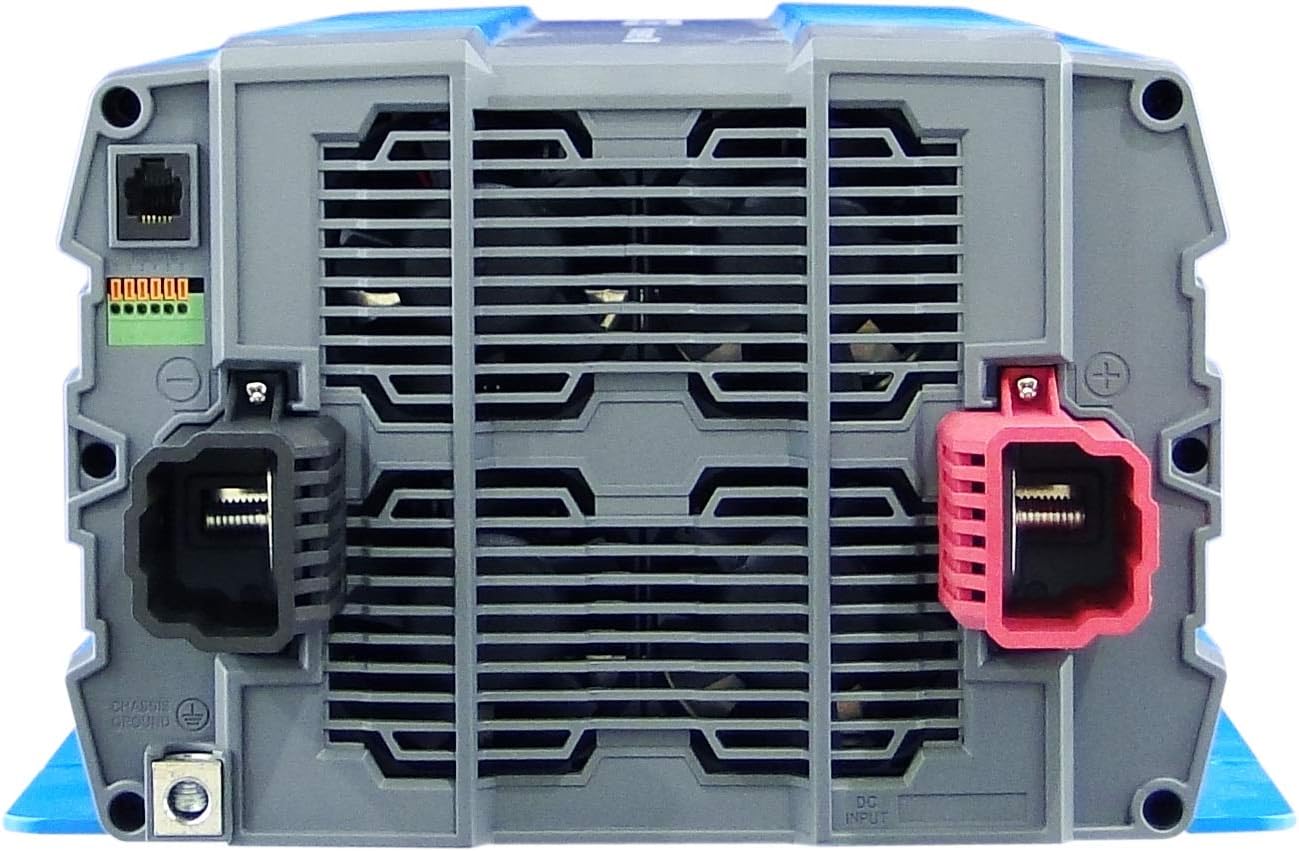
The front panel of the COTEK SP-4000-124 Inverter is depicted, highlighting the robust DC input terminals (red for positive, black for negative) and the chassis ground connection point.

This technical drawing provides detailed mechanical dimensions and outlines of the COTEK SP-4000 series inverter from multiple perspectives (top, front, side), indicating measurements in both millimeters and inches.
5. Eto ati fifi sori
Proper installation is critical for the performance and safety of the inverter. It is highly recommended that installation be performed by a certified electrician or qualified technician.
5.1 Iṣagbesori
- Choose a dry, well-ventilated, and cool location.
- Mount the inverter securely to a stable surface, ensuring adequate clearance for airflow around the cooling fins.
- Avoid mounting near flammable materials or in direct sunlight.
5.2 DC Input Asopọ
- Ensure the DC power source (battery bank) is rated for 24VDC.
- Use appropriately sized cables to minimize voltage drop and ensure safe current handling.
- Connect the positive (+) terminal of the inverter to the positive terminal of the battery bank.
- Connect the negative (-) terminal of the inverter to the negative terminal of the battery bank.
- Install an external DC fuse or circuit breaker between the battery and the inverter for protection.
5.3 AC o wu Asopọ
- The inverter features a hardwire AC outlet. Connect your AC loads directly to this terminal.
- Ensure all AC wiring complies with local electrical codes.
- Do not exceed the inverter's rated output power.
5.4 Ilẹ-ilẹ
- Connect the inverter's chassis ground terminal to a reliable earth ground point.
6. Awọn ilana Iṣiṣẹ
6.1 Titan / Pa a
- After all connections are secure, switch on the external DC circuit breaker (if installed).
- Locate the main power switch on the inverter's rear panel and switch it to the 'ON' position.
- The LED indicators will illuminate, indicating the inverter's status.
- To power off, switch the main power switch to 'OFF', then disconnect the DC power source.
6.2 LED Atọka
The 3-color LED indicators provide visual feedback on the inverter's operational status and any potential faults.
- Alawọ ewe: Iṣiṣẹ deede.
- Yellow: Warning (e.g., low battery, overload warning). Refer to troubleshooting.
- Pupa: Fault (e.g., overload shutdown, over-temperature shutdown). The inverter will shut down.
6.3 Output Frequency and Voltage Aṣayan
The inverter allows for selection of output frequency (50/60 Hz) and voltage via DIP switches. Consult the label near the DIP switches for specific settings. Ensure the inverter is off before adjusting DIP switches.
7. Itọju
Itọju deedee ṣe idaniloju iṣẹ ti o dara julọ ati igba pipẹ ti inverter rẹ.
- Ninu: Periodically clean the exterior of the inverter and ensure cooling vents are free from dust and debris. Use a dry, soft cloth. Do not use liquid cleaners.
- Awọn isopọ: Annually inspect all DC and AC connections for tightness and corrosion. Loose connections can cause overheating and poor performance.
- Ayika: Rii daju pe agbegbe iṣẹ wa laarin iwọn otutu ti a sọ ati awọn sakani ọriniinitutu.
8. Laasigbotitusita
Ẹka yii n pese itọnisọna fun awọn ọran ti o wọpọ. Fun awọn iṣoro idiju, kan si awọn oṣiṣẹ iṣẹ ti o peye.
| Isoro | Owun to le Fa | Ojutu |
|---|---|---|
| No AC output, Red LED on | Overload, Over-temperature, Input over/under voltage | Reduce load, allow cooling, check battery voltage. Cycle power. |
| Yellow LED lori | Low batiri voltage warning, minor overload warning | Charge batteries, reduce load. |
| Inverter ko tan | No DC input power, loose connections, blown DC fuse | Check battery connections, verify battery voltage, inspect DC fuse/breaker. |
| AC output unstable | Poor DC input connections, excessive load, faulty AC wiring | Tighten DC connections, reduce load, inspect AC wiring. |
9. Awọn pato
Detailed technical specifications for the COTEK SP-4000-124 Pure Sine Wave Inverter.
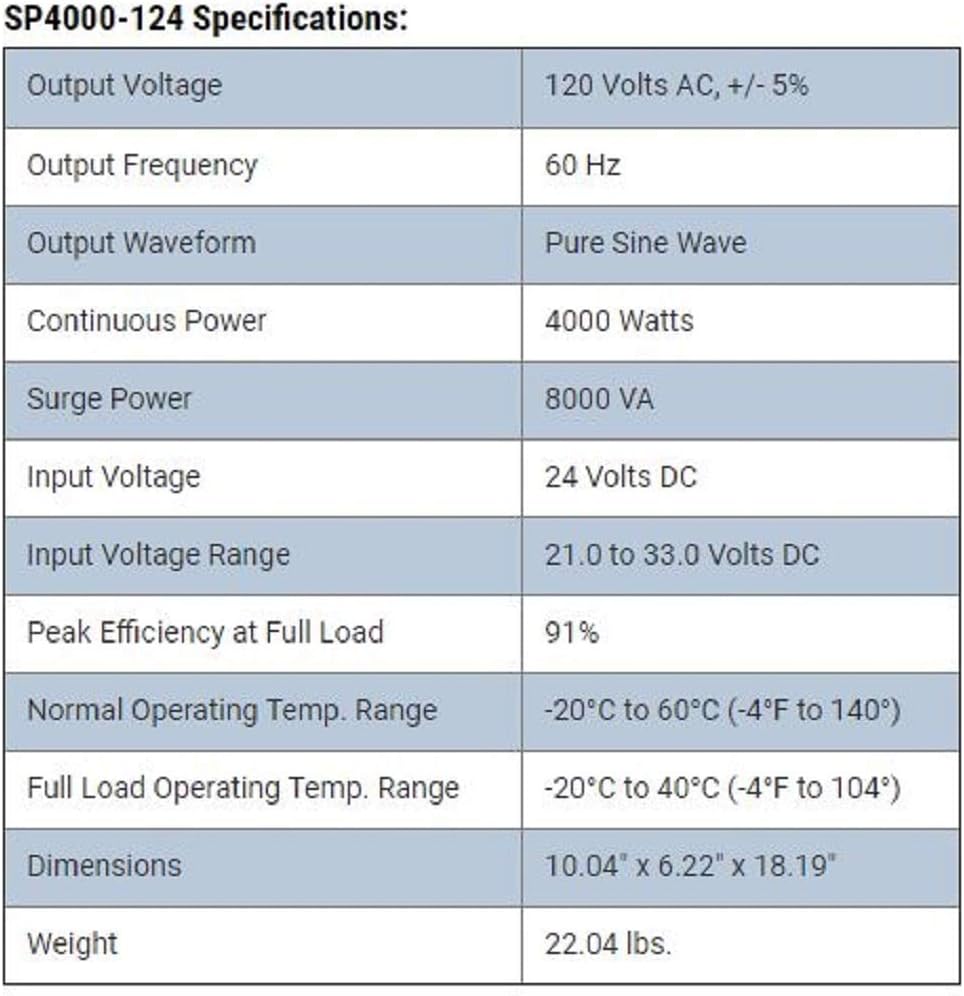
A table detailing the technical specifications of the COTEK SP4000-124 inverter, including output voltage, frequency, waveform, continuous power, surge power, input voltage, efficiency, operating temperature range, dimensions, and weight.
| Paramita | Iye |
|---|---|
| O wujade Voltage | 120 Volts AC, +/- 5% |
| Igbohunsafẹfẹ Ijade | 60 Hz |
| Iwajade Waveform | Wave Sine Sure |
| Agbara Tesiwaju | 4000 Wattis |
| Agbara agbara | 8000 VA |
| Iṣagbewọle Voltage | 24 Volts DC |
| Iṣagbewọle Voltage Ibiti | 21.0 si 33.0 Volts DC |
| Peak Efficiency at Full Load | 91% |
| Normal Operating Temp. Range | -20°C to 60°C (-4°F to 140°) |
| Full Load Operating Temp. Range | -20°C to 40°C (-4°F to 104°) |
| Awọn iwọn (L x W x H) | 18.66 x 12.56 x 9.53 inches (474 x 319 x 242 mm) |
| Iwọn | 24.8 poun (11.25 kg) |
10. Atilẹyin ọja ati Support
For warranty information and technical support, please refer to the documentation provided with your purchase or contact COTEK customer service directly. Keep your purchase receipt as proof of purchase for warranty claims.