1. Ifihan
This manual provides essential information for the installation, operation, and maintenance of the Arista Networks DCS-7050S-52-R 7050 Series Switch. This high-performance switch features 52 SFP+ ports, rear-to-front airflow, and dual 460W AC power supplies, designed for demanding network environments.
Jọ̀wọ́ ka ìwé ìtọ́ni yìí dáadáa kí o tó gbìyànjú láti fi ẹ̀rọ náà sí i tàbí láti ṣiṣẹ́. Pa ìwé ìtọ́ni yìí mọ́ fún ìtọ́kasí ọjọ́ iwájú.
Alaye Aabo
Always observe standard safety precautions when working with electrical equipment. Ensure proper grounding and ventilation. Only qualified personnel should perform installation and maintenance procedures. Disconnect power before servicing.
2. Eto ati fifi sori
2.1 Unpacking the Switch
Carefully remove the switch and all accessories from the packaging. Verify that all components listed in the packing list are present and undamaged. Report any missing or damaged items to your supplier immediately.
2.2 Fifi sori ti ara
The DCS-7050S-52-R switch is designed for rack mounting. Ensure the rack is stable and properly grounded. This model features rear-to-front airflow, meaning cool air enters from the rear of the chassis and exits through the front. Ensure adequate clearance for airflow at both the front and rear of the switch.
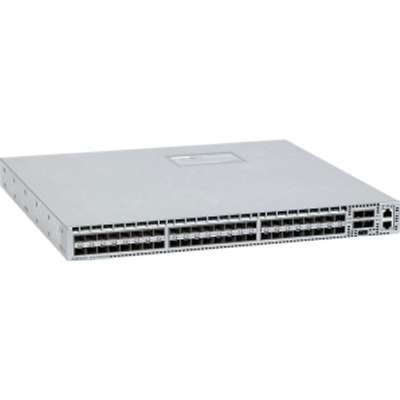
Nọmba 1: Iwaju view of the Arista Networks DCS-7050S-52-R switch, showing the SFP+ ports and status indicators. This image illustrates the port layout and general appearance of the device.
2.3 Asopọ agbara
The switch is equipped with dual 460W AC power supplies for redundancy. Connect the provided 2XC13-C14 power cords to the AC inlets on the rear of the switch and then to separate, grounded AC power sources. It is recommended to connect to different power circuits for maximum redundancy.
- Ensure power sources match the switch's input voltage ibeere.
- Connect both power supplies for redundant operation.
2.4 Awọn isopọ nẹtiwọki
The DCS-7050S-52-R features 52 SFP + ibudo. Insert compatible SFP+ transceivers into the desired ports. Connect appropriate fiber optic or direct attach copper (DAC) cables to the transceivers. Ensure proper cable management to avoid strain on the ports.
2.5 Ibẹrẹ Agbara-On
After all physical connections are made, power on the switch. Observe the system status LEDs for initial boot-up sequence. Refer to the LED indicators section for status interpretation.
3. Awọn ilana Iṣiṣẹ
3.1 Agbara Tan / Pa
To power on, ensure power cords are connected. The switch will automatically power on. To power off, disconnect both power cords from their sources. For graceful shutdown, it is recommended to use the operating system commands before disconnecting power.
3.2 Management Interface Access
The switch can be managed via a console port (RJ-45), out-of-band management (OOB) Ethernet port, or in-band management through one of the SFP+ data ports. Connect a console cable to the console port and use a terminal emulator (e.g., PuTTY, Tera Term) with settings: 9600 baud, 8 data bits, no parity, 1 stop bit, no flow control.
3.3 Arista EOS Overview
The Arista DCS-7050S-52-R runs Arista EOS (Extensible Operating System). EOS provides a command-line interface (CLI) for configuration and monitoring. For detailed configuration instructions, refer to the official Arista EOS documentation available on the Arista Networks webojula.
3.4 SFP+ Port Operation
The 52 SFP+ ports support 10 Gigabit Ethernet connectivity. Ensure that compatible SFP+ transceivers are used for the desired link type (e.g., SR, LR, DAC). Port status LEDs indicate link activity and speed.
4. Itọju
4.1 Ninu
Periodically clean the exterior of the switch with a soft, dry, lint-free cloth. Ensure ventilation openings are free from dust and obstructions. Do not use liquid or aerosol cleaners directly on the switch.
4.2 famuwia imudojuiwọn
Regularly check the Arista Networks support website for the latest EOS firmware updates. Follow the provided instructions for safe and effective firmware upgrades to ensure optimal performance and security.
4.3 Iyipada paati
The DCS-7050S-52-R is designed with hot-swappable components such as fan trays and power supplies. Refer to the Arista Networks hardware guide for specific instructions on replacing these components while the switch is operational.
5. Laasigbotitusita
This section provides basic troubleshooting steps for common issues. For more complex problems, consult the Arista Networks support resources.
5.1 LED Atọka
Observe the status LEDs on the front panel for diagnostic information:
- LED eto: Indicates overall system health (e.g., green for normal, amber for warning, red for critical).
- Power Supply LEDs: Indicate the status of each power supply.
- Fan LEDs: Indicate the status of the fan trays.
- Awọn LED ibudo: Fi ipo asopọ ati iṣẹ-ṣiṣe han fun ibudo SFP+ kọọkan.
Refer to the Arista Networks documentation for a detailed explanation of all LED states.
5.2 wọpọ oran
- Ko si Agbara: Verify power cord connections, power source, and power supply LEDs.
- Ko si Ọna asopọ lori Port: Check transceiver compatibility, cable integrity, and connection to the peer device. Verify port configuration.
- Aṣiṣe eto: Check system LED. If red, consult logs via console or management interface.
5.3 Reset Procedures
A system reboot can often resolve minor issues. Use the appropriate EOS command for a graceful reboot. In cases where the system is unresponsive, a hard power cycle (disconnecting and reconnecting power) may be necessary, but this should be a last resort.
6. Awọn pato
| Ẹya ara ẹrọ | Apejuwe |
|---|---|
| Nọmba awoṣe | DCS-7050S-52-R |
| Olupese | Arista |
| Ni wiwo Iru | SFP+ |
| Nọmba ti Ports | 52 |
| Airflow Itọsọna | Pada si Iwaju |
| Awọn ipese agbara | Dual 460W AC |
| Ọja Mefa | 1 x 1 x 1 inches |
| Iwọn Nkan | 2 iwon |
| Oke otutu Rating | Awọn iwọn Celsius 40 |
| Ohun elo ọran | Irin |
7. atilẹyin ọja Information
This Arista Networks product is covered by a standard manufacturer's warranty. For detailed information regarding warranty terms, conditions, and duration, please refer to the warranty statement provided with your purchase or visit the official Arista Networks webojula. Jeki ẹri rira rẹ fun awọn iṣeduro atilẹyin ọja.
8. Imọ Support
For technical assistance, product documentation, and software downloads, please visit the Arista Networks support portal. You can find comprehensive resources, FAQs, and contact information for their technical support team.
- Arista Awọn nẹtiwọki Webojula: www.arista.com
- Portal Atilẹyin: Refer to the Arista website for specific support contact details and online resources.


