Ọrọ Iṣaaju
Thank you for choosing the KOIOS Upgraded Juicer Machine. This slow masticating juicer is designed to extract maximum nutrients from your fruits and vegetables, providing you with fresh, healthy, and delicious juice. Its cold press technology minimizes oxidation and preserves vitamins, enzymes, and minerals. Please read this manual thoroughly before operation to ensure safe and efficient use.

The KOIOS Upgraded Juicer Machine, ready for use with fresh oranges.
Ọja irinše
Familiarize yourself with the parts of your KOIOS juicer:
- Motor Base: Houses the full copper motor and control buttons.
- Hopper: Top opening where fruits and vegetables are fed.
- Pusher: Used to gently push ingredients into the juicer.
- Drum: Transparent chamber where juicing takes place.
- Auger: The spiral component that crushes and presses produce.
- Juicing Sieve: Stainless steel filter that separates juice from pulp.
- Blank End Cap: Secures the juicing assembly and expels pulp.
- Juice Container: Collects the extracted juice.
- Pulp Collector: Collects the dry pulp expelled from the juicer.
- Cleaning Brush: For easy cleaning of the sieve and other parts.

Ọja ti pariview showing all detachable parts of the juicer.
Eto ati Apejọ
Tẹle awọn igbesẹ wọnyi lati pejọ ẹrọ juicer rẹ ṣaaju lilo akọkọ:
- Insert the auger into the drum.
- Place the juicing sieve onto the auger.
- Cover the blank end cap on the end of the drum, rotating it clockwise until it aligns and clicks into place.
- Attach the assembled drum to the base unit by twisting it clockwise until the locking clip button is pressed and it locks securely.
- Place the pulp container under the pulp ejector and the juice container under the juice outlet.
- Affix the hopper onto the top of the drum.

Visual guide for the five-step installation process.
Awọn ilana Iṣiṣẹ
Prepare your ingredients by washing them thoroughly. Cut fruits and vegetables into smaller pieces (approximately 3 inches) to fit the feeding chute and ensure optimal juicing. Remove any hard pits or large seeds from fruits like peaches or plums.
Awọn Iyara Iyara
The juicer features two speed modes for different types of produce:
- SOFT Mode (70-100 RPM): Ideal for soft and juicy fruits and vegetables such as watermelon, orange, grape, tomato, kiwi, etc.
- HARD Mode (90-110 RPM): Suitable for hard fruits and vegetables like apple, pear, carrot, beets, ginger, and kale.

Control panel and examples for Soft and Hard speed modes.
Ilana jijẹ
- Plug in the juicer and select the appropriate speed mode (SOFT or HARD) using the buttons on the motor base.
- Slowly feed the prepared ingredients into the hopper. Use the pusher only if necessary to gently guide the produce down. Avoid forcing ingredients.
- The juicer will automatically separate the juice into the juice container and the pulp into the pulp collector.
Yiyipada Iš.
If ingredients get jammed or the juicer stops during operation, press the 'Reverse' button. This will rotate the auger in the opposite direction to clear the blockage. Release the button to resume normal operation. This function helps prevent clogging and ensures continuous juicing.

The Reverse function helps clear jams and prevent clogging.
Itọju ati Cleaning
Regular cleaning ensures the longevity and hygiene of your juicer. All detachable parts are made from culinary grade, BPA-free materials.
Disassembly fun Cleaning
To disassemble, simply press the locking clip button and twist the drum counter-clockwise. All parts can then be easily removed.
Ninu Awọn ilana
- Rinse all detachable parts under running water immediately after use to prevent pulp from drying.
- Use the included cleaning brush to thoroughly clean the juicing sieve, as small fibers can get stuck in the mesh.
- The detachable parts can be washed by hand with mild soap and water or placed in the dishwasher for convenience.
- Pa mọto mimọ pẹlu ipolowoamp asọ. Maṣe fi ipilẹ motor bọ inu omi.
- Rí i dájú pé gbogbo àwọn ẹ̀yà ara rẹ̀ gbẹ pátápátá kí o tó tún kó o jọ tàbí kí o tó tọ́jú ohun èlò ìfọṣọ náà.
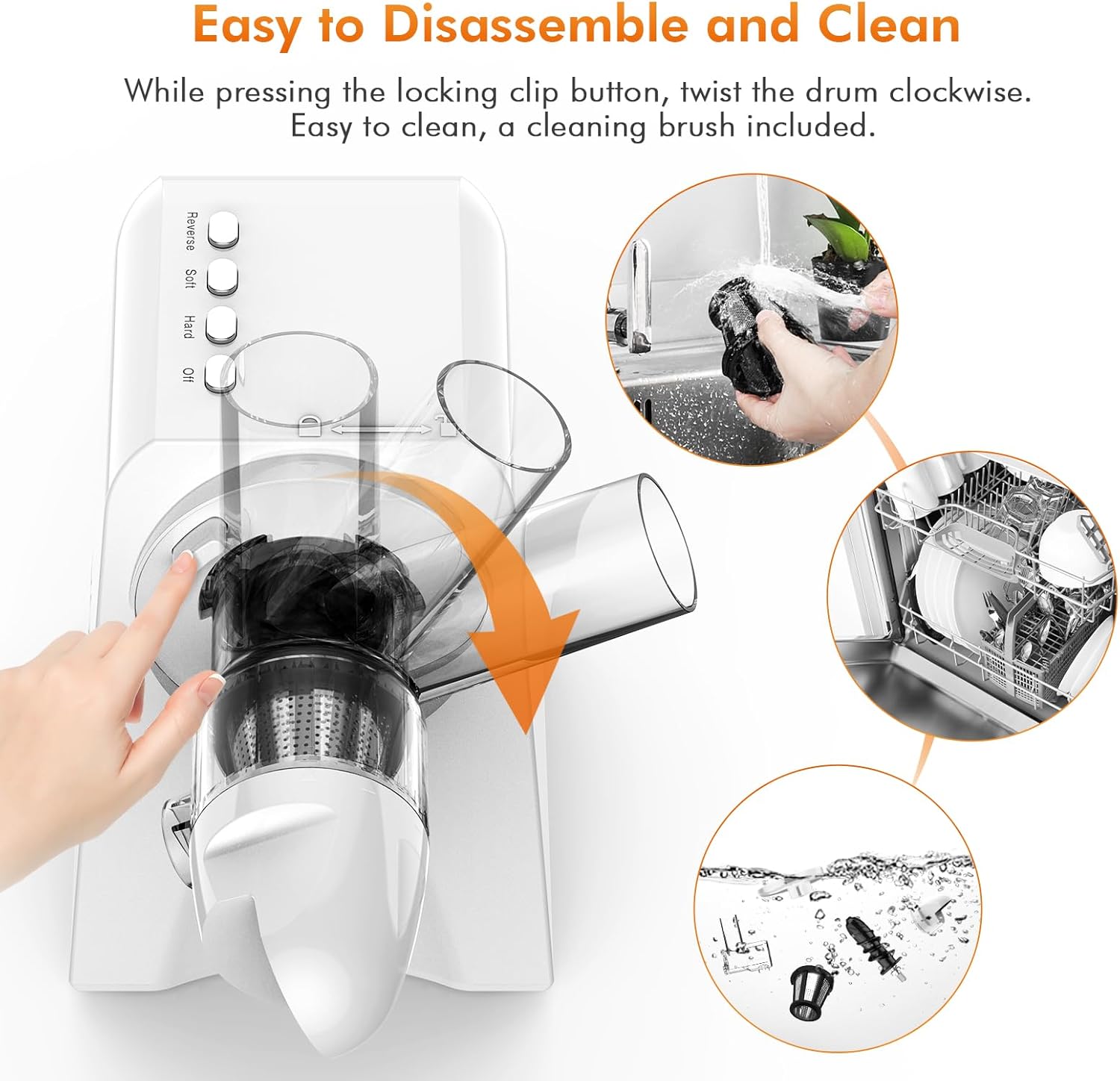
Easy disassembly and cleaning methods for the juicer.

Rinsing the auger, a key component, under running water.
Laasigbotitusita
If you encounter any issues with your juicer, refer to the following common problems and solutions:
| Isoro | Owun to le Fa | Ojutu |
|---|---|---|
| Juicer stops during operation or gets jammed. | Too much produce fed at once; hard ingredients causing blockage. | Press the 'Reverse' button to clear the blockage. If persistent, disassemble and clear manually. Feed ingredients slowly. |
| Púpù tó pọ̀ jù nínú omi. | Sieve is clogged or damaged; improper assembly. | Clean the sieve thoroughly. Ensure all parts are assembled correctly and securely. |
| Ìwọ̀n oje díẹ̀. | Incorrect speed mode selected; ingredients not cut properly. | Ensure appropriate speed mode (SOFT/HARD) is selected. Cut ingredients into smaller pieces. |
| Motor is unusually loud. | Overloading the motor; improper assembly. | Do not overload the juicer. Ensure all parts are correctly assembled. The juicer operates at less than 60dB for quiet use. |
Awọn pato
| Ẹya ara ẹrọ | Ẹ̀kúnrẹ́rẹ́ |
|---|---|
| Brand | KOIOS |
| Orukọ awoṣe | Upgraded Juicer Machines |
| Nọmba Awoṣe Nkan | 9001 |
| Àwọ̀ | Funfun |
| Ọja Mefa | 15.5"D x 10.2"W x 8.7"H |
| Iwọn Nkan | 9.58 iwon |
| Orisun agbara | AC |
| Voltage | 110 Volt (AC) |
| Nọmba ti Awọn iyara | 2 (SOFT/HARD) |
| Pataki Ẹya | BPA Free, Quiet Motor |
| Blade elo | Irin ti ko njepata |
| Agbara | 1 liters |
| Fifọ Ailewu Parts | No (Detachable parts are easy to clean by hand or in dishwasher) |
Atilẹyin ọja ati Support
KOIOS products are manufactured to the highest quality standards. For detailed warranty information and customer support, please refer to the official user manual.
O le gba gbogbo Iwe Itọsọna Olumulo (PDF) Nibi.


