1. Ọja Ipariview
The Western Digital WD Blue SN550 NVMe Internal SSD is designed to boost your system's performance with next-generation NVMe technology. It offers significantly faster speeds compared to traditional SATA SSDs, making it ideal for tasks such as content creation, casual gaming, and processing large amounts of data. This drive comes in a compact M.2 2280 form factor.
Awọn ẹya pataki:
- Boosts system performance with NVMe SSD technology.
- Offers over 4 times faster read speeds than SATA SSDs.
- Features a Western Digital designed controller and firmware for optimized performance.
- Compatible with the Western Digital SSD Dashboard for health monitoring.
- Utilizes an M.2 2280 form factor.

This image displays the physical appearance of the Western Digital WD Blue SN550 NVMe SSD, highlighting its compact M.2 form factor.
2. Understanding NVMe SSD Technology
NVMe (Non-Volatile Memory Express) is a communication interface and protocol developed specifically for SSDs to take advantage of the high-speed data transfer capabilities of PCIe (Peripheral Component Interconnect Express). Unlike older SATA interfaces, NVMe allows SSDs to communicate directly with the system's CPU, significantly reducing latency and increasing throughput.
The WD Blue SN550 uses the M.2 2280 form factor, which is a small, rectangular card designed to plug directly into a compatible slot on your motherboard. The '2280' refers to its dimensions: 22mm wide and 80mm long.

This image provides an angled perspective of the SSD, illustrating its slim profile and connector pins.
Fidio Ọja Oṣiṣẹ:
Yi fidio pese ohun loriview of the Western Digital WD Blue SN550 NVMe SSD, showcasing Awọn ẹya ara ẹrọ ati awọn anfani rẹ.
3. Itọsọna fifi sori ẹrọ
Proper installation is crucial for optimal performance. Please follow these steps carefully.
3.1. Pre-fifi sori Akojọ ayẹwo
- Ibamu: Ensure your motherboard has an available M.2 slot that supports NVMe PCIe Gen3 x4 SSDs. Refer to your motherboard's manual.
- Awọn irinṣẹ: You will typically need a Phillips head screwdriver.
- Aabo: Always power off your computer and disconnect it from the power source before opening the case. Ground yourself to prevent electrostatic discharge (ESD).
- Iṣagbesori Screw: M.2 SSDs require a small screw to secure them to the motherboard. This screw is usually provided with your motherboard, not the SSD itself.
3.2. Fifi sori ti ara
- Àpò Kọ̀ǹpútà Ṣíṣí: Carefully open your computer's case to access the motherboard.
- Wa M.2 Iho: Identify the M.2 slot on your motherboard. It is typically a horizontal slot with a small screw hole at the end.
- Fi SSD sii: Gently insert the WD Blue SN550 NVMe SSD into the M.2 slot at a slight angle (approximately 30 degrees). Push it in until it is fully seated.
- SSD ti o ni aabo: Once seated, push the SSD down so it lies flat against the motherboard. Secure it with the M.2 mounting screw (not included with the SSD).
- Ọran pipade: Pa apoti kọnputa rẹ ki o tun gbogbo awọn kebulu so pọ.

This image shows the SSD securely fitted into the M.2 slot on a motherboard, ready for operation.
Installation Video Guides:
Video 2: How to replace an M.2 SSD. This user-generated video demonstrates the process of replacing an M.2 SSD, which includes steps relevant to installing the WD Blue SN550.
Video 3: Western Digital Blue SN550 - How to Fit & Review & Demo. This user-generated video provides a guide on fitting the Western Digital Blue SN550, along with a review ati ifihan.
4. Operating Your WD Blue SN550 NVMe SSD
After physical installation, the SSD needs to be prepared for use within your operating system.
4.1. Bibẹrẹ ati kika Drive
- Eto bata: Agbara lori kọmputa rẹ.
- Wiwọle Isakoso Disiki: In Windows, right-click the Start button and select 'Disk Management'. In other operating systems, use the equivalent disk utility.
- Bibẹrẹ Disk: Locate the newly installed SSD (it may appear as 'Unallocated Space'). Right-click on it and select 'Initialize Disk'. Choose GPT (GUID Partition Table) for modern systems.
- Ṣẹda Iwọn Irọrun Tuntun: Right-click the unallocated space on the SSD and select 'New Simple Volume'. Follow the wizard to assign a drive letter and format the drive (NTFS for Windows).
4.2. Operating System Migration (Optional)
If you intend to use the WD Blue SN550 as your primary boot drive, you may want to migrate your existing operating system to it. Western Digital often provides or recommends cloning software (e.g., Acronis True Image WD Edition) for this purpose. Refer to the software's instructions for detailed steps.
4.3. WD SSD Dashboard
Download and install the Western Digital SSD Dashboard software from the official Western Digital website. This utility allows you to monitor the health, temperature, and performance of your SSD, as well as update firmware.
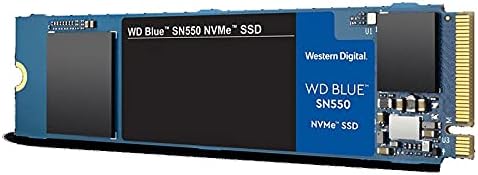
This image illustrates the SSD as part of a functional computer setup, ready for data operations.
Software Setup and Performance Demonstration:
This user-generated video demonstrates the installation, disk management setup, and performance benchmarks of the WD Blue SN550 NVMe SSD.
5. Itọju ati Itọju
To ensure the longevity and optimal performance of your WD Blue SN550 NVMe SSD, consider the following maintenance tips:
- Awọn imudojuiwọn famuwia: Regularly check for and install firmware updates using the WD SSD Dashboard. Firmware updates can improve performance, stability, and compatibility.
- Òfin TRIM: Ensure the TRIM command is enabled in your operating system. TRIM helps the SSD manage its stored data more efficiently, preventing performance degradation over time. Modern operating systems typically enable this by default.
- Abojuto iwọn otutu: Use the WD SSD Dashboard to monitor the drive's temperature. While SSDs are generally robust, excessive heat can impact performance and lifespan. Ensure adequate airflow within your computer case.
- Avoid Full Capacity: Try to avoid filling the SSD to its absolute maximum capacity. Leaving some free space allows the drive's wear-leveling algorithms to function more effectively.
6. Laasigbotitusita wọpọ oran
Here are solutions for common problems you might encounter with your NVMe SSD.
6.1. A ko rii SSD
- Ṣayẹwo Isopọ Ti ara: Ensure the SSD is correctly seated in the M.2 slot and the mounting screw is secure.
- Eto BIOS/UEFI: Enter your system's BIOS/UEFI settings. Verify that the M.2 slot is enabled and configured for NVMe (PCIe) mode, not SATA mode, if applicable.
- Awọn awakọ: Ensure your operating system has the necessary NVMe drivers. Windows 10/11 typically include them, but older OS versions or specific motherboards might require manual installation.
- Ibamu modaboudu: Double-check your motherboard manual for M.2 slot compatibility. Some slots might share bandwidth with SATA ports, disabling them when an M.2 drive is used.
6.2. O lọra Performance
- Thermal Throttling: NVMe SSDs can generate heat. If the drive gets too hot, it may reduce performance to prevent damage (thermal throttling). Ensure good airflow in your case, and consider adding an M.2 heatsink if your motherboard supports it or if you experience consistent high temperatures.
- PCIe Lane Allocation: Confirm that your M.2 slot is operating at its full PCIe Gen3 x4 speed. Check your motherboard's BIOS/UEFI settings and manual.
- Ipo TRIM: Verify that TRIM is enabled for your SSD.
- Awọn imudojuiwọn Awakọ: Ensure your NVMe drivers and chipset drivers are up to date.
7. Awọn pato
| Ẹya ara ẹrọ | Ẹ̀kúnrẹ́rẹ́ |
|---|---|
| Nọmba awoṣe | WDS500G2B0C |
| Digital Ibi Agbara | 500 GB |
| Lile Disk Interface | NVMe (PCIe Gen3 x4) |
| Fọọmù ifosiwewe | M.2 2280 |
| NAND Iru | 3D NAND |
| Sequential Read Speed (Up to) | 2,400 MB/s |
| Sequential Write Speed (Up to) | 1,750 MB/s (for 500GB model) |
| Hardware Platform | Lainos, Mac, PC |
| Awọn iwọn Nkan (LxWxH) | 3.15 x 0.87 x 0.09 inches |
| Iwọn Nkan | 0.247 iwon |
| Àwọ̀ | Buluu |
8. atilẹyin ọja Information
The Western Digital WD Blue SN550 NVMe Internal SSD (WDS500G2B0C) comes with a 5-odun lopin atilẹyin ọja. Please retain your proof of purchase for warranty claims. For full terms and conditions, refer to the official Western Digital warranty documentation available on their webojula.
9. Atilẹyin
For further assistance, technical support, or to download the latest drivers and firmware, please visit the official Western Digital support webojula:
You can also find additional resources and community forums on their webojula.


