1. Ifihan
This manual provides comprehensive instructions for the safe and effective operation, maintenance, and troubleshooting of the RS PRO RSDS 1052 DL+ Digital Storage Oscilloscope. Please read this manual thoroughly before using the device to ensure proper functionality and to prevent damage or injury.
The RS PRO RSDS 1052 DL+ is a versatile 2-channel digital storage oscilloscope with a 50 MHz bandwidth, designed for precise signal analysis. It features a 7-inch TFT LCD display for clear waveform visualization and supports various measurement parameters and mathematical operations.
2. Alaye Aabo
Always adhere to the following safety precautions to prevent electric shock, fire, or damage to the instrument.
- Orisun Agbara: Ensure the oscilloscope is connected to a power source within the specified voltage range (100-240V AC, 50/60Hz).
- Ilẹ: The instrument must be properly grounded to prevent electric shock. Do not defeat the grounding plug.
- Ayika: Operate the oscilloscope in a dry, well-ventilated area, away from direct sunlight, high temperatures, and excessive dust.
- Awọn iwadii: Use only probes supplied or recommended by RS PRO. Ensure probes are correctly rated for the voltage ni won.
- Itọju: Refer all servicing to qualified service personnel. Do not attempt to open the instrument casing unless explicitly instructed.
- Ẹka Abo: This device is rated CAT I, CAT II. Observe all safety warnings on the device and in this manual.
3. Ọja Ipariview ati irinše
Yi apakan pese ohun loriview of the RS PRO RSDS 1052 DL+ oscilloscope and its main components.
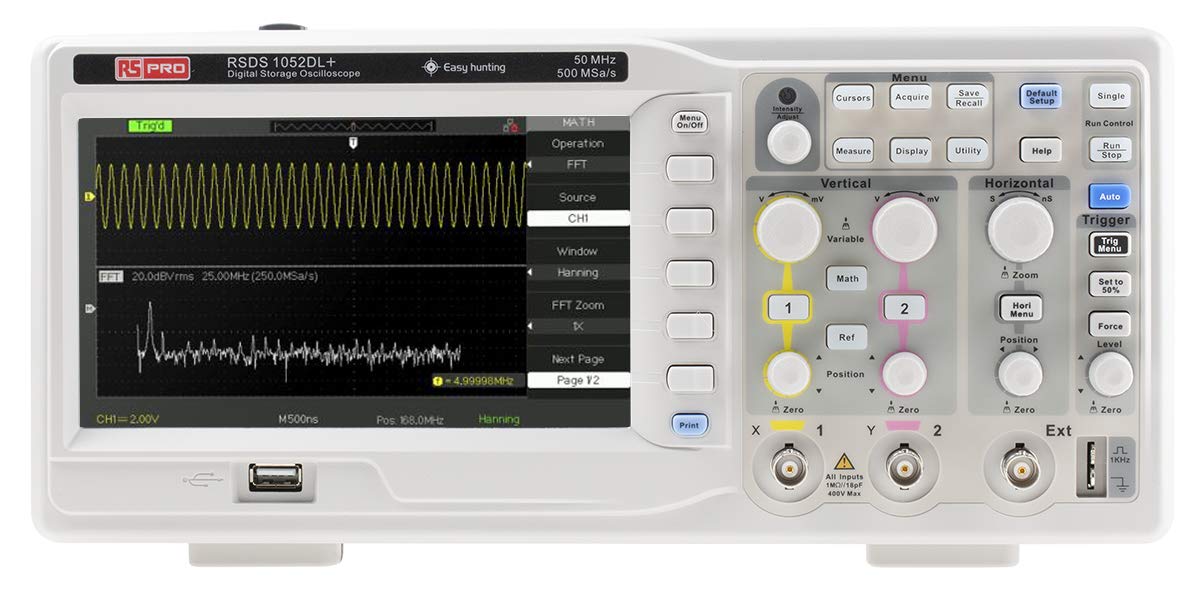
olusin 3.1: Iwaju View of the Oscilloscope. This image shows the front panel of the RS PRO RSDS 1052 DL+ oscilloscope, highlighting the 7-inch TFT LCD display, control knobs, function buttons, and input connectors for channels 1 and 2. The screen displays a typical waveform and FFT analysis.

olusin 3.2: Angled View of the Oscilloscope. This image provides an angled perspective of the RS PRO RSDS 1052 DL+ oscilloscope, showcasing its compact design and integrated handle for portability. The side ventilation grilles are also visible.

olusin 3.3: Ẹyìn View of the Oscilloscope. This image displays the rear panel of the RS PRO RSDS 1052 DL+ oscilloscope, featuring the power input, USB device port, USB host port, LAN port, and Pass/Fail output. Safety warnings and product labels are also visible.
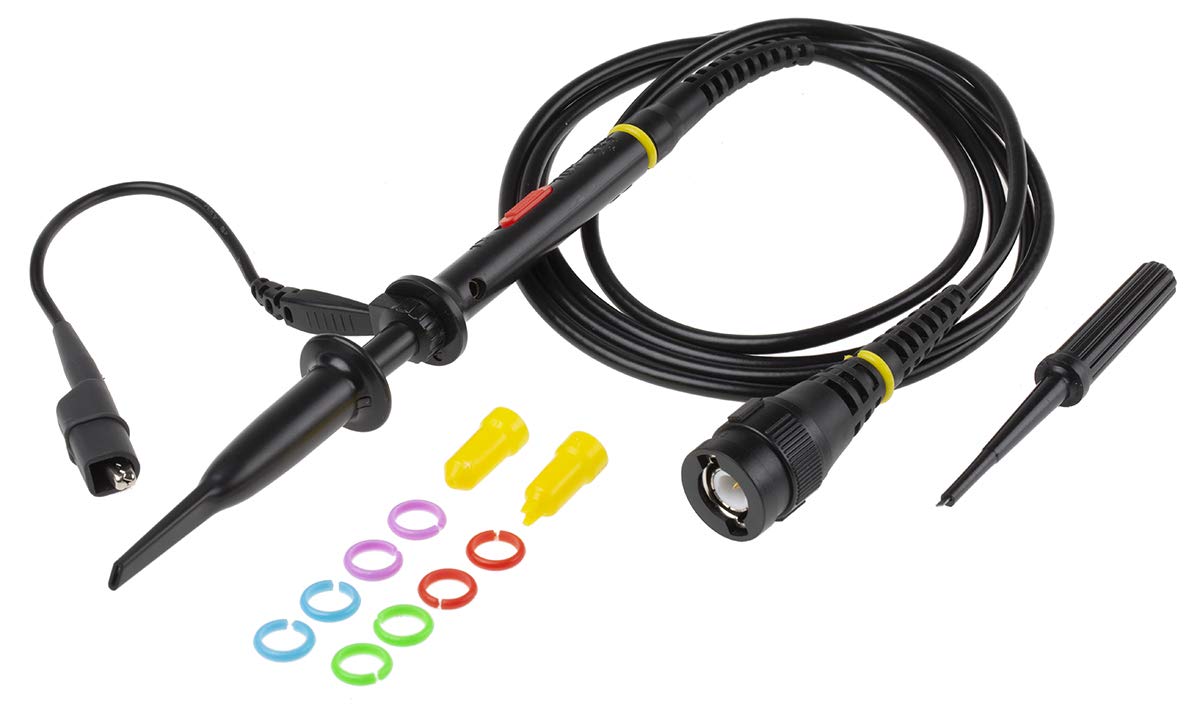
Figure 3.4: Oscilloscope Probe and Accessories. This image shows a passive oscilloscope probe (1:1/10:1) along with various accessories, including colored rings for channel identification and probe tip covers. These are essential for connecting signals to the oscilloscope.

Figure 3.5: Power Plugs and Probe Tip. This image displays an assortment of power plugs (EU, UK, US types) that may be included with the oscilloscope, along with a specialized probe tip. These ensure compatibility with various power outlets and provide versatility for measurements.
3.1 Pẹlu Awọn ẹya ẹrọ miiran
The RS PRO RSDS 1052 DL+ typically includes the following accessories:
- Passive Probe 1:1/10:1 (x2)
- Okun USB
- Quick Bẹrẹ Itọsọna
- Iwe-ẹri Didara
- Okun Agbara (pato agbegbe)
- CD (including User Manual and EasyScopeX software)
4. Eto
4.1 Unpacking ati ayewo
- Carefully remove the oscilloscope and all accessories from the packaging.
- Inspect the instrument for any signs of physical damage during transit. If damage is found, contact your supplier immediately.
- Verify that all included accessories listed in Section 3.1 are present.
4.2 Asopọ agbara
- Rii daju pe iyipada agbara lori nronu ẹhin wa ni ipo PA.
- Connect the provided power cord to the AC input on the rear panel of the oscilloscope.
- Plug the other end of the power cord into a grounded AC power outlet. The oscilloscope supports 100-240V AC, 50/60Hz.
4.3 Probe Connection and Compensation
- Connect the BNC connector of the passive probe to one of the input channels (CH1 or CH2) on the front panel.
- Attach the probe tip to the probe compensation output (usually a square wave test signal) on the front panel.
- Adjust the compensation trimmer on the probe until the displayed square wave is flat-topped, without overshoot or undershoot. This ensures accurate measurements.
5. Awọn ilana Iṣiṣẹ
5.1 Ipilẹ isẹ
- Titan/Apapa: Press the power button on the front panel to turn the oscilloscope on or off.
- Eto Aifọwọyi: Tẹ awọn Aifọwọyi button to automatically adjust vertical, horizontal, and trigger settings for a stable waveform display.
- Àwọn Ìṣàkóso Inaro: Lo awọn VOLTS/DIV knob to adjust the vertical scale (voltage per division) and the IPO knob to move the waveform vertically.
- Àwọn Ìṣàkóso Pẹtẹlẹ̀: Lo awọn SEC/DIV knob to adjust the horizontal scale (time per division) and the IPO knob to move the waveform horizontally.
- Trigger Controls: Ṣatunṣe awọn IPILE knob to set the trigger threshold. The trigger ensures a stable display of repetitive waveforms.
5.2 Awọn iṣẹ ilọsiwaju
- Awọn iṣẹ wiwọn: Tẹ awọn Iwọn button to access automatic measurement parameters such as Vpp, Vmax, Vmin, Freq, Period, etc.
- Awọn iṣẹ Iṣiro: Tẹ awọn Iṣiro button to perform mathematical operations on waveforms (e.g., Add, Subtract, Multiply, Divide, FFT).
- Storage and Recall: Lo awọn Fipamọ/Ranti buttons to save waveform data, setups, or screenshots to internal memory or a USB drive.
- Asopọmọra USB: Connect a USB drive to the front panel USB host port for data storage. Use the rear USB device port to connect the oscilloscope to a PC for data transfer and control via EasyScopeX software.
6. Itọju
6.1 Ninu
- Ge asopọ okun agbara ṣaaju ṣiṣe mimọ.
- Lo asọ, damp cloth with mild detergent to clean the exterior of the instrument.
- Do not use abrasive cleaners or solvents that may damage the plastic parts.
- Rii daju pe omi ko wọ inu ẹrọ naa.
6.2 Idiwọn
The oscilloscope is factory calibrated. For optimal performance, periodic calibration by qualified personnel is recommended, typically every 12-24 months, depending on usage and environmental conditions.
6.3 Ibi ipamọ
When not in use for extended periods, store the oscilloscope in a dry, dust-free environment, away from extreme temperatures and humidity.
7. Laasigbotitusita
Abala yii n pese awọn ojutu si awọn ọran ti o wọpọ ti o le ba pade.
| Isoro | Owun to le Fa | Ojutu |
|---|---|---|
| Ko si agbara | Power cord disconnected; Power switch off; Blown fuse | Check power cord connection; Turn power switch on; Contact service for fuse replacement. |
| Kò sí ìgbì ìgbì tí a fi hàn | Input signal too small/large; Incorrect vertical/horizontal settings; Trigger not set correctly; Probe not connected | Adjust VOLTS/DIV and SEC/DIV; Use Auto Setup; Adjust trigger level; Ensure probe is connected and compensated. |
| Ìgbì ìgbì tí kò dúró ṣinṣin | Incorrect trigger settings; No trigger source selected | Adjust trigger level and mode; Select appropriate trigger source (e.g., CH1, CH2, Ext). |
| Fọọmu igbi ti o daru | Probe compensation incorrect; Probe damaged; Input overloaded | Perform probe compensation; Try a different probe; Check input signal amplitude. |
If the problem persists after attempting these solutions, please contact RS PRO customer support.
8. Awọn pato
Key technical specifications for the RS PRO RSDS 1052 DL+ Digital Storage Oscilloscope:
- Awọn ikanni Analog: 2
- Oscilloscope Type: Ibi ipamọ oni-nọmba
- Bandiwidi: 50 MHz
- Akoko gidi SampOṣuwọn: Up to 500 MSa/s
- Ijinle Iranti: 32 Kpt
- Iru ifihan: TFT LCD
- Iwọn Ifihan: 7 inches (800 x 480 pixels)
- Ifamọ inaro: 2mV/div to 10V/div
- Àkókò Ìpìlẹ̀: 10ns/div si 50s/div
- Ibi ti ina elekitiriki ti nwa: Mains operated (100-240V AC, 50/60Hz)
- Ìwúwo: 2.5 kg
- Ẹka Abo: CAT I, CAT II
- Awọn atọkun: RS232, USB Host, USB Device, LAN
9. Atilẹyin ọja ati Support
RS PRO products are manufactured to high standards and are typically covered by a manufacturer's warranty. Please refer to the warranty card included with your product or visit the official RS PRO webAaye fun alaye atilẹyin ọja ofin ati ipo.
For technical support, service, or inquiries regarding your RS PRO RSDS 1052 DL+ oscilloscope, please contact RS PRO customer service through their official channels. Contact information can usually be found on the RS PRO website or in the documentation provided with the product.
RS PRO Official Webojula: https://uk.rs-online.com/web/


