1. Ifihan
This manual provides comprehensive instructions for the setup, operation, maintenance, and troubleshooting of your DrayTek Vigor 2866 Series Router. Designed for business environments, this high-performance router offers robust connectivity and security features.
Please read this manual carefully before using the device to ensure proper installation and optimal performance.
2. Ọja Ipariview
The DrayTek Vigor 2866 Series is a versatile multi-WAN VPN router engineered for demanding network environments. Key features include:
- G.Fast and Ethernet Load Balancer: Connects to Ultrafast G.fast and Superfast VDSL2 FTTC with an integrated DSL modem. Supports load balancing with Ethernet WAN for enhanced resiliency and throughput.
- Olulana VPN iṣẹ-giga: Facilitates secure, high-speed connections for up to 32 VPN tunnels, supporting DrayTek SSL VPN and OpenVPN for remote access.
- 5+1 Gigabit LAN Ports with VLANs: Provides 6 Gigabit LAN ports for direct connection of computers, servers, and network storage. Supports up to 8 separate VLAN networks, including options for Hotspot Captive Portal and guest networks.
- Feature-Rich Functionality: Includes Quality of Service (QoS), Route Policy, Hotspot Web Portal, VPN Matcher, and DrayDDNS.
- VigorACS SD-WAN Central Management: Enables remote management and powerful SD-WAN features via the VigorACS 3 platform for centralized network control across multiple sites.
2.1. Package Awọn akoonu
Jẹrisi pe gbogbo awọn ohun kan wa ninu package:
- DrayTek Vigor 2866 Router
- Awọn kebulu Ethernet
- Antennas (if applicable to your model variant)
- Agbara Ipese Unit
2.2. Physical Description and Ports
Familiarize yourself with the router's physical layout and port configurations.
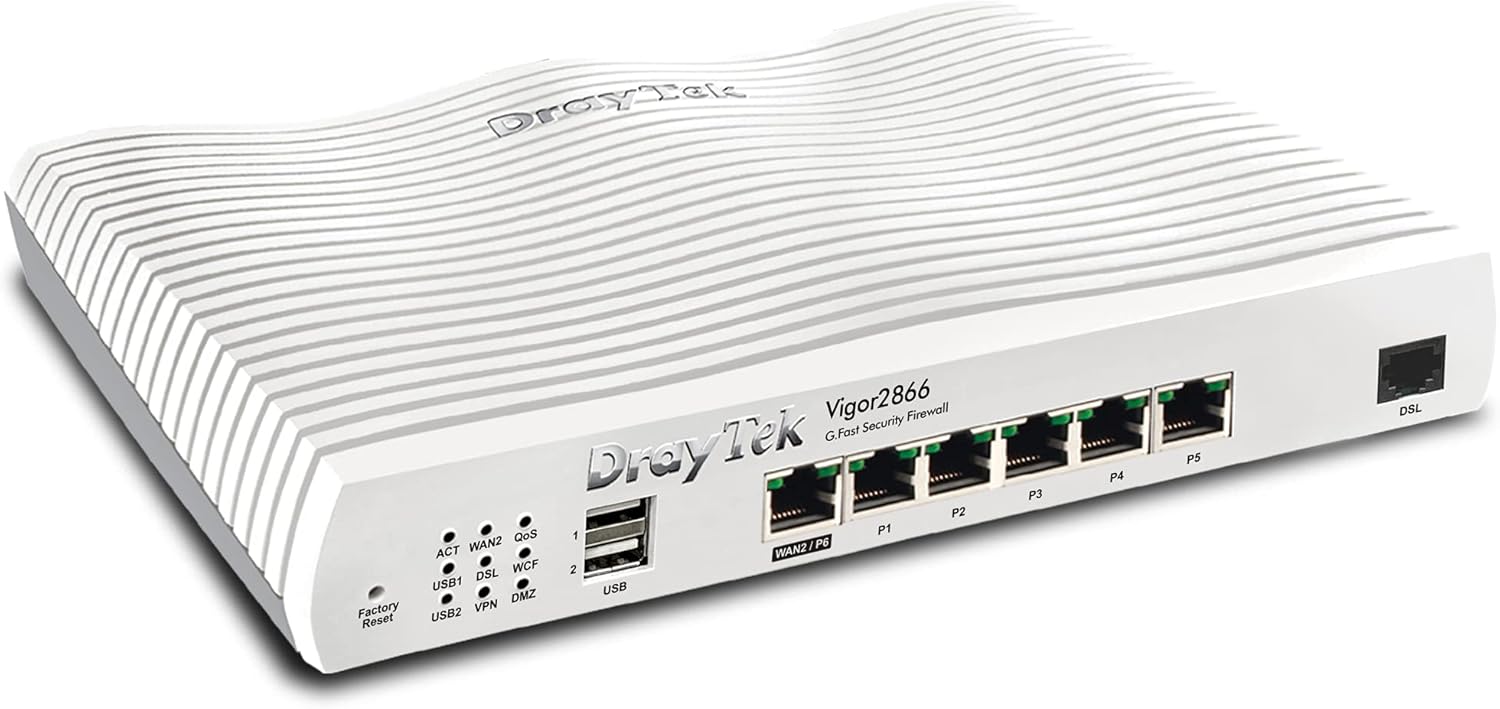
olusin 1: Iwaju-ọtun view of the DrayTek Vigor 2866 Router. This image shows the compact design and the array of ports on the front panel.

Nọmba 2: Alaye view of the DrayTek Vigor 2866 Router's front panel with labeled ports and indicators.
- 1. Awọn afihan Ipo LED: Provide visual feedback on the router's operational status, including WAN activity, DSL connection, VPN status, and USB activity.
- 2. USB 2.0 Ports: Two USB ports for connecting external devices such as 3G/4G USB modems for backup WAN or USB storage.
- 3. 1GbE RJ-45 LAN/WAN Port (WAN2/P6): A versatile Gigabit Ethernet port that can function as either a LAN port or a secondary WAN port for fiber (FTTP) or other Ethernet-based internet connections.
- 4. 5x 1GbE RJ-45 LAN Ports (P1-P5): Five Gigabit Ethernet ports for connecting local network devices such as computers, switches, and network-attached storage (NAS).
- 5. G.Fast / VDSL2 / ADSL2+ RJ-11 Port (DSL): The primary WAN port for connecting to G.Fast, VDSL2 (FTTC), or ADSL2+ broadband lines.
3. Eto
3.1. Ìsopọ̀ Hardware Àkọ́kọ́
- Asopọ agbara: Connect the provided power adapter to the router's power input and then to a wall outlet. Ensure the power switch is in the OFF position before connecting, then turn it ON.
- DSL/WAN Connection:
- For G.Fast/VDSL2/ADSL2+ (FTTC): Connect your DSL line from the wall socket to the RJ-11 DSL port on the router.
- For FTTP (Fiber to the Premises) or Ethernet WAN: Connect the Ethernet cable from your Optical Network Terminal (ONT) or existing modem to the WAN2/P6 port on the router.
- Asopọ LAN: Connect an Ethernet cable from one of the LAN ports (P1-P5) on the router to your computer or network switch.
- Antenna Installation (if applicable): If your model includes external antennas, screw them firmly onto the connectors at the rear of the router.
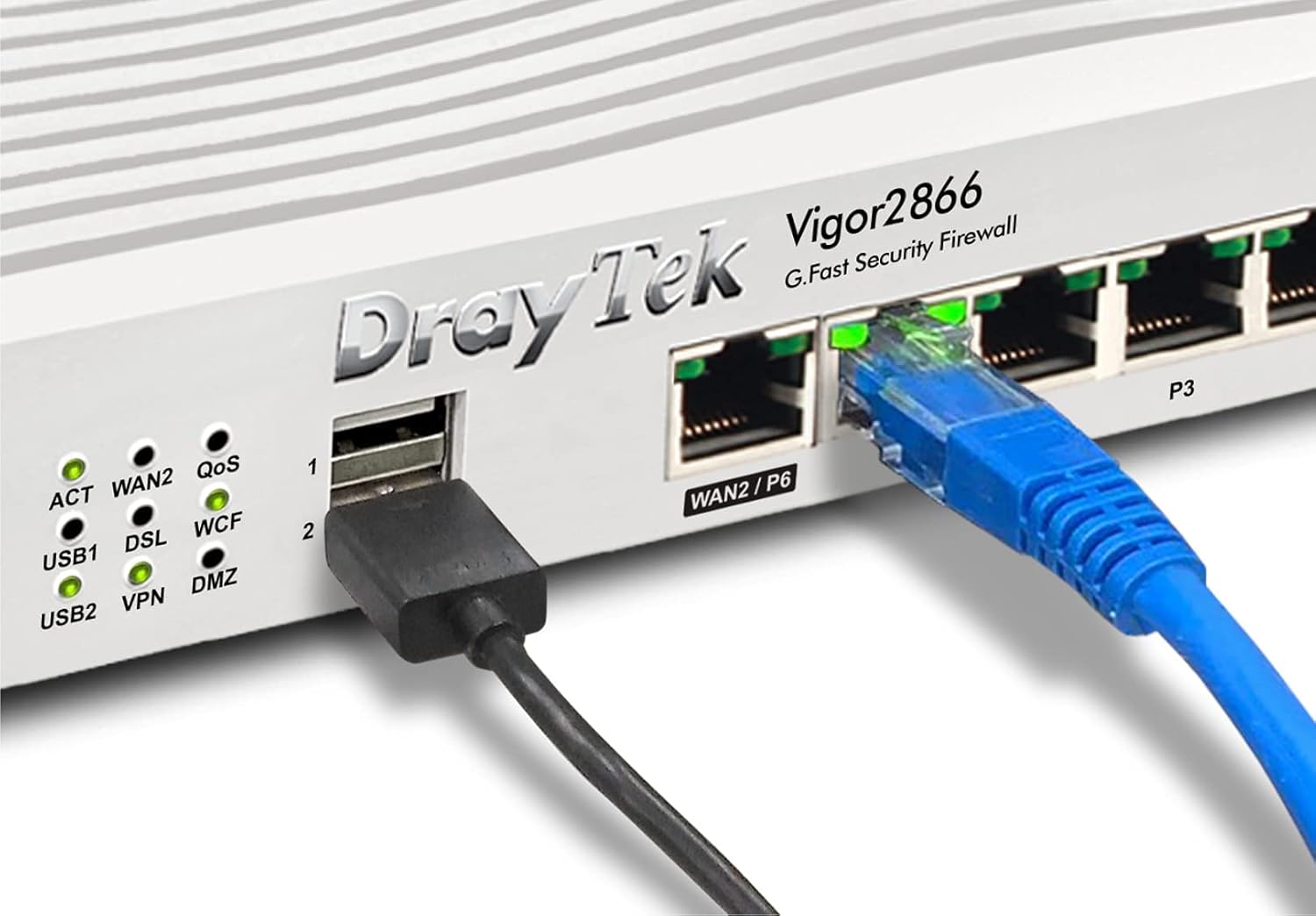
Olusin 3: Example of cable connections to the DrayTek Vigor 2866 Router, showing an Ethernet cable connected to a LAN port and a USB device connected.
3.2. Wíwọlé sí Ìṣètò Àkọ́kọ́
Lati wọle si awọn olulana web ni wiwo atunto:
- Rii daju pe kọmputa rẹ ti sopọ mọ ibudo LAN ti olulana naa.
- Ṣii a web ẹrọ aṣawakiri (fun apẹẹrẹ, Chrome, Firefox, Edge).
- Nínú àdírẹ́sì, tẹ àdírẹ́sì IP àìyẹ̀wọ́: 192.168.1.1 ki o si tẹ Tẹ.
- A login prompt will appear. Enter the default username and password (usually abojuto for both, or as specified on a label on the router).
- Follow the on-screen wizard for initial setup, including changing default login credentials and configuring your internet connection (WAN settings).
4. Awọn ilana Iṣiṣẹ
4.1. Internet Connection Management
The Vigor 2866 supports multiple WAN interfaces for flexible internet connectivity and load balancing.
- WAN1 (DSL): Configured for G.Fast, VDSL2, or ADSL2+ connections. Access the WAN > Eto Gbogbogbo menu to configure your ISP details.
- WAN2 (Ethernet): Configured for FTTP or other Ethernet-based connections. Access the WAN > Eto Gbogbogbo menu to configure IP settings (DHCP, Static IP, PPPoE).
- Load Balance/Failover: Lilö kiri si WAN > Load Balance/Route Policy to configure how internet traffic is distributed across multiple WANs or to set up failover for redundancy.
4.2. VPN Configuration
The router supports various VPN protocols for secure remote access and site-to-site connectivity.
- SSL VPN: For easy and secure remote access for individual users. Configure under VPN àti Ìwọ̀lé Láàárín Ọ̀nà jíjìn > SSL VPN.
- IPsec/PPTP/L2TP VPN: For site-to-site tunnels or traditional remote access. Configure under VPN àti Ìwọ̀lé Latọna jijin > LAN sí LAN or Olùlò Títẹ̀-lọ́wọ́ Láti Aláìlágbára.
4.3. Firewall and Content Filtering
Enhance network security using the built-in firewall and content filtering features.
- Awọn ofin ogiriina: Define rules to control inbound and outbound traffic under Ogiriina > Eto Àlẹ̀mọ́.
- Sisẹ akoonu: Lo URL Content Filter, Web Content Filter (WCF), and Application Filter to manage internet access and block undesirable content. Access these features under CSM (Content Security Management).
5. Itọju
5.1. Awọn imudojuiwọn famuwia
Máa ṣe àtúnṣe firmware ti rédíò déédéé láti rí i dájú pé iṣẹ́ rẹ̀ dára, ààbò, àti ìwọlé sí àwọn ẹ̀yà tuntun.
- Visit the official DrayTek webAaye (www.draytek.co.uk/support/downloads) to download the latest firmware for your Vigor 2866 model.
- Wọle si awọn olulana web ni wiwo.
- Lilö kiri si Ìtọ́jú Ètò > Ìmúdàgbàsókè Firmware.
- Lọ kiri si famuwia ti a gbasile file and initiate the upgrade process. Do not power off the router during the upgrade.
5.2. Backup and Restore Configuration
It is recommended to back up your router's configuration settings before making significant changes or performing firmware updates.
- Afẹyinti: Lọ si Ìtọ́jú Ètò > Àfikún Ìṣètò to save your current settings to your computer.
- Pada sipo: Use the same menu to upload a previously saved configuration file.
5.3. Atunto ile-iṣẹ
If the router becomes unresponsive or you need to revert all settings to their default state, perform a factory reset.
- Sọfitiwia Tunto: Lilö kiri si System Maintenance > Reboot System and select "Restore to Factory Default Settings".
- Tun Hardware Tun: With the router powered on, use a paperclip to press and hold the 'Factory Reset' button (located on the front panel, near the USB ports) for approximately 5-10 seconds until the ACT LED starts blinking rapidly. Release the button and wait for the router to reboot.
6. Laasigbotitusita
This section addresses common issues you might encounter with your DrayTek Vigor 2866 router.
6.1. Ko si Ayelujara Asopọ
- Ṣayẹwo Awọn okun: Ensure all Ethernet and DSL cables are securely connected to the correct ports on the router and your modem/wall socket.
- Awọn itọkasi LED: Observe the WAN/DSL LED indicators on the router. If they are off or blinking incorrectly, refer to the LED status guide in the full user manual or DrayTek's support resources.
- ISP Credentials: Verify that your ISP username and password are correctly entered in the router's WAN settings.
- Modem/ONT Status: If using an external modem or ONT, check its status lights to ensure it has an active connection to your ISP.
- Reboot Cycle: Power cycle your modem/ONT, then the router, and finally your computer. Wait a few minutes between each step.
6.2. Ko le Wiwọle Web Ni wiwo
- Adirẹsi IP: Confirm you are using the correct default IP address (192.168.1.1). If you changed it, use the new IP.
- Eto nẹtiwọki: Rí i dájú pé a ti ṣètò adapter nẹ́tíwọ́ọ̀kì kọ̀ǹpútà rẹ láti gba àdírẹ́sì IP (DHCP) láifọwọ́ṣe.
- Ogiriina/Agbodiyan: Temporarily disable any software firewalls or antivirus programs on your computer that might be blocking access.
- Kaṣe aṣawakiri: Pa rẹ kuro web kaṣe aṣawakiri ati awọn kuki, tabi gbiyanju ẹrọ aṣawakiri miiran.
- Idapada si Bose wa tele: As a last resort, perform a factory reset (see Section 5.3) to revert to default settings, then try accessing the interface again.
6.3. Slow Network Performance
- Bandwidth Usage: Check the router's Iṣakoso bandiwidi or Traffic Graph sections to identify any devices or applications consuming excessive bandwidth.
- Awọn Eto QoS: Review your Quality of Service (QoS) settings under Ìṣàkóso Ìwọ̀n Ìwọ̀n Ìwọ̀n Ìwọ̀n > QoS to ensure critical applications are prioritized correctly.
- Firmware: Ensure your router's firmware is up to date (see Section 5.1).
- Didara okun: Use high-quality Ethernet cables (Cat5e or Cat6) for wired connections.
7. Awọn pato
| Ẹya ara ẹrọ | Apejuwe |
|---|---|
| Orukọ awoṣe | Agbara 2866 |
| Nọmba awoṣe | V2866-K |
| Awọn iwọn (H x W x D) | 4.4 x 24.1 x 16.5 cm (1.73 x 9.49 x 6.5 inches) |
| Iwọn | 1.38 kg (3.04 lbs) |
| WAN Awọn atọkun | 1x G.Fast/VDSL2/ADSL2+ (RJ-11), 1x Gigabit Ethernet (RJ-45, configurable as LAN/WAN) |
| LAN Awọn atọkun | 5x Gigabit Ethernet (RJ-45) |
| Awọn ibudo USB | 2x USB 2.0 (for 3G/4G modem or storage) |
| Awọn oju opo VPN | Up to 32 VPN tunnels (IPsec, PPTP, L2TP, SSL VPN) |
| Ogiriina | SPI (Stateful Packet Inspection), DoS/DDoS Prevention, Object-based Firewall |
| Sisẹ akoonu | URL Content Filter, Web Content Filter (WCF), Application Filter |
| Isakoso | Web-based UI, CLI (Telnet/SSH), SNMP, TR-069 (VigorACS) |
| Ibi ti ina elekitiriki ti nwa | Ohun ti nmu badọgba Agbara Ita |
| Eto isesise | RouterOS (Internal) |
8. Atilẹyin ọja ati Support
For detailed warranty information, please refer to the warranty card included with your product or visit the official DrayTek webojula.
For technical support, firmware downloads, and additional resources, please visit the DrayTek support portal:
You may also contact DrayTek customer service through the contact information provided on their webojula.


