Ọrọ Iṣaaju
The Korg Minilogue is a 37-key polyphonic analog synthesizer designed for musicians seeking powerful analog sound and versatile features. This manual provides essential information for setup, operation, and maintenance of your Minilogue.

Image: The Korg Minilogue synthesizer, showcasing apẹrẹ kekere ati iṣeto iṣakoso rẹ.
Package Awọn akoonu
Ṣaaju ki o to tẹsiwaju, rii daju pe gbogbo awọn ohun kan wa ninu package naa:
- Korg Minilogue Polyphonic Analog Synthesizer
- AC Adapter
- MIDI Cable
- Awọn agbekọri
- Asọ didan
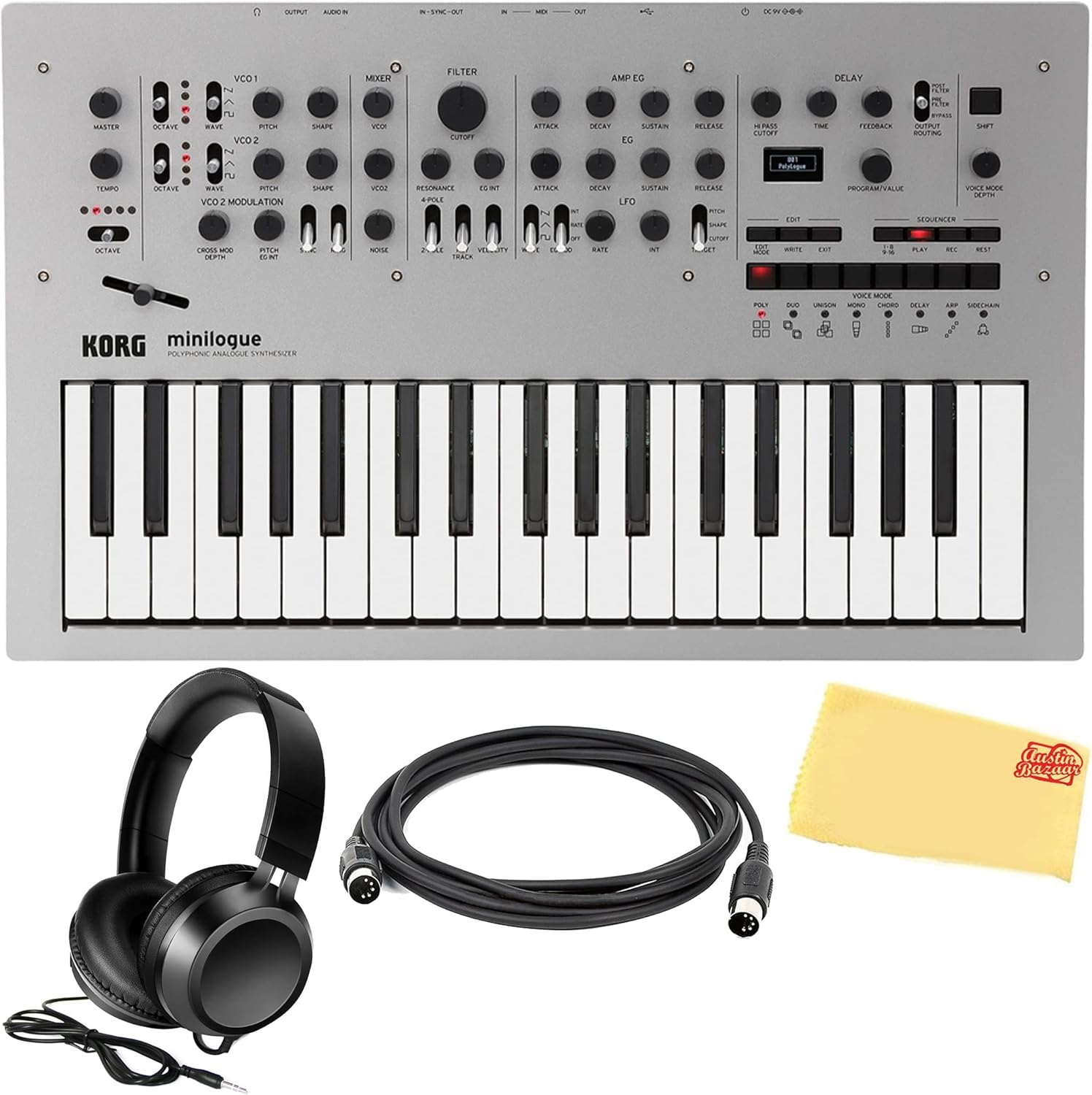
Image: The complete Korg Minilogue bundle, including the synthesizer and accessories.
Ṣeto
1. Asopọ agbara
- Connect the included AC adapter to the DC IN jack on the rear panel of the Minilogue.
- Pulọọgi AC ohun ti nmu badọgba sinu kan boṣewa agbara iṣan.
- Press the power button located on the rear panel to turn on the unit.
2. Awọn isopọ Audio
- Agbekọri: Connect the included headphones to the HEADPHONE jack on the rear panel for private monitoring.
- Ijade ohun: Connect the AUDIO OUT jack to an amplifier, mixer, or audio interface using a standard 1/4-inch audio cable.
3. MIDI Connections
- MIDI SINU/ODE: Use the included MIDI cable to connect the Minilogue to other MIDI devices (e.g., MIDI controller, computer interface) for control or synchronization.
- USB MIDI: Connect a USB cable (not included) from the Minilogue's USB port to a computer for MIDI communication.
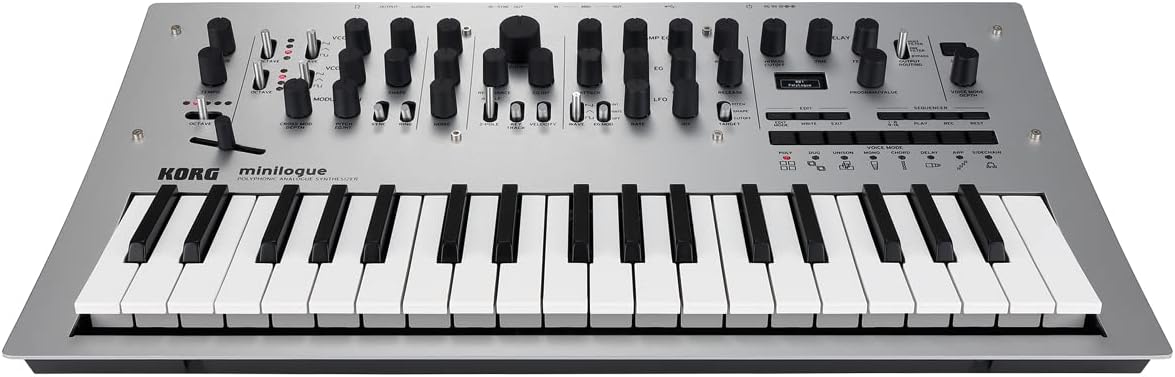
Image: The rear panel of the Korg Minilogue, highlighting the various input and output ports.
Awọn ilana Iṣiṣẹ
Ibi iwaju alabujutoview
The Minilogue's front panel is intuitively laid out for direct control over its sound engine. It features dedicated knobs and switches for each parameter, along with an OLED display.

Aworan: Alaye view of the Korg Minilogue's control panel, illustrating the layout of sound shaping parameters.
Sound Generation Parameters
- VCO1 & VCO2: Control Octave, Waveform (Saw, Triangle, Square), Pitch, and Shape. VCO2 also includes Cross Mod Depth, Pitch EG Int, Sync, and Ring modulation options.
- ALADALU: Adjust the levels of VCO1, VCO2, and Noise.
- ÀYỌ: Shape the tone with Cutoff, Resonance, EG Int, Filter Type (2-Pole, 4-Pole), Keytrack, and Velocity controls.
- AMP Fun apẹẹrẹ: Ṣakoso awọn amplitude envelope with Attack, Decay, Sustain, and Release parameters.
Voice Modes
The Minilogue offers 8 voice modes, each altering how the four voices interact:
- Poly: Standard 4-voice polyphony.
- Duo: 2-voice unison polyphony.
- Unison: All four voices stacked for a thick monophonic sound.
- Mono: Monophonic operation.
- Egbe: Plays a chord with a single key press.
- Idaduro: Creates a delay effect.
- Arp: Iṣẹ́ Arpeggiator.
- Side Chain: Applies a side-chain effect.
16-Igbese Sequencer
The built-in 16-step sequencer allows for real-time recording with overdubbing and step recording. Motion sequencing records knob movements, adding dynamic changes to your sequences.
Onboard Delay
The Minilogue includes a tape-style delay effect. Adjust parameters like Time and Feedback to create various delay textures.
Oscilloscope Display
The OLED display features an oscilloscope function, visually representing the waveform as you sculpt your sound. This provides real-time visual feedback on your sound design.
Synchronization with External Devices
The Minilogue can synchronize with Korg's groove machines (e.g., Volca series, Electribe, SQ-1) via its sync connector, allowing for integrated sequencer playback across multiple devices.
Itoju
- Ninu: Use the included polishing cloth to gently clean the surface of the synthesizer. Avoid abrasive cleaners or solvents.
- Ibi ipamọ: Store the Minilogue in a dry, dust-free environment away from direct sunlight and extreme temperatures.
- Gbigbe: When transporting, use a protective case to prevent damage to the keys and controls.
Laasigbotitusita
Ko si Ijade ohun
- Ensure the power adapter is securely connected and the unit is turned on.
- Check that headphones or external speakers are properly connected and their volume is turned up.
- Verify that the master volume knob on the Minilogue is not set to minimum.
- Confirm that the program selected is not muted or set to a very low volume.
MIDI ko fesi
- Check MIDI cable connections (IN to OUT, OUT to IN).
- Ensure MIDI settings on both the Minilogue and the connected device are correctly configured (e.g., MIDI channel, clock source).
- If using USB MIDI, verify that the necessary drivers are installed on your computer.
Awọn pato
| Ẹya ara ẹrọ | Ẹ̀kúnrẹ́rẹ́ |
|---|---|
| Keyboard | 37-keys (Slim-key, velocity sensitive) |
| Iran Ohun | Analog synthesis |
| Polyphony ti o pọju | 4 ohun |
| Awọn eto | 200 (100 Presets / 100 Users) |
| Voice Modes | 8 modes (Poly, Duo, Unison, Mono, Chord, Delay, Arp, Side Chain) |
| Atẹle | 16-step polyphonic step and motion sequencer |
| Ifihan | OLED oscilloscope display |
| Awọn asopọ | Headphone, Audio Out, Sync In/Out, MIDI In/Out, USB Type B |
| Ibi ti ina elekitiriki ti nwa | Adaparọ AC (DC9V) |
| Awọn iwọn (L x W x H) | 24.4 x 6.2 x 16.3 inches |
| Iwọn | 9.38 iwon |
| Ohun elo ara | Aluminum, Metal, Wood |
Atilẹyin ọja ati Support
For warranty information and technical support, please refer to the official Korg website or contact your authorized Korg dealer. Keep your purchase receipt as proof of purchase.


