1. Eto
1.1 Unpacking ati Ibẹrẹ ayewo
Carefully remove all components from the packaging. Verify that all items listed in the package contents are present and undamaged. If any items are missing or damaged, please contact customer support.
1.2 Power Supply and Charging
The KONIX PS88B Roll-Up Piano is equipped with a built-in rechargeable Lithium battery. It supports charging via USB or a power bank. A full charge provides approximately 6-8 hours of playtime.
 Image: The roll-up piano connected to a USB charging cable.
1.3 Placement and Unrolling
For optimal performance, place the roll-up piano on a long, flat, and stable surface. Ensure the surface is free from obstructions that could interfere with key presses. The keyboard measures approximately 51.26 inches (135 cm) in width when fully unrolled.
 Image: The flexible silicone keyboard unrolled on a flat surface, showing its full length.
 Image: A diagram illustrating the dimensions of the roll-up piano, including its length and width.
1.4 Nsopọ Peripherals
The control panel features various ports for enhanced functionality:
- Agbekọri/Agbọrọsọ: Connect external headphones or speakers via the 3.5mm jack for private practice or amplified ohun.
- USB/MIDI: Use the USB port for MIDI connectivity to computers, iPads, or mobile devices. This allows for music creation and interaction with music learning applications.
- Iṣawọle gbohungbohun: So gbohungbohun pọ fun ohun ti o n ba ọ sọrọ.
- Efatelese idaduro: Attach a sustain pedal for extended note duration.
 Aworan: A alaye view of the control panel, highlighting the USB/MIDI port, headphone output, MP3 connection, sustain pedal input, and microphone input.
Video: This video demonstrates the various jack functions, including charging, connecting headphones, connecting to a computer/iPad/mobile device, microphone mode, and sustain pedal connection. It also shows the waterproof material and how to roll up the keyboard.
2. Awọn ilana Iṣiṣẹ
2.1 Ipilẹ isẹ
Turn on the piano using the power switch located on the control panel. The LED display will illuminate, indicating the current settings. The 88-key silicone keyboard is designed for responsive play.
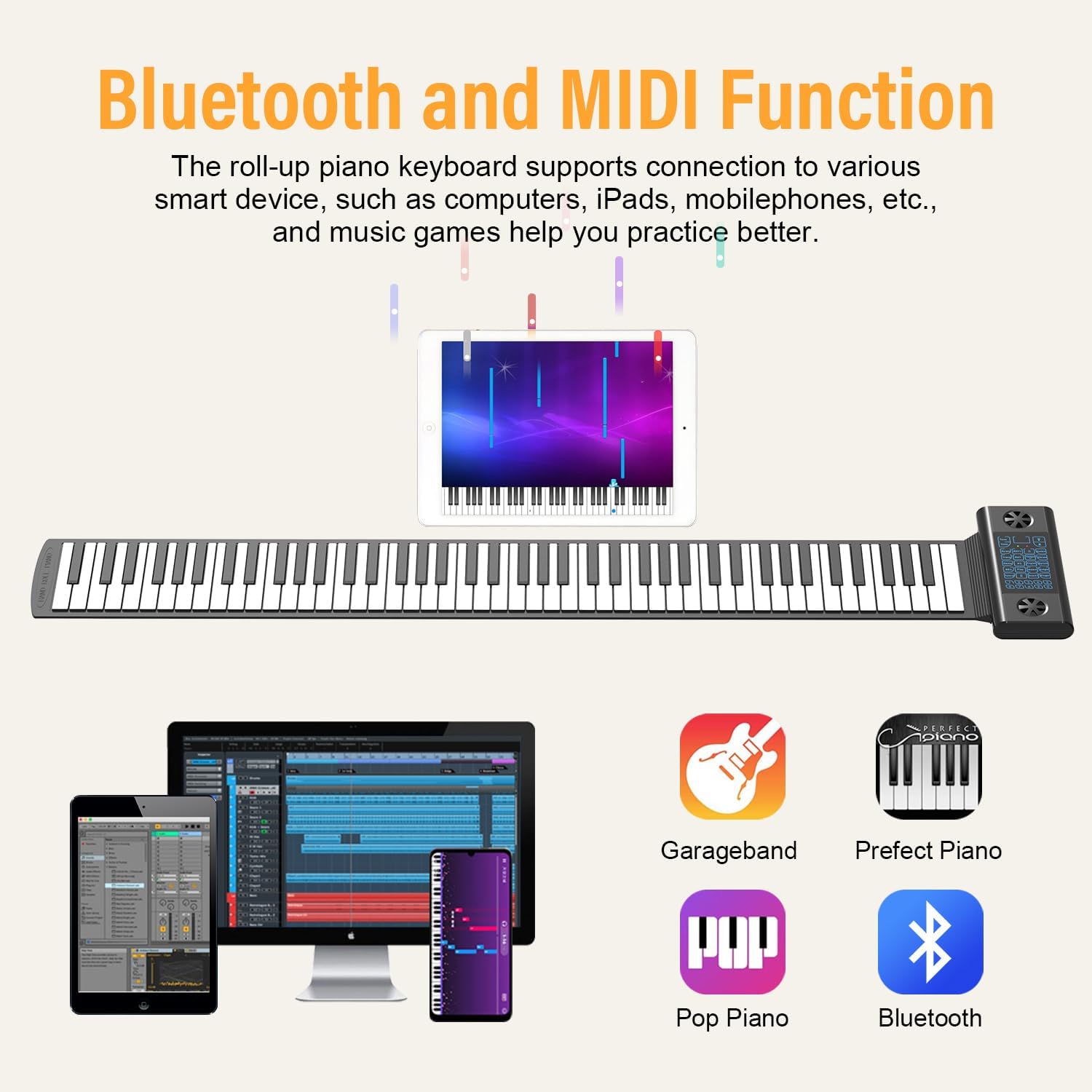 Image: The control panel of the roll-up piano, showing the LED display, tone and rhythm selection buttons, and other function controls.
2.2 Awọn ohun orin ati awọn ilu
The piano offers 128 different tones and 128 rhythms. Use the 'Tone+' and 'Tone-' buttons to cycle through the available instrument sounds. Similarly, use the 'RHY+' and 'RHY-' buttons to select from the various rhythm patterns. There are also 14 demonstration songs available for playback.
2.3 Awọn iṣẹ pataki
The control panel includes buttons for various functions:
- REC (Àkọsílẹ̀): Ó bẹ̀rẹ̀ sí ní gba ìkọsílẹ̀ iṣẹ́ rẹ.
- Mu ṣiṣẹ: Plays back recorded music.
- Duro: Activates the sustain effect for notes.
- Vibrato: Adds a vibrato effect to the sound.
- Ẹkọ: Accesses built-in teaching modes.
- Àwọn Iṣẹ́ Kọd: Supports both single-finger and multi-finger chord recognition.
2.4 Bluetooth and MIDI Connectivity
The KONIX PS88B features Bluetooth and MIDI functionality, allowing connection to smart devices such as computers, iPads, and mobile phones. This enables interaction with music applications like GarageBand or other piano learning games, expanding the instrument's utility for practice and creation.
 Image: The roll-up piano wirelessly connected to a tablet, laptop, and smartphone, demonstrating its Bluetooth and MIDI capabilities with music applications.
3. Itọju
3.1 Ninu Keyboard
The keyboard is made from food-grade silicone, which is durable and wear-resistant. To clean, gently wipe the surface with a soft, damp cloth. Avoid using harsh chemicals or abrasive materials that could damage the silicone.
 Image: A hand cleaning the keys of the roll-up piano, demonstrating its easy-to-clean silicone material.
3.2 Ibi ipamọ
When not in use, the roll-up piano can be easily rolled up for compact storage. This design prevents damage and makes it convenient for transport.
4. Laasigbotitusita
4.1 Unresponsive Keys or Repeated Notes
Due to the flexible nature of roll-up keyboards, occasional issues with key responsiveness or unintended repeated notes may occur. Ensure the piano is placed on a completely flat and firm surface. Avoid pressing keys with excessive force or at an angle that might cause the silicone to buckle.
4.2 Low Volume from Speakers
If the built-in speakers produce low volume even at the highest setting, consider connecting external headphones or amplified speakers. The internal speakers are designed for portability and may have limited output.
4.3 Batiri Ko dani agbara
If the battery life is significantly shorter than the advertised 6-8 hours, ensure the charging cable and adapter are functioning correctly. Try charging with a different compatible USB power source. If the issue persists, the battery may require service.
5. Awọn pato
| Orukọ awoṣe | PS88B |
| Nọmba ti Awọn bọtini | 88 |
| Ohun elo Iru | Silikoni |
| Ọja Mefa | 1.22"D x 51.26"W x 1.22"H |
| Iwọn Nkan | 3.45 iwon (1.57 kilo) |
| Asopọmọra Technology | Bluetooth, USB |
| Orisun agbara | Okun Itanna & Agbara Batiri |
| Awọn agbekọri Jack | 3.5mm Jack |
| Software atilẹyin | Cakewalk, Sonar, Cubase, Nuendo, VST/VSTi |
| Eto isesise | Windows, Mac OSX |
| Pataki Ẹya | Portable, Roll Up |
6. Atilẹyin ọja ati Support
For warranty information and customer support, please refer to the documentation included with your purchase or visit the official KONIX website. Contact details for technical assistance and service inquiries can typically be found there.


