1. Ifihan
This manual provides essential information for the proper setup, operation, and maintenance of your Beyerdynamic M 201 Hypercardioid Dynamic Instrument Microphone. Please read this manual thoroughly before using the product to ensure optimal performance and longevity.
The Beyerdynamic M 201 is a high-quality dynamic microphone designed for instrument recording and live sound applications. Its hypercardioid polar pattern offers excellent off-axis rejection, making it suitable for isolating sound sources in complex acoustic environments.
2. Key Awọn ẹya ara ẹrọ
- Hypercardioid Polar Pattern: Provides superior isolation of the sound source and reduces feedback.
- Dynamic Transducer: Robust and capable of handling high sound pressure levels (SPL).
- Ikole Irin ti o tọ: Ensures reliability and longevity in various environments.
- Asopọmọra XLR: Standard professional audio connection for compatibility with mixers and audio interfaces.
- Okunfa Fọọmu Iwapọ: Facilitates easy placement in tight spaces.
3. Kini To wa
Upon unpacking your Beyerdynamic M 201, please ensure all items are present:
- Beyerdynamic M 201 Microphone
- Microphone Clip (MA-CL 25)
- Ọran gbigbe
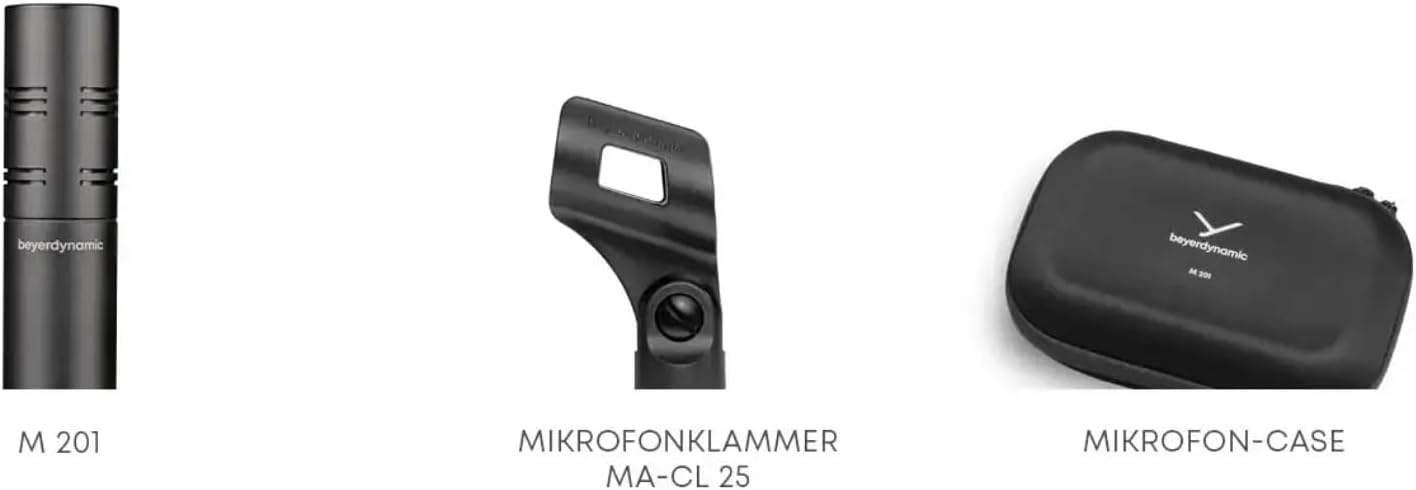
Image: The Beyerdynamic M 201 microphone, its MA-CL 25 microphone clip, and the protective carrying case.
4. Awọn ilana iṣeto
- So Agekuru Gbohungbohun So mọ: Secure the MA-CL 25 microphone clip to a standard microphone stand.
- Gbé Gbohungbohun kalẹ̀: Carefully insert the Beyerdynamic M 201 microphone into the clip. Ensure it is firmly seated.
- So okun XLR pọ: Connect a balanced XLR cable (not included) to the microphone's XLR output and to an input on your audio mixer or audio interface.
- Ipo: Position the microphone appropriately for the sound source. The hypercardioid pattern is most sensitive directly in front of the microphone.

Image: The M 201 microphone mounted on a stand, positioned to capture sound from a snare drum. This illustrates a typical setup for drum recording.

Image: The M 201 microphone on a stand, capturing audio from an acoustic guitar. This demonstrates its use for acoustic instruments.

Image: The M 201 microphone placed in front of an electric guitar amplifier, suitable for capturing amplified instrument sounds.
5. Awọn ilana Iṣiṣẹ
The Beyerdynamic M 201 is a passive dynamic microphone and does not require phantom power. It is ready for use once connected to an appropriate input.
- Gba Staging: Adjust the gain on your mixer or audio interface to achieve an optimal signal level without clipping.
- Ipa isunmọtosi: Be aware of the proximity effect, where bass frequencies are accentuated when the microphone is close to the sound source. Adjust positioning as needed for desired tonal balance.
- Ìkọ̀sílẹ̀ níta Ààrin: Utilize the hypercardioid pattern by aiming the microphone directly at the desired sound source and positioning unwanted sound sources in the null points (sides) of the microphone.
6. Itọju ati Itọju
- Ninu: Lo aṣọ rírọrùn tí ó gbẹ láti nu ara gbohungbohun náà. Má ṣe lo àwọn ohun ìfọmọ́ omi tàbí àwọn ohun èlò ìfọ́mọ́.
- Fifọ Grille: If the microphone grille becomes dirty, gently wipe it with a slightly damp cloth. Ensure no moisture enters the microphone capsule.
- Ibi ipamọ: Tí o kò bá lò ó, fi gbohùngbohùn náà sínú àpótí ìrùsókè tí a pèsè láti dáàbò bò ó kúrò lọ́wọ́ eruku, ọrinrin, àti ìbàjẹ́ ara.
- Yago fun awọn isọ silẹ: While robust, avoid dropping the microphone as this can damage internal components.

Aworan: Alaye view of the microphone's internal components during assembly, demonstrating the precision engineering.
7. Laasigbotitusita
| Isoro | Owun to le Fa | Ojutu |
|---|---|---|
| Ko si Ijade ohun |
|
|
| Ohun Daru |
|
|
| Ariwo abẹlẹ ti o pọju |
|
|
8. Imọ ni pato
| Iru transducer | Ìmúdàgba |
| Pola Àpẹẹrẹ | Hypercardioid (Unidirectional) |
| Idahun Igbohunsafẹfẹ | 40 Hz - 18 kHz |
| Ifamọ Audio | 58 dB |
| Ipalara | 200 ohm |
| Ifihan Ibuwọlu-si-Noise | 76 dB |
| Asopọmọra | XLR |
| Ohun elo | Irin |
| Awọn iwọn (L x W x H) | 9.3 x 6.6 x 3.55 inches |
| Iwọn | 1.4 iwon |
9. atilẹyin ọja Information
Beyerdynamic products are covered by a manufacturer's warranty. For detailed information regarding warranty terms, conditions, and registration, please refer to the official Beyerdynamic webojú òpó wẹ́ẹ̀bù tàbí kí o kàn sí àwọn oníbàárà wọn. Pa ẹ̀rí ìrajà rẹ mọ́ fún àwọn ẹ̀tọ́ ìdánilójú.
10. Onibara Support
For further assistance, technical support, or service inquiries, please visit the official Beyerdynamic website or contact their customer service department. Contact information can typically be found on the Beyerdynamic webapakan support ojula.
Official Beyerdynamic Webojula: www.beyerdynamic.com


