Ọrọ Iṣaaju
The Flysky FS-SR8 is an advanced 8-channel receiver designed for use with RC transmitters utilizing the ANT protocol, specifically compatible with the FS-ST8. This compact receiver features two external antennas for enhanced signal reception and supports bidirectional transmission, allowing the transmitter to display returned information from the receiver after two-way binding. It is versatile, adapting to a wide range of models including fixed-wing aircraft, helicopters, gliders, delta-wing airplanes, multicopters, racing drones, engineering vehicles, nest boats, robots, and cars.
Key features include PWM/PPM/i-BUS/S.BUS data output, a wide input power range of 3.5V to 9V DC, and robust construction for reliable performance.
Alaye Aabo
Jọwọ san ifojusi si voltage and safety when using this device. Ensure correct polarity and voltage within the specified range (3.5V~9V/DC) to prevent damage to the receiver or connected components.
Ọja Pariview
The FS-SR8 receiver features clearly labeled ports and indicators for easy setup and operation.

Nọmba 1: Iwaju view of the FS-SR8 receiver. Visible labels include LED indicator, SERVO, SENS, BVD/VCC, BIND ports, and channels 1-8. The "BIND" button and "S+- PPM/1" output are also clearly marked.

Nọmba 2: The FS-SR8 receiver shown with its two external antennas and a snippet of the product manual, illustrating the compact design and included components.

Nọmba 3: Ẹyìn view of the FS-SR8 receiver, displaying regulatory markings such as 'CE' and the country of manufacture, 'MADE IN CHINA'.
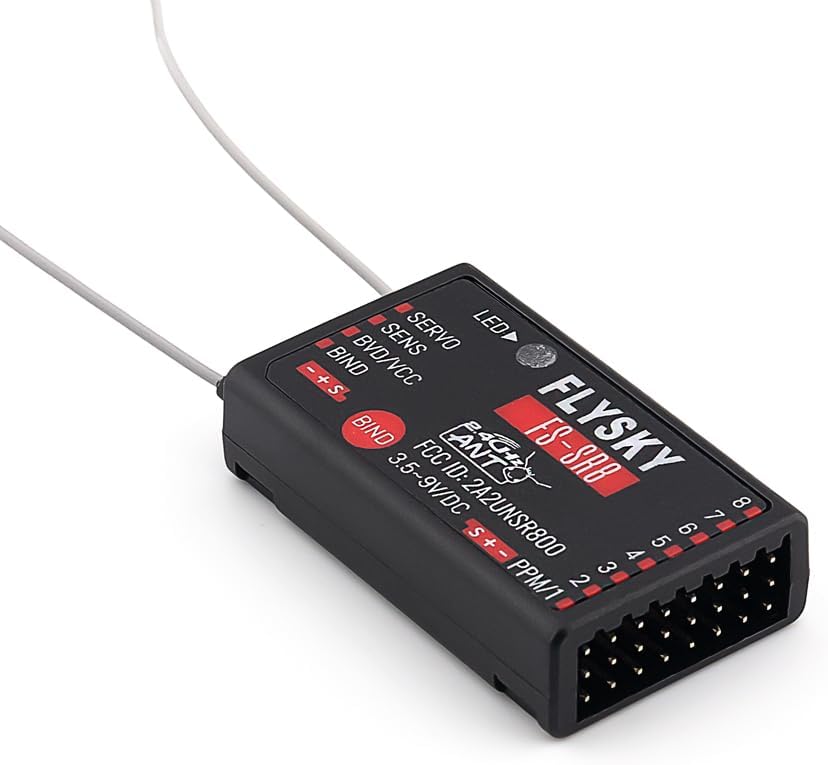
Nọmba 4: Igun view of the FS-SR8 receiver, providing a clear perspective of the antenna connections and the arrangement of the various input/output ports.

Nọmba 5: The FS-SR8 receiver sealed in its anti-static retail packaging, ready for distribution.
Awọn apejuwe ibudo:
- LED: Ina Atọka ipo.
- SERVO: Standard servo output channels (1-8).
- SENS: Sensor input port.
- BVD/VCC: Batiri Voltage Detection / Power Input.
- Di: Binding port/button for pairing with transmitter.
- S+- PPM/1: Multi-functional port for S.BUS, PPM, or Channel 1 output.
Ṣeto
Ilana Asopọmọra:
- Ensure your FS-ST8 transmitter is powered off.
- Connect power to the FS-SR8 receiver (3.5V~9V/DC). The LED on the receiver should start flashing, indicating it's ready for binding.
- Press and hold the BIND button on the receiver.
- While holding the BIND button, power on your FS-ST8 transmitter.
- The LED on the receiver should change to a solid light, indicating successful binding. Release the BIND button.
- Agbara iyipo mejeeji ti transmitter ati olugba lati jẹrisi asopọ naa.
- The FS-SR8 supports both one-way and two-way binding. For two-way binding, the transmitter will display telemetry information returned from the receiver.
Ibi Antenna:
Proper antenna placement is crucial for optimal range and signal reliability. Position the two antennas at a 90-degree angle to each other, away from carbon fiber, metal, or other conductive materials that could shield the signal. Ensure the antenna tips are exposed and not bent sharply.
Connecting to Flight Controller/Servos:
Connect the receiver's output ports (PWM/PPM/i-BUS/S.BUS) to your flight controller or servos according to your model's wiring diagram. Refer to your flight controller's manual for specific connection details for each data output type.
Ṣiṣẹ
Awọn awoṣe ibaramu:
The FS-SR8 receiver is designed for a broad range of RC models, including:
- Fixed-wing aircraft
- Awọn ọkọ ofurufu
- Gliders
- Delta-wing airplanes
- Multicopters
- Racing drones
- Engineering vehicles
- Nest boats
- Awọn roboti
- Awọn ọkọ ayọkẹlẹ RC
Ibiti ati ifihan agbara:
The receiver offers a typical air distance of over 1000m without interference. Always perform a range check before flying or operating your model to ensure a stable connection. Avoid operating in areas with high RF interference.
Itoju
- Ninu: Keep the receiver clean and free from dust, dirt, and moisture. Use a soft, dry cloth for cleaning.
- Awọn ipo Ayika: Operate and store the receiver within the specified temperature range of -10℃ to +60℃ and humidity limit of 20% to 95%. Avoid extreme temperatures and high humidity.
- Ayewo ti ara: Regularly inspect the antennas for any damage or kinks. Ensure all connections are secure.
- Awọn imudojuiwọn famuwia: The receiver supports online updates. Check the official Flysky website for the latest firmware versions and update instructions to ensure optimal performance and compatibility.
Laasigbotitusita
| Isoro | Owun to le Fa | Ojutu |
|---|---|---|
| Receiver LED not solid after binding | Binding failed; Transmitter not in binding mode; Receiver not powered correctly. | Re-attempt binding procedure carefully. Ensure transmitter is in binding mode. Check receiver power supply. |
| Loss of signal/short range | Poor antenna placement; Interference; Damaged antenna. | Adjust antenna position (90-degree angle, away from carbon/metal). Avoid operating near strong RF sources. Inspect and replace damaged antennas. |
| No response from servos/flight controller | Incorrect wiring; Receiver not bound; Flight controller not configured correctly. | Verify all wiring connections. Ensure receiver is successfully bound. Check flight controller settings for correct receiver protocol (PWM/PPM/i-BUS/S.BUS). |
| Olùgbà kò ṣiṣẹ́ | Voltage; Reversed polarity; Faulty power source. | Ṣayẹwo igbewọle voltage (3.5V~9V/DC). Verify polarity. Test with a different power source. |
Awọn pato
| Orukọ ọja | FS-SR8 |
| Awọn Atagba ibaramu | FS-ST8 (Adapts transmitters with ANT protocol) |
| Awọn ikanni PWM | 8 |
| RF | 2.4GHz ISM |
| Agbara to pọju | <20dBm (eirp) (EU) |
| 2.4G Ilana | ANT |
| Ipinnu | 4096 |
| Eriali | Eriali meji |
| Ijinna | > 1000m (ijinna afẹfẹ laisi kikọlu) |
| Agbara titẹ sii | 3.5 ~ 9V / DC |
| Ijade data | PWM/PPM/i-BUS/S.BUS |
| Imudojuiwọn Ayelujara | Bẹẹni |
| Iwọn otutu | -10 ℃ ~ +60 ℃ |
| Idinku Ọriniinitutu | 20% ~ 95% |
| Awọn iwọn | 44.8 * 26.6 * 11.3mm |
| Iwọn | 10g |
| Awọn iwe-ẹri | CE, FCC ID: 2A2UNSR800 |
Ohun ti o wa ninu Apoti
- 1x Flysky FS-SR8 Receiver
Atilẹyin ọja ati Support
For warranty information, technical support, and the latest product updates, please visit the official Flysky webojula. Tọju iwe-ẹri rira rẹ bi ẹri rira fun eyikeyi awọn ibeere atilẹyin ọja.
Osise Webojula: http://www.flysky-cn.com


