1. Ọja Ipariview
The SHIDU SD-258 is a compact and powerful portable voice amplifier designed to enhance vocal clarity and projection. It is suitable for various applications such as teaching, tour guiding, presentations, and outdoor activities. This device features a 10W output, an 1800mAh rechargeable battery, and supports multiple audio input options.
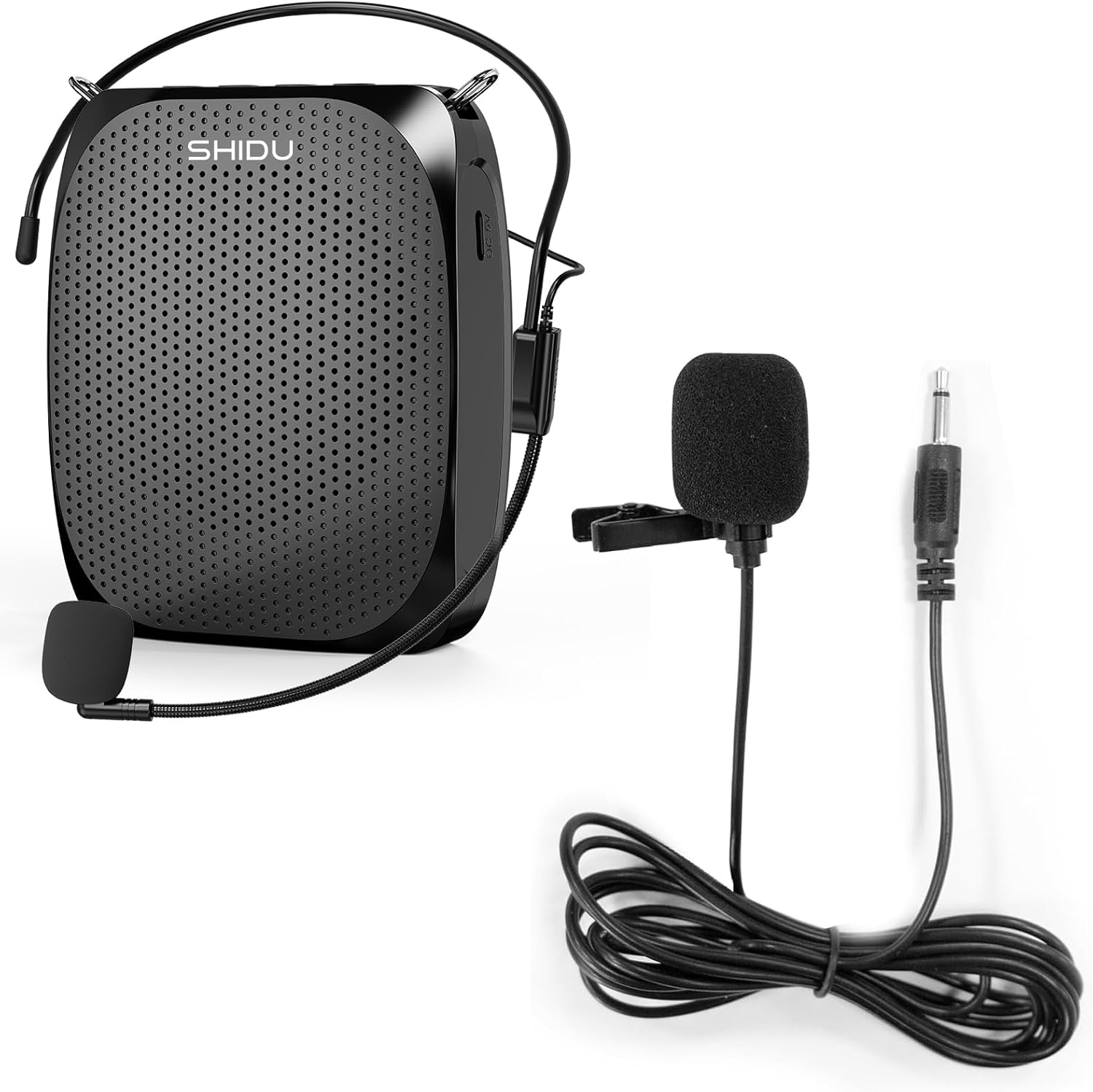
The SHIDU portable voice amplifier unit, accompanied by both the wired headset microphone and the 3.5mm lavalier clip-on microphone.
2. Package Awọn akoonu
Jọwọ rii daju pe gbogbo awọn nkan ti a ṣe akojọ rẹ si isalẹ wa ninu package rẹ:
- 1 x SHIDU Voice Amplifier (SD-258)
- 1 x Gbohungbohun Agbekọri Alailowaya
- 1 x 3.5mm Lavalier Clip-On Microphone
- 1 x Waistband
- 1 x Okun Ngba agbara USB
- 1 x Itọsọna olumulo
Note: A wall charger is not included. You can use any standard 5V USB power adapter or a computer USB port for charging.

Contents of the package, including the voice amplifier, wired headset microphone, USB charging cable, and waistband.
3. Awọn ẹya Ọja
- Powerful and Clear Sound: The SD-258 delivers 10W of clear audio output, capable of covering an area of approximately 11,000 sq.ft (1020 ㎡), suitable for groups of up to 100 people.
- Igbesi aye batiri gigun: Equipped with an 1800mAh built-in rechargeable lithium battery, providing up to 12 hours of amplification time or 10 hours of music playback on a full charge. Full charging takes 3-5 hours.
- Multifunctional Playback: Supports TF (Micro SD) card and USB flash drive playback. It can play music while amplifying your voice, functioning as a mini karaoke system.
- Iṣawọle Olohun AUX: The microphone port doubles as an AUX input, allowing connection to cell phones or computers via a 3.5mm AUX cable for use as a wired speaker.
- Ìdàrúdàpọ̀ Kekere: Engineered for accurate sound reproduction with minimal distortion, ensuring your voice is heard clearly.

Visual representation of the 1800mAh built-in rechargeable lithium battery, highlighting 12-15 hours of amplification time and 3-5 hours charging time.

Ohun exploded view diagram illustrating the internal components responsible for accurate and low-distortion sound reproduction.

An illustration demonstrating the effective sound coverage area of the voice amplifier, approximately 11,000 square feet (1020 square meters).
4. Eto
4.1 Ngba agbara si Ẹrọ
- Connect the small end of the provided USB charging cable to the DC 5V charging port on the voice amplifier.
- Connect the large end of the USB cable to a 5V USB power adapter (not included) or a computer's USB port.
- The charging indicator light will illuminate. The device is fully charged when the light changes or turns off (refer to specific model indicator behavior).
- Gbigba agbara ni kikun maa n gba awọn wakati 3-5.
4.2 Nsopọ Gbohungbohun
- Identify the microphone input port on the voice amplifier (usually labeled 'MIC' or with a microphone icon).
- Insert the 3.5mm plug of either the wired headset microphone or the lavalier clip-on microphone firmly into the MIC input port.
4.3 Wearing the Device and Microphone
- Ohùn Ampolutọpa: Attach the waistband to the amplifier and wear it around your waist, or clip it to your belt. Ensure the speaker faces your audience.
- Gbohungbo Agbekọri: Position the headset comfortably on your head. Adjust the microphone boom so the microphone is approximately 1-2 inches (2.5-5 cm) from your mouth.
- Gbohungbohun Lavalier: Clip the lavalier microphone to your clothing, ideally near your collar or lapel, ensuring it is facing towards your mouth.

A person demonstrating the proper use and placement of the 3.5mm lavalier clip-on microphone.
5. Awọn ilana Iṣiṣẹ
5.1 Agbara Tan / Pa
- To power on, rotate the volume knob clockwise until you hear a click and the power indicator light illuminates.
- To power off, rotate the volume knob counter-clockwise until you hear a click and the power indicator light turns off.
5.2 Siṣàtúnṣe iwọn
- Yi bọtini iwọn didun si ọna aago lati mu iwọn didun pọ si.
- Rotate the volume knob counter-clockwise to decrease the volume.
5.3 Music Playback (TF Card / USB Flash Drive)
- Insert a TF (Micro SD) card or USB flash drive containing MP3 audio files into the respective slot on the amplifier.
- Awọn amplifier should automatically detect and begin playing music.
- Use the control buttons (e.g., Play/Pause, Next Track, Previous Track) on the amplifier to manage playback.
- The device supports repeating individual songs or looping all music.
Ìtẹ̀wọlé ohùn AUX 5.4
- Connect one end of a 3.5mm AUX cable (not included) to your external audio source (e.g., smartphone, computer).
- Connect the other end of the AUX cable to the microphone input port on the voice amplifier.
- Awọn amplifier will now function as a wired speaker for your external device.
5.5 Preventing Feedback (Whistling Sound)
- Maintain a sufficient distance between the microphone and the speaker (amplifier unit).
- Ensure the microphone is not directly facing the speaker.
- Lower the volume if feedback occurs, then gradually increase it to a comfortable level.
- Avoid placing the microphone too close to walls or reflective surfaces.
6. Itọju
- Ninu: Use a soft, dry cloth to clean the surface of the amplifier. Má ṣe lo àwọn ohun èlò ìfọmọ́ omi tàbí àwọn ohun èlò ìpara.
- Ibi ipamọ: Tọju ẹrọ naa ni itura, aye gbigbẹ kuro lati orun taara ati awọn iwọn otutu to gaju.
- Itọju Batiri: Láti mú kí batiri pẹ́ sí i, gba agbára lórí ẹ̀rọ náà déédéé, kódà bí kò bá tiẹ̀ jẹ́ pé a ń lò ó déédéé. Má ṣe jẹ́ kí batiri náà máa jáde pátápátá fún ìgbà pípẹ́.
- Mimu: Handle the device and microphones with care to prevent damage from drops or impacts.
7. Laasigbotitusita
| Oro | Owun to le Fa | Ojutu |
|---|---|---|
| Ko si ohun lati ampitanna | Device is off; Volume is too low; Microphone not connected; Microphone faulty; Battery low. | Turn on the device; Increase volume; Ensure microphone is securely plugged in; Try another microphone if available; Charge the battery. |
| Whistling/Feedback sound | Microphone too close to speaker; Microphone facing speaker; Volume too high. | Increase distance between microphone and speaker; Adjust microphone position away from speaker; Reduce volume. |
| Ẹrọ ko gba agbara | Charging cable loose or faulty; Power adapter faulty; Charging port damaged. | Ensure cable is securely connected; Try a different USB cable or power adapter; Contact support if port is damaged. |
| Music playback issues | TF card/USB drive not inserted correctly; Incompatible file ọna kika; Ti bajẹ files. | Reinsert TF card/USB drive; Ensure files are MP3 format; Try different files or storage device. |
8. Awọn pato
| Ijade agbara | 10W |
| Agbara Batiri | 1800mAh |
| Ngba agbara Voltage | DC5V, 500mA |
| Akoko gbigba agbara | 3-5 wakati |
| Working Time (MIC mode) | Wákàtí 8-12 (da lori iwọn didun) |
| Working Time (Music mode) | Wákàtí 6-10 (da lori iwọn didun) |
| Ideri Ohun | Up to 11,000 sq.ft (1020 ㎡) |
| Asopọmọra Technology | AUX, USB |
| Input Audio | Gbohungbohun |
| Awọn ẹrọ ibaramu | Microphones, Musical Instruments, DJ Mixers, Audio Players, Headsets, Smartphones, Tablets, Laptops |
9. Atilẹyin ọja ati Support
SHIDU provides a worry-free warranty for this product. This includes:
- 30-Day Return and Refund: You may return the product for a refund within 30 days of purchase without reason.
- Atilẹyin fun oṣu 36: A 36-month warranty covers manufacturing defects and malfunctions under normal use.
- Atilẹyin Imọ-ọjọ igbesi aye: SHIDU offers lifetime technical support for the product.
For warranty claims or technical assistance, please contact SHIDU customer support through the retailer where the product was purchased or visit the official SHIDU webojula fun alaye olubasọrọ.


