1. Ifihan
The Flashpoint R2 Nano Remote is a compact and advanced wireless flash trigger designed for Panasonic and Olympus camera systems. It offers precise control over your flash settings through an intuitive touchscreen interface and OLED display, enhancing your photography experience with seamless integration and reliable performance.
Awọn ẹya pataki pẹlu:
- Ijọpọ Ailokun: Full TTL compatibility with Olympus/Panasonic cameras for optimal exposure.
- Ultimate Reliability: Stable 2.4 GHz radio frequency with 32 channels, ensuring consistent triggering up to 328 feet (100 meters).
- Amuṣiṣẹpọ-iyara giga (HSS): Achieve sync speeds up to 1/8000s for creative effects and motion freezing.
- Iṣakoso iboju ifọwọkan ogbon: Responsive interface for quick and easy adjustments.
- Versatile Group Control: Manage up to 16 groups (A-F, 0-9) independently for complex lighting setups.
2. Ohun ti o wa ninu Apoti
Upon unboxing your Flashpoint R2 Nano, please verify that all components are present:
- Flashpoint R2 Nano Remote
- USB-C Ngba agbara Cable
- Apo ipamọ
- Afowoyi Olumulo (iwe-ipamọ yii)
3. Ọja Ipariview
Familiarize yourself with the components and controls of your R2 Nano remote.
Àwòrán 3.1: Iwájú àti Ẹ̀gbẹ́ View of the R2 Nano with Key Components Labeled.
- Afi ika te: Main interface for settings and control.
- Yan Póòlù: Fun awọn akojọ aṣayan lilọ kiri ati ṣatunṣe iye.
- Agbara Yi pada: Yipada ẹrọ si tan/pa.
- Bọtini Idanwo: Nfa filasi idanwo kan.
- Installing/Detaching Button: Releases the remote from the hotshoe.
- Iṣagbesori Iho: Connects to the camera's hotshoe.
- Ibudo Ngba agbara USB-C: Fun gbigba agbara batiri.

Figure 3.2: R2 Nano Touchscreen Interface Details.
- Ikanni (CH): Displays the current wireless channel (e.g., CH6).
- Group (A, B, C, etc.): Indicates the active flash groups.
- Ipele Agbara Ijade: Shows the flash power setting (e.g., +0.0, 1/128).
- Parameters - / +: Touch controls for decreasing/ìpọ̀síasinàwọn iye g.
- Awọn ọna amuṣiṣẹpọ: Icons indicating sync modes (e.g., HSS, front curtain, rear curtain).
- Awoṣe Lamp: Icon for modeling lamp ipo.
- Atọka Batiri: Ṣe afihan ipele batiri lọwọlọwọ.
4. Eto
4.1 Ngba agbara si Batiri naa
The R2 Nano is equipped with a built-in rechargeable lithium battery. Before first use, fully charge the device.
- Locate the USB-C charging port on the side of the R2 Nano.
- Connect the provided USB-C charging cable to the port.
- So opin okun miiran pọ si ohun ti nmu badọgba agbara USB (kii ṣe pẹlu) tabi ibudo USB ti kọnputa kan.
- The battery indicator on the screen will show charging status. A full charge from 0% to 100% typically takes approximately 2 hours.

Figure 4.1: Charging the R2 Nano via USB-C.
4.2 Fífi sori Kamẹra
The R2 Nano features an easy-mounting, durable hotshoe design for secure attachment to your camera.
- Rii daju pe kamẹra rẹ ti wa ni pipa.
- Slide the R2 Nano's mounting slot onto your camera's hotshoe.
- Gently push until it clicks into place, ensuring a secure connection.
- To detach, press the Installing/Detaching Button and slide the remote off.

Figure 4.2: Mounting the R2 Nano on a Camera Hotshoe.
5. Awọn ilana Iṣiṣẹ
5.1 Titan / Pa a
- To power on, press and hold the Power Switch until the screen illuminates.
- To power off, press and hold the Power Switch until the screen turns off.
5.2 Lilọ kiri ni wiwo iboju ifọwọkan
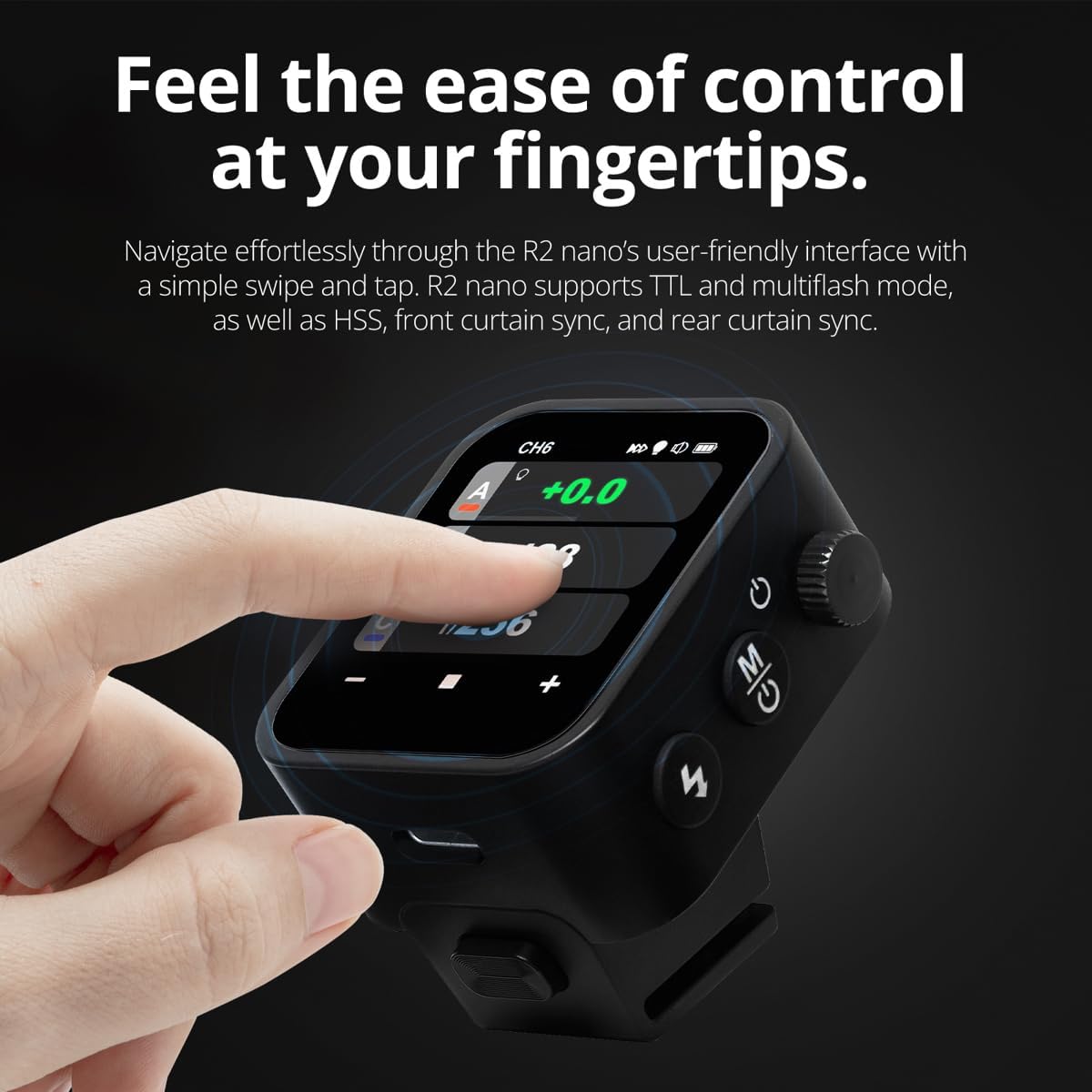
The R2 Nano features a responsive touchscreen and a select dial for intuitive control.

Figure 5.1: High Definition OLED Screen Interface.
- Touch Interaction: Tap on a group (A, B, C, etc.) to select it for adjustment. Tap on parameters like power level to modify them.
- Yan Póòlù: Rotate the dial to scroll through options or adjust values. Press the dial to confirm selections.
- Atunse paramita: Use the on-screen '-' and '+' buttons or the Select Dial to change flash power, exposure compensation, or other settings.

Figure 5.2: Touchscreen Interaction for Settings Adjustment.
5.3 Setting Channels and Groups
To avoid interference and control multiple flashes, set appropriate channels and groups.
- Access the channel settings through the touchscreen menu. Select a channel from 1 to 32. Ensure your flash units are set to the same channel.
- Assign flash units to different groups (A-F, 0-9) to control them independently. The R2 Nano allows control of up to 16 groups.
5.4 Flash Modes (TTL, Manual, Multi-flash)
The R2 Nano supports various flash modes to suit different shooting scenarios.
- TTL (Lẹ́ńsì-Lẹ́ńsì): Automatically adjusts flash output for correct exposure. Ideal for fast-paced shooting where lighting conditions change frequently.
- Afọwọṣe (M): Allows precise control over flash power output (e.g., 1/1 to 1/256). Suitable for consistent lighting setups and creative control.
- Multi-flash (Stroboscopic): Fires a series of rapid flashes during a single exposure to capture multiple movements of a subject.
5.5 Sync Modes (HSS, Front Curtain, Rear Curtain)
Select the appropriate sync mode based on your shutter speed and desired effect.
- HSS (High-Speed Sync): Enables flash synchronization at shutter speeds faster than the camera's native sync speed (up to 1/8000s). Useful for overpowering ambient light or using wide apertures in bright conditions.
- Imuṣiṣẹpọ Aṣọ Iwaju: The flash fires at the beginning of the exposure. This is the standard sync mode.
- Imuṣiṣẹpọ Aṣọ Tẹhin: The flash fires just before the second curtain closes. This creates a streaking effect behind moving subjects, giving a sense of motion.
6. Itọju
Proper maintenance ensures the longevity and optimal performance of your R2 Nano remote.
- Ninu: Use a soft, dry cloth to clean the exterior of the device. For the touchscreen, use a microfiber cloth specifically designed for electronics. Avoid using harsh chemicals or abrasive materials.
- Ibi ipamọ: When not in use, store the R2 Nano in its provided storage bag to protect it from dust and scratches. Store in a cool, dry place away from direct sunlight and extreme temperatures.
- Itọju Batiri: To maintain battery health, avoid fully discharging the battery frequently. If storing for extended periods, charge the battery to approximately 50% every few months.
- Hotshoe Contacts: Keep the hotshoe contacts clean and free of debris to ensure reliable communication with your camera.
7. Laasigbotitusita
If you encounter issues with your Flashpoint R2 Nano, refer to the following common problems and solutions.
| Isoro | Owun to le Fa | Ojutu |
|---|---|---|
| Ẹrọ naa ko ṣiṣẹ. | Batiri ti dinku. | Gba agbara si ẹrọ naa nipa lilo okun USB-C. |
| Flash units not firing. | Incorrect channel or group settings. | Ensure the R2 Nano and flash units are set to the same channel and correct groups. |
| Flash units not firing. | Remote not securely mounted. | Ensure the R2 Nano is fully seated in the camera's hotshoe. |
| Inconsistent flash triggering. | kikọlu ayika. | Change the wireless channel to one with less interference. Ensure no obstructions between remote and flash. |
| Iboju ifọwọkan ko dahun. | Ibùgbé software glitch. | Power off the device, wait a few seconds, then power it back on. |
| HSS ko ṣiṣẹ. | Camera or flash not set to HSS mode. | Verify HSS is enabled on both the R2 Nano and your compatible flash unit. Ensure camera shutter speed is above sync speed. |
8. Awọn pato
| Ẹya ara ẹrọ | Ẹ̀kúnrẹ́rẹ́ |
|---|---|
| Awoṣe | Flashpoint R2 Nano |
| Ibamu | Panasonic and Olympus Cameras |
| Alailowaya Igbohunsafẹfẹ | 2.4 GHz |
| Awọn ikanni | 32 |
| Awọn ẹgbẹ | 16 (AF, 0-9) |
| Alailowaya Ibiti | Titi de awọn mita 100 (328 ẹsẹ) |
| Iyara Sync | Títí dé 1/8000 (HSS) |
| Ifihan | Touchscreen OLED |
| Batiri | Batiri Lithium gbigba agbara gbigba |
| Gbigba agbara Port | USB-C |
| Ọja Mefa | 5.25 x 4.25 x 2.5 inches |
| Iwọn Nkan | 6.4 iwon |
| Olupese | Oju filaṣi |
| Ọjọ Akọkọ Wa | Oṣu Kẹfa Ọjọ 19, Ọdun 2024 |
9. Atilẹyin ọja ati Support
Flashpoint products are designed for reliability and performance. For warranty information, technical support, or service inquiries, please refer to the official Flashpoint webaaye tabi kan si alagbata ti a fun ni aṣẹ.
Jọwọ ṣe idaduro ẹri rira rẹ fun eyikeyi awọn ibeere atilẹyin ọja.


