Ọja Pariview
The SONICAKE Clean Boost Pedal (Model: QSS-22), also known as the Sonic Super Master, is a compact and versatile effects pedal designed for both guitar and bass. It features a clean boost function with an adjustable gain range and an integrated buffer to maintain signal integrity. This pedal is engineered to provide a pure boost without altering your instrument's tone, making it ideal for pushing your amplifier, driving other pedals, or compensating for signal loss in long cable runs.

Image: The SONICAKE Clean Boost Pedal, a compact white unit with a large white knob, a footswitch, and a toggle switch.

Aworan: An loriview of the Clean Boost/Buffer Effect Pedal, highlighting its primary function as a clean boost and buffer.
Awọn ẹya pataki:
- Clean Boost with Buffer: Provides a transparent gain increase while maintaining signal strength.
- Èrè tí a lè ṣàtúnṣe: Offers a gain range from 0dB to +12dB, allowing for subtle volume lifts or significant boosts.
- Iṣakoso ẹlẹsẹ: Easy on/off switching for the effect.
- Ipo LED: A red indicator light clearly shows when the pedal is active.
- Buffer Function: Activates automatically when the pedal is in bypass status (effect off) to prevent signal degradation over long cable runs or complex pedalboards.
- Apẹrẹ Iwapọ: Mini enclosure saves valuable space on your pedalboard.

Image: The SONICAKE Clean Boost Pedal with dimensions labeled: 3.68 inches (93.5mm) length, 1.65 inches (42mm) width, and 2.05 inches (52mm) height.
Idanimọ eroja:

Image: A diagram of the SONICAKE Clean Boost Pedal with numbered components for easy identification.
- Iṣawọle DC 9V: Power supply connection (9V Center Negative).
- Idaduro Yipada: Toggle switch to enable/disable the buffer function when the pedal is bypassed.
- Boost Knob: Adjusts the gain level from 0dB to +12dB.
- O wu Jack: Connects to your amplifia tabi pedal tókàn ninu ẹwọn ifihan agbara.
- Jack Input: Connects to your instrument or previous pedal.
- Ipo LED: Illuminates red when the pedal effect is active.
- Ẹsẹ ẹlẹsẹ: Engages or disengages the boost effect.
Ṣeto
Follow these steps to set up your SONICAKE Clean Boost Pedal:
- Ibi ti ina elekitiriki ti nwa: Connect a standard 9V DC center-negative power supply (not included) to the DC 9V input jack (1) on the top of the pedal. Ensure the power supply meets the specified voltage and polarity requirements to avoid damage.
- Asopọ-iwọle: Connect your guitar or bass to the Input Jack (5) on the right side of the pedal using a standard 1/4-inch instrument cable. If using other effects pedals, connect the output of the preceding pedal to this input.
- Asopọ jade: Connect the Output Jack (4) on the left side of the pedal to your amplifier's input or to the input of the next pedal in your signal chain using a standard 1/4-inch instrument cable.
- Idaduro Yipada: Set the Buffer Switch (2) to the desired position. When set to 'ON', the buffer function will be active even when the pedal's effect is bypassed. When set to 'OFF', the pedal will be true bypass when disengaged.

Image: The SONICAKE Clean Boost Pedal connected and in use on a pedalboard alongside another SONICAKE pedal, demonstrating a typical setup.
Awọn ilana Iṣiṣẹ
Once the pedal is properly set up, you can begin using it:
Boost Knob (3):
This large white knob controls the amount of clean gain applied to your signal. Rotate it clockwise to increase the boost level, up to +12dB. Rotate it counter-clockwise to decrease the boost level, down to 0dB (unity gain). Start with the knob at a lower setting and gradually increase it to find your desired boost level.
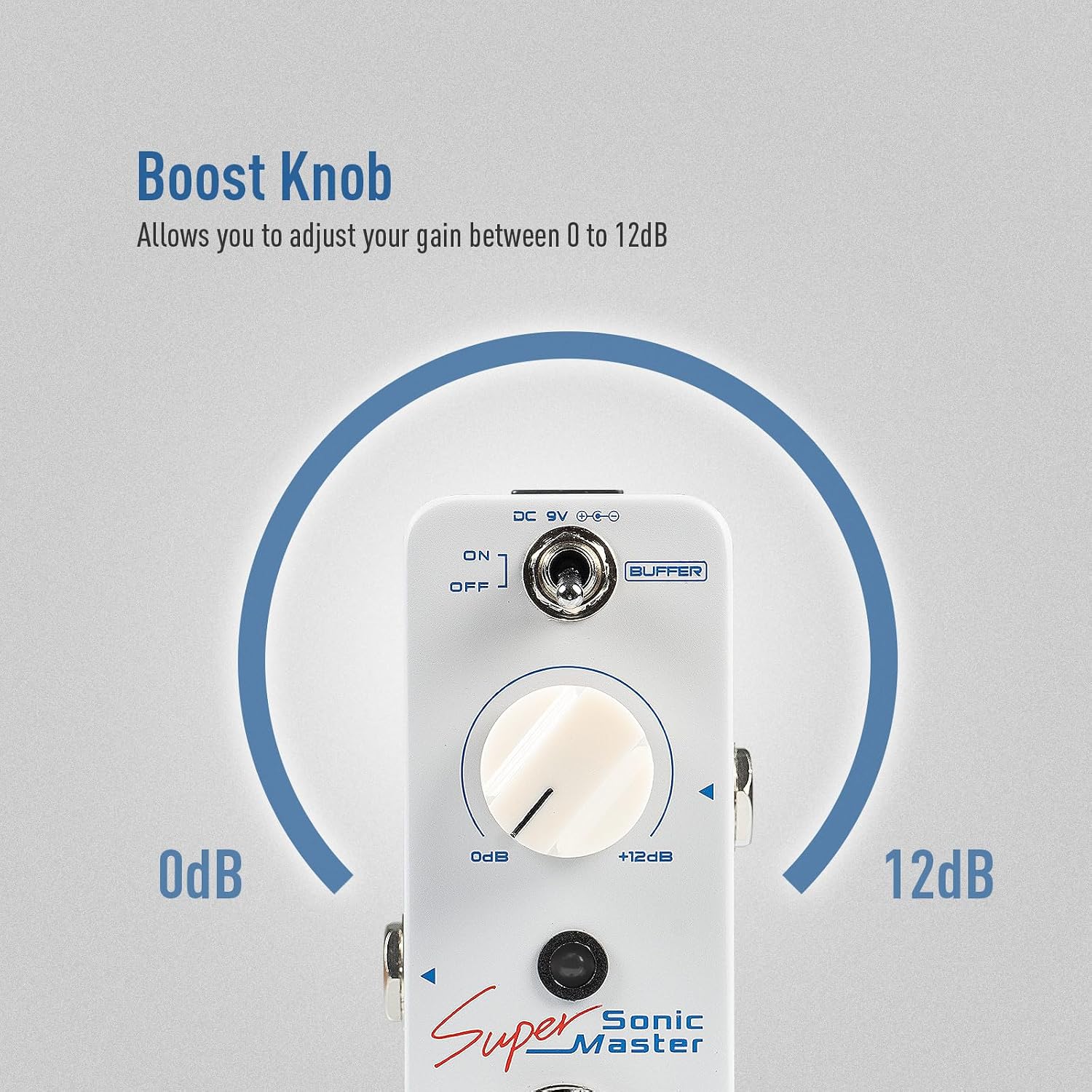
Image: A close-up of the Boost Knob, illustrating its adjustable range from 0dB to +12dB.
Footswitch (7):
Press the footswitch to toggle the boost effect on or off. When the effect is engaged, the Status LED (6) will illuminate red. When the effect is disengaged, the LED will turn off.

Image: The footswitch on the pedal, indicating its role in switching the effect on or off.
Status LED (6):
The red LED indicates the operational status of the pedal. It lights up when the Clean Boost effect is active and turns off when the pedal is in bypass mode.
Image: The red Status LED on the pedal, showing its position relative to the other controls.
Buffer Switch (2):
This toggle switch allows you to activate the built-in buffer function even when the pedal's effect is turned off (bypass status). A buffer helps to maintain your signal's strength and clarity, especially when using long cables or a large number of true bypass pedals, preventing tone loss due to capacitance. Set it to 'ON' to engage the buffer in bypass, or 'OFF' for true bypass.

Image: The Buffer Shift Switch, indicating its 'ON' and 'OFF' positions and its function to activate the buffer when the pedal is in bypass.
Itoju
Proper maintenance ensures the longevity and optimal performance of your SONICAKE Clean Boost Pedal:
- Ninu: Lo aṣọ rírọrùn tí ó gbẹ láti nu ìta pedal náà. Yẹra fún lílo àwọn ohun ìfọṣọ, àwọn ohun olómi, tàbí epo, nítorí pé wọ́n lè ba ìparí tàbí àwọn ohun èlò inú jẹ́.
- Ibi ipamọ: Store the pedal in a cool, dry place away from direct sunlight, extreme temperatures, and high humidity. If storing for an extended period, disconnect the power supply.
- Ibi ti ina elekitiriki ti nwa: Always use a regulated 9V DC center-negative power supply. Using an incorrect power supply can damage the pedal and void the warranty. Disconnect the power supply when the pedal is not in use to prevent unnecessary wear.
- Awọn isopọ: Máa ṣàyẹ̀wò gbogbo ìsopọ̀ okùn náà lẹ́ẹ̀kọ̀ọ̀kan bóyá ó ti bàjẹ́ tàbí ó ti bàjẹ́. Rí i dájú pé àwọn jacks kò ní eruku àti ìdọ̀tí.
Laasigbotitusita
If you encounter issues with your SONICAKE Clean Boost Pedal, try the following troubleshooting steps:
- Ko si Ohun:
- Rí i dájú pé agbára ìpèsè náà so pọ̀ dáadáa tí ó sì ń ṣiṣẹ́ dáadáa.
- Check all instrument cables for proper connection and integrity. Try swapping cables.
- Verify that your instrument and amplifier n ṣiṣẹ ni deede.
- Ensure the footswitch is engaged (Status LED should be red).
- Ariwo/Hum ti aifẹ:
- Ensure you are using a regulated power supply. Unregulated power supplies can introduce noise.
- Check for ground loop issues in your setup. Try isolating the pedal's power or using a different outlet.
- Rí i dájú pé gbogbo àwọn okùn wa ni ààbò àti pé wọ́n wà ní ipò tó dára.
- If the buffer is on, try turning it off to see if the noise persists (if using true bypass pedals before/after).
- Àbájáde Tí Kò Ní Ìfàmọ́ra:
- Confirm the power supply is connected and providing power.
- Press the footswitch firmly.
- Gain Not Changing:
- Ensure the Boost Knob is being rotated through its full range.
- Verify the pedal is engaged.
If these steps do not resolve the issue, please contact SONICAKE customer support for further assistance.
Awọn pato
| Ẹya ara ẹrọ | Sipesifikesonu |
|---|---|
| Nọmba awoṣe | QSS-22 |
| Ọja Mefa | 2.44 x 4.13 x 2.44 inches (62 x 105 x 62 mm) |
| Iwọn Nkan | 8.1 iwon (230 Giramu) |
| Ohun elo ara | Ṣiṣu |
| Orisun agbara | DC power supply (9V Center Negative, not included) |
| Voltage | 9 Volts |
| Asopọmọra Iru | 1/4 inch (6.35mm) gbohungbohun |
| Ni wiwo Hardware | 1/4-inch Audio |
| Ilana ifihan agbara | Analog |
Atilẹyin ọja & Atilẹyin
SONICAKE products are designed for reliability and performance. This product comes with a limited warranty against defects in materials and workmanship under normal use. For specific warranty terms and conditions, please refer to the warranty card included with your product or visit the official SONICAKE webojula.
Atilẹyin Onibara:
For technical assistance, troubleshooting, or warranty claims, please contact SONICAKE customer support through their official website or the retailer where you purchased the product. You can also visit the SONICAKE Store on Amazon fun alaye siwaju sii ati ọja oro.


