Ọrọ Iṣaaju
This manual provides detailed instructions for the setup, operation, and maintenance of your TONOR TW361 4-Channel UHF Wireless Microphone System. Please read this manual thoroughly before use to ensure optimal performance and longevity of your device.
Ohun ti o wa ninu Apoti

Image shows the complete TONOR TW361 system, including four grey handheld microphones and one compact black receiver with a 6.35mm jack and antenna.
- 4 x Handheld Microphones
- 1 x Rechargeable Receiver
- 4 x Anti-slip Rings (various colors)
- 4 x Mic Covers
- 1 x USB si Iru-C okun Ngba agbara
- 1 x Itọsọna olumulo

This image displays all the accessories: two microphones, the receiver, four anti-slip rings, four mic covers, a charging cable, and the user manual. The microphone dimensions are also indicated as 10.7 inches (27.2 cm).
Ọja Pariview
Gbohungbo amusowo

The image highlights key features of the handheld microphone: a metal shockproof mic head, a real-time battery indicator on the display, and a mute/power button. Each microphone requires 2 AA batteries (not included).
- Metal Shockproof Mic Head: Designed for durability and sound protection.
- Àmì Bátìrì Àkókò Gíga: Ṣe afihan ipele batiri lọwọlọwọ.
- Mute/Power Button: Ó ń darí agbára ó sì ń pa gbohùngbohùn náà lẹ́nu.
- Iboju ifihan: Shows frequency, battery status, and mute status.
- Orisun Agbara: Each microphone requires 2 AA batteries (not included).
Yiyi gbohungbohun Kapusulu
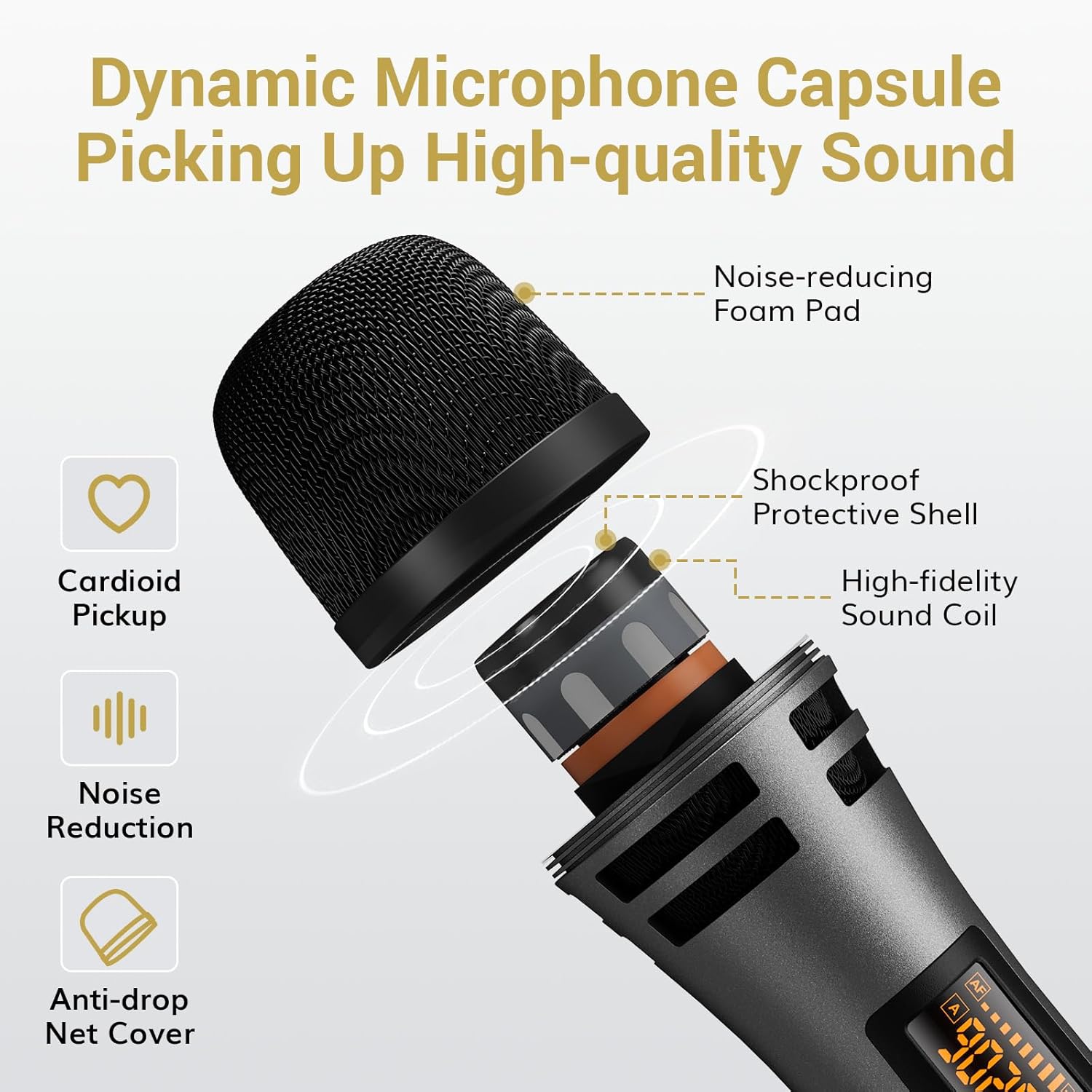
Aworan yi pese ohun exploded view of the microphone head, showing its internal components: a noise-reducing foam pad, a shockproof protective shell, a high-fidelity sound coil, and an anti-drop net cover. It also indicates cardioid pickup and noise reduction features.
- Àpẹẹrẹ Gbigba Cardioid: Minimizes background noise, focusing on the sound source.
- Idinku Ariwo: Integrated features for clear audio.
- Awọn eroja: Includes noise-reducing foam pad, shockproof protective shell, high-fidelity sound coil, and anti-drop net cover.
Olugba gbigba agbara

The image details the receiver's features: current frequency display, battery indicator, connection indicator, disconnection indicator, USB-C charging port, antenna, power switch, charging indicator, and a 6.35mm jack. The antenna can be adjusted to 0°, 45°, or 90°.
- Iboju ifihan: Shows current frequency, battery indicator, connection, and disconnection status.
- Ibudo Ngba agbara USB-C: For recharging the internal 1500mAh battery.
- Jack 6.35mm: For connecting to audio devices.
- Antenna ti a le ṣatunṣe: Can be set to 0°, 45°, or 90° for optimal signal reception.
- Igbesi aye batiri: 7-9 hours of usage time on a full charge.
- Akoko gbigba agbara: Ni isunmọ awọn wakati 4-5 fun idiyele ni kikun.
- Akiyesi pataki: Use a 5V charging head. Avoid fast charging heads (e.g., 9V, 12V) to prevent damage.
Awọn ilana iṣeto
1. Install Batteries in Microphones
Unscrew the bottom part of each microphone and insert 2 AA batteries, ensuring correct polarity. Batteries are not included.
Video demonstrating how to insert 2 AA batteries into the handheld microphone. This is the first step in preparing the microphone for use.
2. Pairing the Microphones and Receiver (Plug & Play)
- Tan gbohungbohun.
- Tan olugba.
- The microphone and receiver will automatically synchronize.

This image illustrates the three simple steps for pairing: 1. Turn on the microphone. 2. Turn on the receiver. 3. Plug the receiver into the speaker. A checkmark indicates successful pairing.
3. Connecting to Audio Devices
Plug the receiver's 6.35mm jack directly into the MIC IN port of your compatible audio device (e.g., karaoke machine, powered speaker, amplifier, mixer). If your device has a 3.5mm input, use the included 6.35mm to 3.5mm converter.
Video demonstrating the connection of the receiver to an audio device (speaker) and the successful pairing with a microphone. It also briefly shows the wireless range and adjustable features.

This image illustrates the wide compatibility of the system with devices featuring a 1/4" (6.35mm) Mic Input, including outdoor speakers, power amplifiers, sound mixer boards, DJ controllers, karaoke machines, and portable speakers. It also explicitly states that the system is not compatible with mobile phones, computers, or tablets without an additional 3.5mm interface.
Awọn ilana Iṣiṣẹ
Adjusting Channels and Volume
The system offers 10 adjustable channels to minimize interference. Each microphone has a unique channel and frequency number. You can adjust the volume directly on the microphone.

This image shows how to adjust the microphone's channel and volume. It displays the microphone's screen changing from one frequency to another (e.g., 902.8 MHz to 903.4 MHz) and indicates the volume up (VOL+) and volume down (VOL-) buttons.
- Atunse ikanni: If interference occurs, you can change the microphone's channel. Refer to the troubleshooting section for detailed steps on switching channels.
- Iṣakoso iwọn didun: Use the VOL+ and VOL- buttons on the microphone to adjust the output volume.
- Pa Iṣẹ́ Dakẹ́ The power button also functions as a one-touch mute button.
Gbigba agbara si olugba
The receiver has a built-in 1500mAh rechargeable battery. Use the provided USB to Type-C charging cable to charge it. A full charge takes approximately 4-5 hours and provides 7-9 hours of usage.

This image shows the receiver being charged via a USB-C cable connected to a wall adapter, indicating 7-9 hours of usage time and 4-5 hours of charging time. It also reminds that each microphone is powered by 2 AA batteries (not included).
Ibamu
The TONOR TW361 system is designed for wide compatibility with various audio equipment. However, certain devices require specific connections or are not supported.
Compatible Devices (with 6.35mm MIC IN port):
- Awọn ẹrọ Karaoke
- Agbara Agbọrọsọ
- Ampalifiers
- Awọn alapọpo
- Awọn ọna ṣiṣe PA
- Ita Agbọrọsọ
- DJ Awọn oludari
- Awọn Agbọrọsọ to ṣee gbe
Incompatible Devices / Special Considerations:
- Mobile Phones, Computers, Tablets: Not directly compatible. An additional 3.5mm interface converter is needed (not included).
- Bluetooth: The system does not support Bluetooth connectivity.
- TV/Soundbar: Requires an intermediary audio device for connection.

This image provides important tips for better usage and connectivity, visually indicating that output devices require XLR and 6.35mm inputs, an adapter is needed for mobile/laptop connections, Bluetooth is not supported, and a TV/Soundbar requires an intermediary audio device.
Itoju
- Store the microphones and receiver in a dry, cool place when not in use.
- Clean the microphone body and receiver with a soft, dry cloth. Avoid using harsh chemicals or abrasive materials.
- Ensure the receiver is fully charged before each use for optimal performance.
- Replace AA batteries in the microphones when the battery indicator shows low power.
Laasigbotitusita
Microphone Not Working / Signal Issues
If you encounter a microphone that is not working or experiencing signal issues, follow these steps:
- Check Microphone Channels: Ensure that the microphone channels are not duplicated. If two microphones are on the same channel, they cannot be used normally. You will need to switch channels for one of them.
- Re-pair the Microphone and Receiver: If the signal light on the receiver does not turn steady after turning on the microphone, re-pairing is necessary.
Video illustrating how to connect the receiver and audio devices, showing the pairing process and the wireless range of the system.
Video explaining troubleshooting steps when a microphone is not working, specifically addressing duplicated channels and the need to switch channels or re-pair the microphone and receiver.
How to Switch Microphone Channels (A/B Mic)
- Turn off the microphone with the problem.
- Long press the power button for 10 seconds, waiting for the screen to display from "A" to "B" and then release it. This switches the channel group.
- Each microphone has a unique channel and frequency number that can be used simultaneously.
Video demonstrating the re-pairing process for the microphone and receiver. It shows how to activate pairing mode on the microphone and then confirm successful pairing on the receiver.
How to Re-pair the Microphone and Receiver
- Turn on the mic, and long press the "SET" button until the screen flashes quickly.
- Tan olugba.
- Then click the "SET" button on the microphone once.
- When the RF light on the receiver turns steady, the pairing is successful.
Video demonstrating the re-pairing process for the microphone and receiver. It shows how to activate pairing mode on the microphone and then confirm successful pairing on the receiver.
Awọn pato
| Orukọ awoṣe | TW361 |
| Gbohungbo Fọọmù ifosiwewe | Amusowo |
| Asopọmọra Technology | UHF |
| Nọmba ti awọn ikanni | 10 |
| Alailowaya Ibiti | Títí dé 200 ft (60 m) ìlà ojú |
| Idahun Igbohunsafẹfẹ | 40Hz-18kHz |
| Ifamọ | 52dB± 3dB |
| Idarudapọ | <0.03% |
| Lairi | <3ms |
| Batiri olugba | 1500mAh Litiumu Ion (gbigba agbara) |
| Receiver Usage Time | 7-9 wakati |
| Akoko Gbigba agbara olugba | 4-5 wakati |
| Orísun Agbára Mákróónù | Awọn batiri 2 x AA (kii ṣe pẹlu) |
| Asopọmọra Iru | 6.35 mm Jack |
| Ọja Mefa | 15.16 x 12.2 x 2.36 inches |
| Iwọn Nkan | 2.91 iwon |
| Ohun elo | Ṣiṣu |
| Àwọ̀ | Grẹy |
Atilẹyin ọja ati Support
TONOR products are designed for reliability and performance. For warranty information, technical support, or any inquiries regarding your product, please refer to the official TONOR website or contact customer service directly. Keep your purchase receipt for warranty claims.
Fun iranlọwọ siwaju sii, ṣabẹwo si TONOR Store on Amazon.


